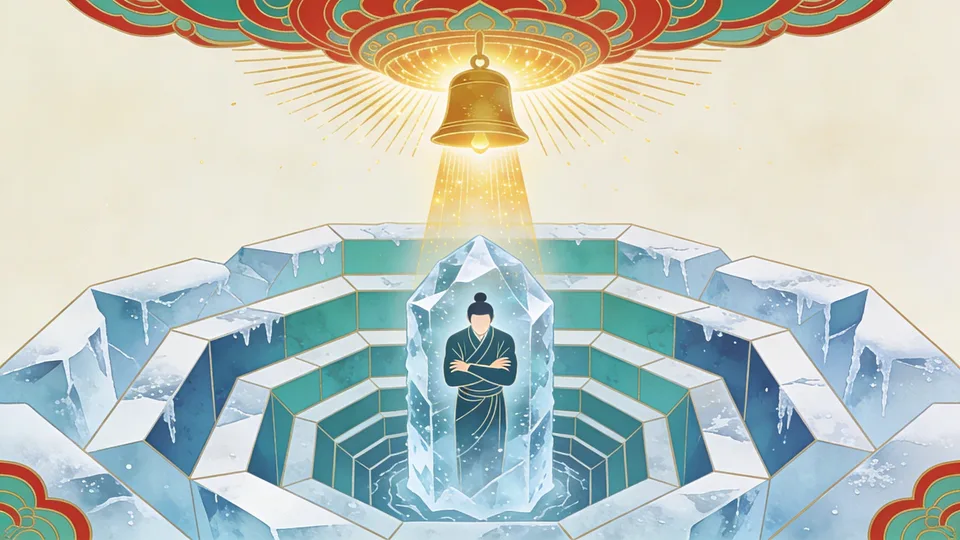
The farthest place from the sun isn’t on fire.
Most people picture Hell as a lake of fire. But fire is an odd choice for the place farthest from God. Fire is energy: friction, heat, nearness to a source. If damnation means being cut off from what gives life, why would it burn?
Dante noticed the problem. There is fire in his Inferno, but the lowest circle is a frozen lake, and Satan is locked in its ice. He beats his enormous wings to escape, and the wind from those wings is what keeps the lake frozen. That image gets the physics right. The structural reality of Hell is absolute zero: the frozen, solipsistic vacuum created when the ego secedes from reality, kept cold by its own efforts to get free.
Where the heat comes from
Laozi asked: 天地之间,其犹橐龠乎 — “Between heaven and earth, is it not like a bellows?” A bellows is empty, yet endlessly productive. It has no preferences and no agenda. It just pumps.
The Sun works the same way: it shines on the murderer and the saint, the predator and the prey, and in that sense it is unconditional love: indifferent to your behaviour, and entirely bound by physical law. Plant a seed in soil and the Sun grows it. Stand in the desert without water and the Sun kills you. Heaven and earth are not kind; they treat all things as straw dogs. This is love as prime mover stripped to its thermodynamics: a field that radiates whether or not you stand in it.
The bellows keeps no list of who deserves Hell. If someone ends up frozen, they walked away from the warmth themselves.
How someone freezes
The walking away starts with one error: the tyranny of “it should be.” Reality hands you something that doesn’t match your preferences. A sibling gets the inheritance, a career stalls, a body fails. The ego answers with resentment, and instead of updating its model to fit what happened, it builds a small sealed universe where its own rules apply. It steps out of the airflow and into the vault.
Every resentment is another brick in the vault’s wall, and every refusal to accept what is adds another layer of insulation between you and the source of warmth. The punishment therefore needs no warden. Proximity to God, or reality, is oxygen, warmth and life; distance from it is suffocation and cold. In this vacuum, Lucifer is not a warden wielding a pitchfork. Lucifer is simply the entity trapped in the deepest, oldest block of ice.
What keeps the vault sealed is one of the most common strategies people use: “I will be unhappy until things change.” It feels like leverage. The ego believes that by generating enough suffering it can exert force on the universe, the way a hunger strike pressures a government. But a hunger strike works only when someone on the other side is watching, and the bellows isn’t. The strategy amounts to holding your breath to punish the atmosphere. It is also Dante’s Satan beating his wings: the effort to force a way out is exactly what keeps the ice solid. The resentments you guard so fiercely are not protecting you from the cold. They are the cold.
Pain is not the cold
The obvious objection is that this blames people for their pain. Some things really should be different, and wrongs are real.
The answer lies in the difference between pain and suffering. Standing in the Sun has a price: grief, loss, failure, the heat of things you didn’t choose. That pain is what proximity to reality costs, and it is not Hell. Hell is the further move of walking into the vault to protest the Sun’s terms. You can still fight a wrong from the warm side. What you can’t do is make your own warmth the hostage.
So Hell is neither a torture chamber underground nor a myth to be outgrown. The better take is that Hell is the thermodynamic endpoint of ontological isolation. You are not punished for your resentment. You are punished by it.
Which leaves the uncomfortable part of Dante’s image. If the wings are what keep the lake frozen, the way out cannot be a stronger escape attempt. It can only be stopping, and to the one flapping, stopping feels exactly like giving up.