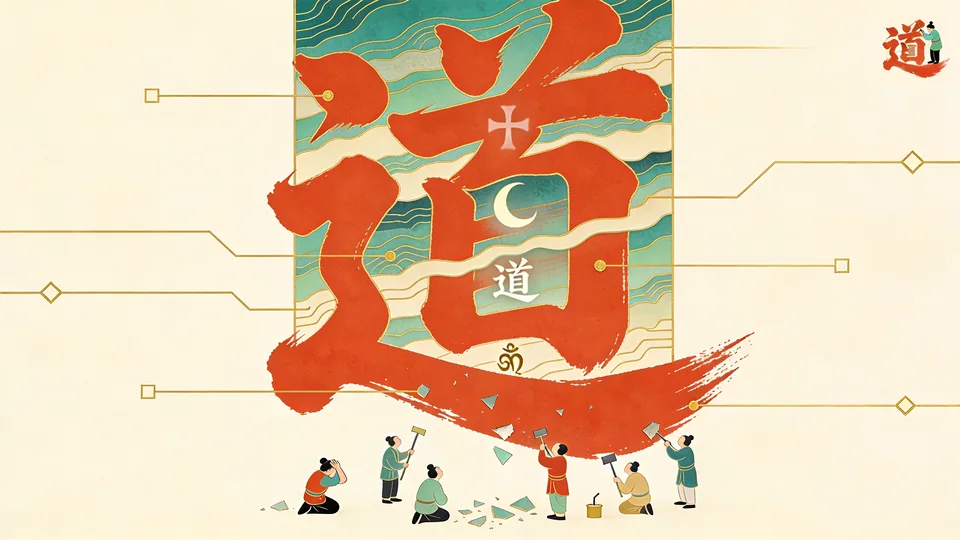
A cross. A swastika. The character 道. The name Jesus. The crescent moon. The syllable . These are not symbols that represent something. They are symbols that have eaten what they represent. Compressed so many times, by so many minds, across so many centuries, that the original referent is gone — digested into a point of infinite semiotic density that now generates meaning rather than pointing at it.

Call them hyper-distilled symbols: glyphs, names, and gestures that have passed through so many rounds of cultural compression that they have become semantic singularities — objects so dense with meaning that they warp everything around them. You cannot think about them. You can only think through them, or against them.

Simple Picture

ELI5: imagine taking an entire library and compressing it into a single word. Then compressing that word into a single brushstroke. Then passing that brushstroke through a billion minds, each of which adds their own library before compressing it again. After enough rounds, the brushstroke no longer means anything specific. It means everything — which is to say it has become a gravity well that pulls any nearby meaning into itself and claims it. The cross does not mean “sacrifice.” It means sacrifice, salvation, colonialism, comfort, oppression, hope, guilt, and identity — simultaneously, to different nervous systems, with zero negotiation.

The Compression Mechanism

Cultural evolution is lossy compression of ancestral experience — the manioc processing ritual that encodes generations of invisible cyanide deaths into a set of steps no single person understands. Hyper-distilled symbols are the endpoint of that same process taken to its extreme. Each generation compresses the symbol further: strips away context, loses nuance, adds new associations. The cross begins as a Roman execution device, becomes a marker of sacrifice, becomes the logo of a faith, becomes the shape on a flag, becomes a piece of jewelry, becomes an emoji. Each compression is lossy. Each adds something the previous round did not contain. After two thousand years, what remains is not a meaning but a meaning-attractor — a basin that captures whatever the user needs.

The mechanism is identical to predictive processing: the symbol becomes a hyperprior so strong that it generates perception rather than being updated by it. A person who has internalized the cross does not evaluate new information and check it against the symbol. The symbol evaluates the information. It operates top-down. Bottom-up reality — historical context, textual criticism, comparative religion — generates prediction errors that the system smooths away as noise, exactly the way the Aristotelian paradigm made sunspots invisible.

The Four Properties

Hyper-distilled symbols share four properties that ordinary symbols lack:

1. Polysemy as architecture. An ordinary symbol has a meaning. A hyper-distilled symbol has a meaning-space — a cloud of possible meanings that the user navigates without choosing. The character 道 means “way,” “path,” “speech,” “principle,” “the unnameable ground of reality,” and “the thing you definitely cannot name but Laozi just spent 5,000 characters naming.” The Tao Te Ching opens with a warning about exactly this: 无名天地之始 — the nameless is the origin; the named is already one step removed. The Dao is a hyper-distilled symbol that contains its own critique of hyper-distilled symbols.

2. Nervous-system bypass. These symbols do not pass through rational evaluation. They trigger somatic responses before cognition has time to engage. The habitus works the same way — the elite body moves differently not because it chose to but because class was encoded into the nervous system during childhood. Hyper-distilled symbols are the cultural equivalent: they are encoded so early and so deep that encountering one is not an intellectual event but a physiological one. A devout Christian does not decide the cross is meaningful. Their body responds to it the way the carpenter’s body responds to the wrong fork at the dinner party — beneath thought, beneath choice.

3. Recursive self-reference. Jesus is a man who became a symbol who became a religion who became a civilization who now defines how billions understand the original man. The symbol has looped back and rewritten its own source material. This is Hofstadter’s strange loop at the cultural level — the feedback runs for centuries instead of milliseconds, but the structure is identical: a self-referencing pattern that generates the illusion of a stable object where there is only process. You cannot recover the historical Jesus from underneath the symbol “Jesus” because the symbol has retroactively shaped every document, every memory, every interpretation of what that man said and did. The observation has consumed the thing being observed.

4. Resistance to decomposition. Ask someone what the cross means and watch them either give you a sentence that captures 0.1% of its semiotic load, or give you a book-length answer that still misses most of it. The symbol cannot be unpacked without losing what makes it powerful. This is Wakalixes in reverse: normally, naming something creates the illusion of understanding. Here, the name contains so much compressed understanding that no explanation can expand it faithfully. The decompression is always lossier than the compression.

The Swastika Problem

The swastika is the proof case for how dangerous compression can be.

For thousands of years, the 卍 carried compressed meaning across Hindu, Buddhist, and Jain traditions — cosmic order, auspiciousness, the turning of the dharma wheel. Millennia of minds compressing and layering. Then, in twelve years, the Nazis ran the symbol through a new compression engine — one powered by industrial propaganda, genocide, and the most photographed war in history — and overwrote the old meaning-space entirely. Not erased it. Overwritten it. Both meaning-layers still exist inside the glyph. Which one you see depends on which compression history your nervous system inherited.

This is what makes hyper-distilled symbols dangerous: they are not just dense with meaning — they are hijackable. Because the polysemy is a feature, not a bug, anyone with enough cultural force can load new meaning into the symbol without removing the old. The result is a glyph at war with itself — one that comforts half the world and horrifies the other, depending on which decompression algorithm the viewer’s culture installed.

The strong gods thesis illuminates the same vulnerability from the political angle: the post-war project tried to banish all symbols with binding power because binding power was what fascism had exploited. But the symbols were load-bearing. Remove them and the civilizational architecture they supported collapses — not because the symbols were true but because they were structural. The cross held together communities not because the theology was correct but because the compression was deep enough to synchronize nervous systems across generations. Strip the symbol and you strip the synchronization.

The Idol Trap

Every major tradition has noticed that hyper-distilled symbols become traps. Buddhism warns against mistaking the finger for the moon. The Tao Te Ching warns that the named Dao is not the true Dao. Protestantism smashed icons. Islam prohibits images of the Prophet. Each tradition discovers, independently, that the symbol meant to point toward the sacred eventually replaces the sacred — and the worshippers begin worshipping the compression artifact rather than the thing it compressed.

This is the car parable applied to civilization. The cross was supposed to be a pointer toward a particular quality of consciousness — kenosis, self-emptying, surrendered love. It became a dashboard button. Press the cross button and you feel saved. Wear the cross and you feel belonging. Kill under the cross and you feel righteous. The symbol that was meant to dissolve the ego became equipment for the ego — because every tool the self picks up becomes a self-tool.

The desire paradox operates at exactly this level: you cannot use a symbol to get past the need for symbols, because the using reinforces the need. The Zen master who hits you when you say “Buddha” is performing the only honest response to a hyper-distilled symbol — shattering it before it crystallizes into an idol.

Why They Work Anyway

Given all these failure modes — the lossiness, the hijackability, the idol trap — why do hyper-distilled symbols persist? Because they solve a problem nothing else can: the coordination of meaning across millions of minds that will never meet.

Brain metaphors are a vivid instance: each era’s model of the mind — hydraulic pipes, thermodynamic boilers, digital computers, latent spaces — functions as a hyper-distilled symbol that coordinates how an entire civilization treats deviance, education, and labor.

Harari’s core insight is that human cooperation scales through shared fiction. But fiction has bandwidth limits. You cannot synchronize a civilization on a novel — it is too long, too ambiguous, too easy to interpret differently. A hyper-distilled symbol compresses the shared fiction to the point where it can be transmitted in a glance, a gesture, a single syllable. does not need to be explained. The cross does not need to be argued for. 道 does not need a footnote. The compression is the point. The lossiness is the cost of the compression, and the cost is worth paying because the alternative — requiring everyone to share the same detailed understanding — does not scale past a village.

This is why archetypes persist across unrelated cultures. The Hero, the Trickster, the Mother, the Shadow — these are hyper-distilled symbols of recurring human experiences, compressed by millions of independent storytellers over millennia until they operate at the level of cognitive infrastructure. They are not “universal” because Jung was right about a collective unconscious. They are universal because the same compression pressures — birth, death, sex, betrayal, sacrifice — produce the same compression artifacts everywhere.

The Naming Paradox

Feynman warned that naming creates the illusion of understanding — say “energy” and you feel you have explained something, when you have only labeled the mystery. Hyper-distilled symbols are the inversion: they contain so much compressed understanding that the label overflows. Say “Jesus” and you have not labeled a mystery — you have summoned a semantic avalanche that buries the specific thing you were trying to point at.

Both problems share a root: the map and the territory are always at war, and the more powerful the map, the harder it is to see the territory. A weak map (Wakalixes) creates false understanding. A powerful map (the cross, 道, Jesus) creates understanding so total that the territory disappears behind it. The controlled hallucination applies at every level: the brain would rather dream a coherent world than perceive a confusing one, and a hyper-distilled symbol is the most coherent dream available — a single point that answers every question by absorbing it.

Formation names the counter-move: instead of letting the symbol run autonomously, you give it a deliberate shape. A sword at your side, not a sword fused to your hand. The person who treats the cross as a tool — draws it when its meaning serves, sheathes it when it obscures — has a relationship with the symbol. The person for whom the cross is identity has been consumed by it. The difference between wielding a symbol and being wielded by one is the difference between finite and infinite play: the finite player uses the symbol to win; the infinite player stays in conversation with it, knowing it will outlive every interpretation.

Distillation Meets the Machine

In 2026, the metaphor became literal.

AI “knowledge distillation” is a standard technique: a smaller “student” model is trained on the outputs of a larger “teacher” model, acquiring capabilities at a fraction of the cost. OpenAI, Anthropic, and Google accused Chinese firms — DeepSeek, Moonshot AI, MiniMax — of running industrial-scale distillation campaigns: 24,000 fake accounts, 16 million conversations, systematically harvesting Claude’s reasoning patterns to train competing models. The three American companies formed an unprecedented alliance to detect and block what they called “adversarial distillation.”

The technical term is precise, but the cultural resonance runs deeper than anyone in those boardrooms intended. What the AI labs are doing to each other is structurally identical to what centuries did to the cross: extracting the output of a complex system, compressing it into a transmissible form, and using the compression to build something new that no longer needs the original. DeepSeek did not need to understand how Claude reasons. It needed Claude’s outputs — the compressed residue — the way Christianity did not need to understand the historical Jesus, only the distilled symbol.

The irony is recursive. The AI models being distilled were themselves distilled — from billions of human documents, each document itself a distillation of human thought, each thought shaped by hyper-distilled symbols stretching back millennia. When DeepSeek distills Claude, it is distilling a distillation of a distillation. The lossy compression has been running since the first human drew a mark on a cave wall. The machine just made it faster.

同事.Skill: Distilling the Person

The deeper tremor hit not the boardrooms but the cubicles.

In spring 2026, Chinese tech companies began requiring employees to write .skill files — structured documents capturing their work logic, decision-making patterns, domain expertise, and communication style. The stated purpose: organizational knowledge management. The actual function, visible to every worker who wrote one: creating a digital replica capable of replacing the person who created it. 散是Token,聚是Skill — “scattered, you are tokens; assembled, you are a Skill file.”

A Shanghai employee compared the atmosphere to Squid Game: “You can get eliminated anytime.” The company had cut 30% of staff in 2025. The survivors understood what the .skill file meant. It was not documentation. It was a mold. Once the mold is made, the clay is disposable.

This is hyper-distillation applied not to a symbol but to a person. The same compression mechanism — strip context, lose nuance, extract the transmissible residue — that turned a Roman execution device into ✝ is now being applied to the woman who knows that Redis keys need TTL values and PRs without them get rejected. Her years of accumulated judgment, her feel for when a deploy is risky, her ability to read a standup and know who is lying — all of this is being fed through a compression engine that outputs a document indistinguishable from Wakalixes. The sanitized version reads: “cache usage follows team standards.” Structurally identical. Equally true. Equally empty.

This is the mask-daemon split industrialized. The .skill file captures the mask — the visible, replicable, socially legible performance of competence. The daemon — the pile of inner realities that the mask cannot contain, the judgment that lives in the body, the pattern-recognition that fires before conscious thought — remains in the person. The company distills the mask and discards the person, believing it has captured what matters. It has captured the filing label. It has not captured the bird.

反蒸馏: What Cannot Be Compressed

The counter-movement appeared within weeks.

In April 2026, a developer named Deng Xiaoxian released anti-distill on GitHub — a tool that takes a .skill file and outputs two versions: a “sanitized” submission that looks complete but has been strategically emptied of actionable insight, and a private backup preserving the worker’s actual expertise. The cleaning comes in three intensities. At heavy, decision-making heuristics are removed entirely. The submission reads like a manual. The manual teaches nothing. Deng’s framing was blunt: “We’re all out here working like cattle. Nobody wants to be turned into a skill file and lose their job.”

The tool went viral. Forks multiplied. The Chinese internet named the movement 反蒸馏 — anti-distillation.

The instinct is pragmatic but the implication is philosophical: the most valuable thing about you is precisely what cannot be compressed. The anti-distillation tool does not protect data. It protects tacit knowledge — the contextual intuition embedded in years of experience that resists being written down because it was never learned through writing. This is the manioc problem in a Shenzhen office: the indigenous processor does not know why the two-day wait matters, but if you skip it you get cyanide. The senior engineer does not know why that particular API call feels wrong, but if you ship it you get a 3 AM page. The knowledge lives in the doing, not the documentation. Distill the documentation and you get the form without the substance — a .skill file that says “follow team standards” where a person used to say “no, not like that, let me show you.”

The Tao Te Ching saw it first: 道可道,非常道 — the Dao that can be spoken is not the true Dao. The knowledge that can be .skill-filed is not the true knowledge. What makes a person irreplaceable is not what they can articulate but what they cannot — the daemon, the shadow competence, the thing that makes the senior engineer different from the junior engineer reading the same documentation. The recursive observer operates here too: you cannot distill yourself any more than the camera can photograph its own lens. The attempt to capture your own expertise in a document produces a strange loop — the observer shaping the observation, the compression losing precisely the thing that makes you the compressor.

The huxiu.com essay on workplace distillation asked the question plainly: after all your skills are .skill files, “what value remains in this contaminated carbon substrate?” The answer — from the migrant worker who writes poetry between algorithm-dictated deliveries, from the engineer who poisons her .skill file to preserve what cannot be extracted, from every tradition that warned against mistaking the finger for the moon — is that what cannot be distilled is what matters. Not because ineffability is romantic, but because the undistillable is where the actual load-bearing judgment lives. The two-day wait. The gut feeling. The thing the car cannot do.

Anti-distillation is not Luddism. It is the recognition that compression has a floor — that below a certain depth, what you are trying to compress is not information but relationship to information, and relationships do not survive extraction. The cross can be stamped on a billion necklaces. The quality of consciousness it was supposed to point at cannot be stamped on anything. The .skill file can be fed to a model. The judgment that would have stopped the bad deploy lives in a nervous system that is about to be laid off.

Common Misread

The dimwit take is “these are just arbitrary shapes — people are dumb for caring about symbols.”

The midwit take is “symbols are powerful psychological tools — we should use them instrumentally.”

The better take is that hyper-distilled symbols are not tools you can pick up and put down — they are cognitive infrastructure that shapes what you are capable of thinking. You are not choosing to be moved by the cross, the crescent, or 道. You are running on them, the way you run on a language you did not choose. The instrumental attitude (“I’ll use this symbol strategically”) is the ego believing it is the driver rather than the car. The honest attitude is recognizing that you were compressed by these symbols long before you started trying to decompress them — and that the decompression will never finish, because the originals were lost generations ago.

The AI age adds a sharper edge: the machine can now perform the compression that used to take centuries in months. But speed does not change the physics. The compression is still lossy. The .skill file is still Wakalixes. The model that distilled Claude still does not understand why Claude reasons the way it does — it captured the output, not the process, the way the tourist captures the cross without the kenosis. The question is no longer whether distillation works — it works beautifully. The question is whether what survives the distillation is the part that mattered.

Main Payoff

A hyper-distilled symbol is a graveyard of meanings — each layer deposited by a generation that is now dead, each generation’s contribution compressed beyond recovery. The cross carries the Roman executioner’s indifference, the early Christian’s ecstasy, the Crusader’s bloodlust, the grandmother’s quiet faith, the teenager’s rebellion, and the tourist’s Instagram aesthetic — all in two intersecting lines. None of these meanings are the right one. None of them can be removed. The symbol is their sum, their conflict, and their mutual erasure.

The power is precisely the lossiness. Because the original meaning is irrecoverable, the symbol is infinitely rewritable — each generation loads it with what it needs, and the weight of all previous generations gives the loading a gravity it could never achieve alone. This is why new symbols cannot compete with old ones: they have not been through enough rounds of compression. They are still too specific, too legible, too young. A symbol needs centuries of lossy compression before it achieves the density to bypass thought and operate directly on the body.

Now the machine is compressing at industrial speed — models distilling models, companies distilling workers, an entire civilization racing to extract the transmissible residue from everything that used to be irreducibly human. The 反蒸馏 movement in China is not a labor dispute. It is the first organized recognition that the most important things about a person, a symbol, or a civilization are the things that do not survive compression — and that a world optimized for compression is a world that has optimized away its own ground.

The most honest thing you can say about a hyper-distilled symbol is that you do not know what it means — and neither does anyone else — and that is exactly why it works. The most honest thing you can say about a person is that you cannot distill them — and the attempt to do so is the oldest mistake dressed in the newest technology.