Every time you argue with the old grudge, you feed it.
A colleague was passed over for promotion ten years ago, and every meeting still finds its way back there. A budget discussion becomes a story about how leadership plays favorites. A new hire becomes evidence that loyalty counts for nothing. You have tried the obvious moves. You argued that the decision made sense at the time. You sympathized, at length. Someone suggested he talk to a therapist, and he came back with a better vocabulary for the injury. Each attempt seemed to make the grievance sturdier. Why would help make it worse?
Because the help assumed it was dealing with a feeling. Resentment that has compounded into identity is no longer an emotion — it is a load-bearing structural adaptation that the ego will fight harder to defend than to dissolve. Bitterness describes how that feels from the inside, decades downstream, and resentment-as-treasure describes the daily transactions that compound into it. The question here is the outside one: what do you do about a structure you cannot dissolve, when you are not the one carrying it?
Heavy groups
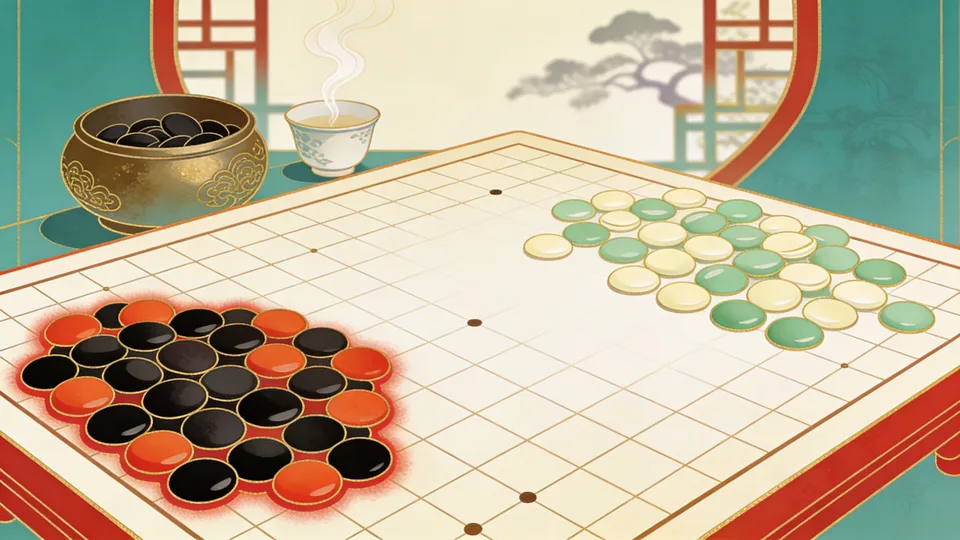
The board game Weiqi has a concept English lacks: heaviness (重い). A heavy group is one that has been over-committed to a rigid, indefensible shape: too many stones, too little potential, no room to manoeuvre. The opposite is light play (軽い), flexible and able to abandon stones without abandoning the position.
The colleague plays heavy. The grievance has committed him to a shape, I was wronged, therefore I matter, therefore the wronging must be defended at all costs, and he cannot sacrifice any stone in it without invalidating the whole structure. That is why every small concession feels existential to him. And the pressure the group meets from outside is what keeps it standing, because the friction is what proves the carrier exists. The world pushes back, so the world is there; he resists, so he is here.
That makes recognition the first move. If you cannot tell that the group is heavy, you will spend the rest of the engagement giving it exactly the friction it needs to solidify. The signal is a wound that doesn’t move. A processed wound changes shape: the feeling cools, the language softens, the lesson generalizes. A heavy group returns identical at every opportunity, with the same intensity it had ten years ago, which is exactly how the promotion story has behaved in every meeting.
Play light
Seen this way, all three of the obvious moves were pushes on the heavy group. Argument gave it intellectual friction. Sympathy gave it emotional friction. Therapy that names and validates the grievance gave it clinical friction, and as the diagnosed life warns, a label given to a heavy group doesn’t lighten it but calcifies it into immutable identity. The colleague who learned the precise vocabulary of his wound became more fluent in deploying it, not less attached to it.
The Weiqi rule transposes directly: do not attack a heavy group. Attack invites it to defend itself, and defending is the activity that keeps it alive. You play light elsewhere and let the over-committed shape carry its own weight. With the colleague, that means collapsing the interface to the work: the deliverable, the schedule, the decision, never the history or the philosophy. When the conversation swings back to the promotion, you neither argue nor agree; you return to the agenda. This is not callousness. Resentment recruits, and every retelling is an attempt to load the listener with a copy of the grievance. Declining the copy is triage.
The reason this works is a matter of fuel. The friction-starved structure cannot maintain itself indefinitely; the engaged structure can. There is even a crude natural experiment. A grievance needs a surplus to live on: a setting where it earns sympathy, status or leverage faster than it costs energy. Take the surplus away and the logic reverses. When biological survival requires immediate kinetic action, the brain ruthlessly prunes the caloric luxury of maintaining phantom psychic debts. Old grudges tend to look very different in an emergency. Nobody should want that kind of shock, but it shows that the structure is a luxury good and can starve.
When validation is right
None of this means empathy is the mistake. The point is that the validation strategy works for fresh wounds and fails for calcified structures, and the operator must learn to tell the difference. A wound that has not yet become identity dissolves under patient attention. The test is whether the grievance moves when you engage it. If it does, validate. If it doesn’t, the kind move is to quietly refuse the friction.
There is no clean exit either. A relationship with a heavy group is itself friction, so when you withdraw the fuel, the carrier may experience it as abandonment and escalate to find friction elsewhere. Playing light anyway takes a patience that can feel, from the inside, like coldness.
The Weiqi master doesn’t try to teach the heavy group to be light. One further move remains: mirroring the redirection, reflecting back, without argument or validation, that the carrier is the only one bleeding. It rarely lands. Whether you try it with the colleague depends on what you think a decade of friction has left underneath.