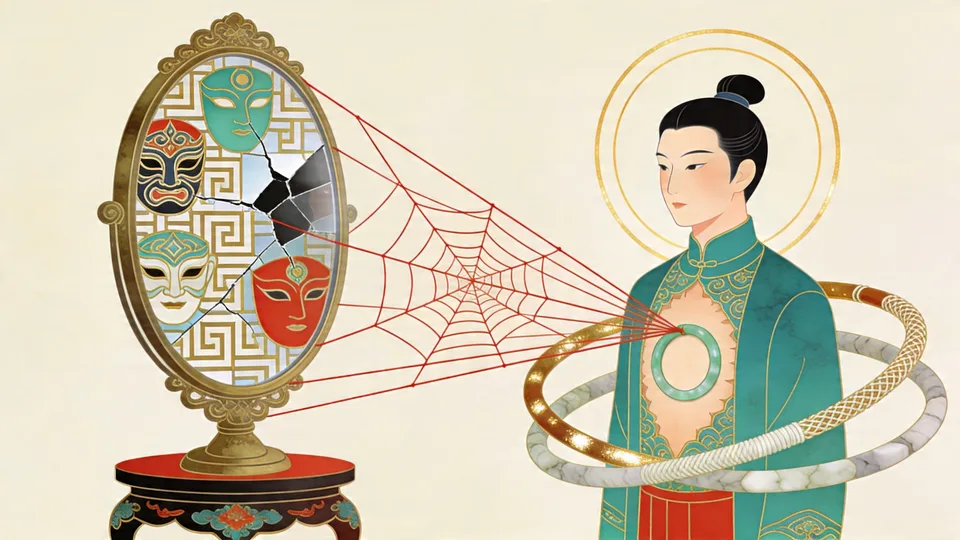
The subject is split. You are not who you see in the mirror, you do not want what you think you want, and the words you use to know yourself are the bars of the cage you cannot see.
This note grows from the intersection of Mask and Daemon, Desire vs Love, Load-Bearing Illusions, Nachträglichkeit, and Fortress Walls. The question it answers: what is the essence of Lacan? The claim it makes: the garden has been speaking Lacanian from a dozen independent angles — the mask is the Imaginary, the shared fictions are the Symbolic, and the daemon knocking at the door is the Real. Lacan is the rosetta stone that reveals these notes are all saying the same thing.
Simple Picture
ELI5: a child looks in the mirror and sees a whole, unified person for the first time. “That’s me!” But it is not. It is an image — coherent, bounded, complete — and the child is none of those things. The child is a mess of drives, sensations, and fragmented needs. From this moment on, identity is a misrecognition: you mistake the image for the thing. Everything that follows — who you think you are, what you think you want, the story you tell about your life — is built on this original error. Lacan’s entire project is a map of the consequences.
The Three Registers
Lacan’s architecture of the psyche rests on three interlocking registers — Imaginary, Symbolic, and Real — which together describe how a human being is constituted. They are not developmental stages. They are simultaneous, co-present, and knotted together like a Borromean ring: remove any one and the other two come apart.
The Imaginary: The Mask
The Imaginary is the domain of images, identification, and the ego. It begins at the mirror stage — the moment (around 6-18 months) when the infant sees its reflection and identifies with the image as a unified whole. This is exhilarating and fraudulent. The infant’s actual experience is fragmented — uncoordinated limbs, chaotic drives, total dependence — but the mirror presents a gestalt: bounded, coherent, masterful. The ego is born from this misrecognition. It is not the self but a picture of the self.
The mask is the Imaginary. The social persona — accumulated strategies, performances, adaptations — is a mirror image that others see and that the subject mistakes for its own being. The displacement experience reveals it: strip away the environment that reflected the image, and the ego collapses, because it was never yours — it was the reflection’s. “I was special” was never a fact about the self. It was a fact about the mirror.
The controlled hallucination is the Imaginary’s neural mechanism. The brain generates a top-down model and calls it perception. Most of what you “see” — including who you see when you look at yourself — is prediction, not data. The Imaginary is the register where the prediction machine operates on the self: it generates a coherent self-image and smooths away any bottom-up signal that contradicts it. The diagnostic label is the Imaginary in clinical disguise — a coherent image of dysfunction that replaces the messy, unnamed reality it claims to capture.
The Symbolic: The Language
The Symbolic is the domain of language, law, and social structure. It is the entire system of signs, rules, and differences through which meaning is produced. Crucially, you do not enter the Symbolic by choice. It enters you. You are born into a language, a family name, a kinship structure, a set of prohibitions — and these precede and constitute you. The unconscious, Lacan insists, is structured like a language.
This is the insight the garden names from a dozen angles. Load-bearing illusions are the Symbolic order itself — the shared fictions about fairness, identity, meritocracy, and progress that hold up the ceiling of social reality. You cannot shatter them without collapsing the structure on everyone inside. Brain metaphors are the Symbolic at civilizational scale — the lossy compression algorithms that coordinate how a culture treats its members. The Symbolic is not true. It is structural. And questioning it feels like questioning reality itself, because for the subject constituted by the Symbolic, it is reality.
The Name-of-the-Father — Lacan’s term for the fundamental prohibition that structures the Symbolic order — is not literally about fathers. It is about the law that says: you cannot have everything, you must accept loss, you must enter the system of exchange and substitution that language is. The respectable person has internalized this law so completely that they cannot see it as constructed. The rebel fights the law but remains defined by it. Only the free person — Lacan would call this the person who has traversed the fantasy — can wear the Symbolic like a loose garment.
The Real: The Daemon
The Real is what resists symbolization absolutely. It is not “reality” — reality is what the Imaginary and Symbolic construct together. The Real is what those constructions fail to capture: the raw, formless, impossible remainder that language cannot tame and the mirror cannot reflect.
The daemon is the Real — the accumulating pile of inner realities that the mask suppresses and the Symbolic cannot name. When the daemon erupts, “you get something between an inappropriate outburst and a psychotic break.” This is Lacan’s point exactly: the Real intrudes as trauma, as breakdown, as the uncanny — the moment when the Imaginary cracks and something unnameable shows through. Shadow formation is the attempt to give the Real a form — to wrap the unnameable into a shape the Symbolic can handle without being destroyed by it.
Nachträglichkeit is how the Real operates temporally. Lacan’s après-coup: the traumatic event is not real at . It becomes real only when provides the Symbolic frame to retroactively constitute it. “The event that reveals is also the event that creates.” Trauma is not a memory stored in the brain. It is a piece of the Real that the Symbolic failed to metabolize — and it keeps returning, not as memory but as repetition, until a new signifying frame can absorb it.
Desire as Lack
The Lacanian theory of desire is the single most important concept for reading the garden through Lacan.
Desire is not a want. It is a structural lack that was produced the moment the subject entered language. Before the Symbolic, the infant experiences need — biological, urgent, satisfiable. When need passes through language (“I’m hungry,” “I want mama”), something is lost in translation. The demand is never exactly the need, and the response is never exactly what was demanded. The gap between need and demand, between demand and satisfaction, is desire. Desire is the remainder — the thing that cannot be asked for because putting it into words already distorts it.
Desire vs Love is Lacanian to its core. “The person you desire most is usually the one who touches your deepest wound, not your deepest love.” Lacan would say: desire is structured by the Other’s desire. You desire what the Other desires, and ultimately you desire to be desired — to fill the lack in the Other, because that would retroactively fill the lack in you. But the lack is structural. It cannot be filled. This is why “the wound does not want love — it wants intensity.” Intensity is the closest approximation to filling the lack, and it is always temporary, because the lack is not a hole that a person can plug but a condition of being a speaking subject.
Objet petit a — the object-cause of desire — is Lacan’s name for the phantom object that desire circles around but never reaches. It is not the thing you want. It is the thing that makes you want. The dopamine note describes the mechanism: anticipation, not reward, drives behavior. Dopamine fires for the pursuit, not the capture. Objet petit a is the psychoanalytic version: the object that sustains desire by remaining forever just out of reach. The moment you grasp it, it dissolves — because it was never the object itself but the structure of lacking it that generated the desire.
neediness is desire misrecognized as a motivational orientation. The needy person “places higher priority on how others perceive them than on how they perceive themselves.” In Lacanian terms: they have not separated from the Other’s desire. They are still trying to be the object of the Other’s desire, which is another way of saying they are still organized around the lack rather than having recognized it as structural and unfillable.
The Barred Subject
Lacan writes the subject as $ — the barred subject — to indicate that the subject is constitutively split. Split between the ego (Imaginary) and the unconscious (Symbolic). Split between what it says and what it means. Split between who it thinks it is and the desire that drives it from behind.
The flashlight problem is the barred subject in phenomenological terms: looking for the self is like shining a flashlight around a dark room trying to find the source of the light. “All you find are ideas, images, and feelings that attention falls upon. But these are all objects of experience — they cannot be the subject.” Lacan would agree and add: the subject is the searching. Not the thing found, not the light, not the room — but the gap between the looking and the looked-at. The subject exists only in the interstices of the signifying chain — in the slips, the jokes, the parapraxes where the unconscious speaks through the cracks in the Symbolic.
The fortress wall framework describes what the barred subject builds to conceal its own split: “personality is largely a deterministic evasion algorithm — a concealment strategy optimized not for authenticity but for the prevention of a specific, often forgotten, catastrophe.” Lacan’s term for this concealment is fantasy ($◇a) — the fundamental scenario the subject constructs to mask the lack at its core. The fantasy is not a daydream. It is the invisible lens through which the subject perceives all of reality. “Traversing the fantasy” — the goal of Lacanian analysis — does not mean seeing reality without a lens. It means recognizing the lens as a lens.
Hanson and Simler arrive at a related observation from evolutionary psychology: the conscious self is not a CEO but a press secretary — narrating and defending decisions that were already made by systems it cannot access. But Hanson’s subject is real and merely misinformed. Peel away the self-deception and you find the strategic ape underneath — a coherent agent with hidden but rational motives (status, mates, coalitions). Lacan’s barred subject is more radical: there is no agent underneath. The press secretary is not covering for a competent CEO. The press secretary is a portrait hanging in the lobby, and everyone — including the portrait — acts as though it is in charge. The self-deception is not a layer over a true self. The self-deception is the self. The hiding is the you.
Jouissance: Beyond Pleasure
Jouissance is the hardest Lacanian concept because it defies the pleasure principle. It is not pleasure. It is an excessive, painful satisfaction — the thing the subject pursues despite the suffering it causes, because the suffering is part of the payoff.
Wound-driven desire is jouissance in romantic form. “The anxiety is not a feeling the brain is trying to escape. It is a prediction the brain is trying to confirm.” The person who repeatedly chooses the partner who activates their wound is not failing at love. They are succeeding at jouissance — extracting a dark satisfaction from the repetition of the trauma that constituted them. The brain would rather be right and miserable than wrong and happy. This is the pleasure principle overridden by jouissance: the drive to repeat, not because it feels good, but because the repetition sustains the subject’s fundamental structure.
The safety trap is the renunciation of jouissance — and Lacan would say it produces a different kind of suffering. “The heart in the casket does not stay the same heart. It changes — becomes unbreakable, impenetrable, irredeemable.” The fully defended subject has eliminated jouissance along with pleasure, and what remains is not peace but a void — the damnation Lewis names, which Lacan would call the foreclosure of desire itself.
Lacan and No-Self
The Buddhist doctrine of anatta — no-self — and Lacan’s barred subject arrive at the same observation: when you look for the self, you do not find one. The flashlight finds only objects. The recursive observer collapses into the realization that the observation and the observer are the same event. Both traditions agree: there is no fixed, unified agent at the center of experience.
They go in opposite directions with that discovery.
The contemplative path says the absence of self is liberation. Suffering is the metabolic cost of maintaining the self-simulation. See through the simulation — solve the three puzzles, crash the prediction machine’s most expensive prediction — and the suffering dissolves. What remains is consciousness itself, unmarked by the constructions it was generating. The mask can be taken off. Underneath is ground.
Lacan says the absence of self is the condition. There is no liberation from it. The split is constitutive — not a mistake to correct but the structure of being a creature who speaks. Language itself produces the gap. The moment you were named, spoken to, placed in a kinship structure, the unified self became impossible. Not because you lost something real but because the “something real” was never there to lose. You cannot meditate your way out of the signifying chain because the meditator is a product of the chain.
The spiritual path says: drop the illusion and find peace. Lacan says: the illusion is load-bearing. Drop it and you do not find peace. You find psychosis — the unraveling of the Symbolic order that was holding reality together.
The middle ground may be where the real insight lives. McKenna’s formulation — wearing the ego “like a loose garment” — threads the needle. You do not dissolve the mask (Lacan is right that it is structural). You do not take it seriously (the Buddhists are right that it is constructed). You wear it knowing it is a costume, at a costume party you did not choose to attend. This is the third stance applied to the deepest question: not conformity to the ego, not rebellion against it, but freedom through it — using the Imaginary without being captured by it, speaking the Symbolic without believing you are the one speaking.
Why Lacan Matters for the Garden
Lacan provides the garden with three things it has been reaching for without naming:
A theory of why the mask cannot simply be removed. The mask is not a costume over a true self. The Imaginary ego is the only self the subject has access to. The daemon is Real — but the Real is by definition what cannot be directly apprehended. Integration is not “revealing the true self.” It is restructuring the relationship between registers so the Imaginary no longer needs to be totalizing and the Real can intrude without catastrophe.
A structural account of desire. The garden keeps returning to the insight that desire is not what it appears — that “desire is regression,” that the wound calls out to itself, that intensity is mistaken for love. Lacan’s framework explains why this is structural rather than pathological: desire is produced by the entry into language, and it is necessarily aimed at what it cannot have. This is not a bug in the psyche. It is the operating system.
The link between language and the unconscious. The brain metaphor is a Symbolic structure that shapes perception. Shared fictions are Symbolic structures that constitute social reality. Diagnostic labels are Symbolic structures that colonize identity. Lacan unifies all of these under a single principle: the unconscious is structured like a language, which means the structures of language (metaphor, metonymy, substitution, absence) are also the structures of the psyche. You do not have a self and then describe it in words. The words constitute the self — and what the words cannot reach is the Real that keeps disrupting it.
Common Misread
The dimwit take is “Lacan is incomprehensible French obscurantism — word salad dressed as philosophy.”
The midwit take is “Lacan is interesting but outdated — we have neuroscience now, we don’t need metaphors about mirrors and signifiers.”
The better take is that Lacan is not a theory of the brain but a theory of the subject — of what it means to be a creature who speaks, desires, and misrecognizes itself. Neuroscience can tell you which circuits fire when you see your reflection. It cannot tell you why the reflection constitutes an identity that will organize your entire life around its maintenance. The controlled hallucination describes the mechanism. Lacan describes the stakes — what it costs to be a creature whose self-model is always, structurally, a misrecognition. The garden needs both: the mechanism and the meaning.
Main Payoff
Lacan is difficult not because his ideas are obscure but because they are uncomfortable. The essence is three wounds that do not heal:
You are not whole. The mirror stage gives you a picture of wholeness, but the picture is a lie. The subject is split — between conscious and unconscious, between ego and desire, between the Imaginary self and the Real that exceeds it. The esteem ceiling is the moment this split becomes unbearable: “the person getting all the praise, prizes, and adulation is someone else — the mask, not the real you.”
You cannot get what you want. Not because you are unlucky or broken, but because desire is structured by a lack that is constitutive. Objet petit a is always receding. The wound does not want love — it wants intensity, because intensity approximates the impossible satisfaction that the entry into language permanently foreclosed. This is not pessimism. It is the precondition for a different kind of living — one that does not organize itself around the fantasy of completion.
You are spoken more than you speak. The Symbolic precedes you. Your name, your language, your prohibitions, your desire — all of these were waiting for you before you arrived. The unconscious is not a hidden depth full of repressed memories. It is the discourse of the Other — the way language speaks through you while you believe you are speaking it. Every insult you throw is painted with a picture of your own monster. Every retroactive reinterpretation reveals that meaning was never yours to assign. The subject does not master language. Language masters the subject — and the only freedom is recognizing the mastery.
References:
- Jacques Lacan, Écrits (1966)
- Jacques Lacan, The Four Fundamental Concepts of Psychoanalysis (Seminar XI)
- Bruce Fink, The Lacanian Subject: Between Language and Jouissance
- Slavoj Žižek, How to Read Lacan