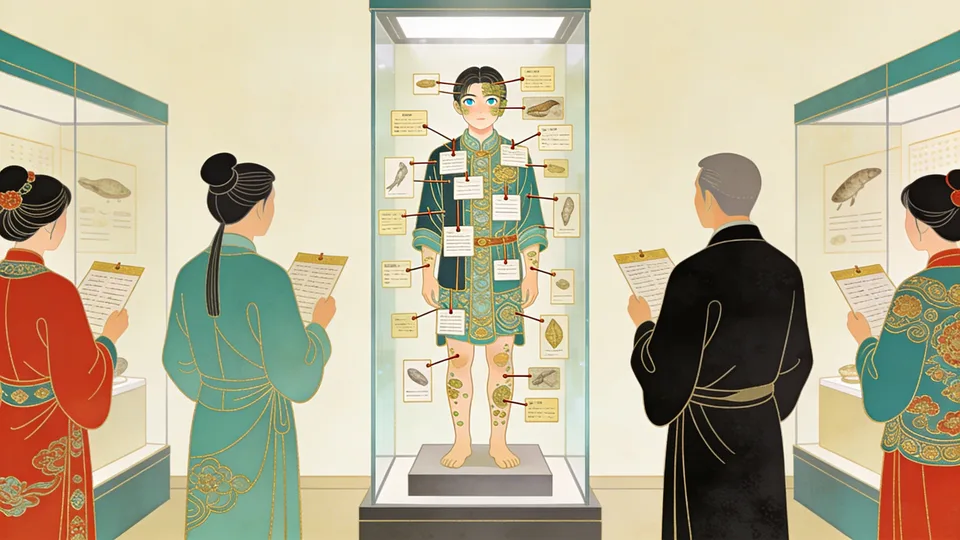
Swap “avoidantly attached” for “a Gemini,” and the explanation loses nothing.
Listen to how a family describes itself now. The grandmother who was once “lovably forgetful” probably had ADHD. The mother is “a people-pleaser” with anxious attachment. The quiet father is “on the spectrum,” and the son who keeps ending relationships explains that he can’t commit because he’s avoidantly attached. Freya India’s essay “Nobody Has a Personality Anymore” traces this shift across a generation.
Most people read this as progress. The new words sound more precise than the old ones, they come from psychology rather than folklore, and they seem to carry less stigma. In one survey, 72% of Gen Z women reported that mental health challenges are an important part of their identity: not something they experience, but something they are. The question this note asks is whether that vocabulary actually gives people more self-knowledge than the one it replaced, and what it costs if it does not.
What the label explains
Take the son’s sentence: “I can’t commit because I’m avoidantly attached.” It has the shape of an explanation, with a cause and an effect joined by “because.” Richard Feynman’s warning supplies a test for sentences of this shape. A child told that “energy makes it go” has learned nothing, and you can show it by replacing “energy” with a nonsense word, “Wakalixes.” The sentence stays equally true and equally empty.
Run the same substitution on the son’s sentence. Replace “avoidantly attached” with “emotionally cautious,” “commitment-averse,” or “a Gemini,” and its explanatory power is unchanged, because it was zero to begin with. The label classifies the behavior; it does not explain it. The real test is whether the label improves your predictions. If “avoidantly attached” cannot tell the son which relationships will trigger his retreat, or what childhood scene the retreat echoes, he is doing taxonomy rather than psychology. He has the name of the bird and knows nothing about the bird.
The trouble is that the empty version feels like the full one. It has the vocabulary, the confidence, and the relief of having an answer, so it removes the difficulty of self-understanding while keeping its appearance. In that sense diagnostic identity is a near enemy of self-knowledge: close enough to pass for it, and so more likely to replace it than an obvious falsehood would be.
What the old words did
When the family called the grandmother “lovably forgetful,” it was not offering a theory of her memory. It was describing her from inside a relationship, with the affection built into the adjective. The newer description locates the same trait in a system of pathology. We have gained explanation, much of it hollow, and lost description.
The old word also left her alone. Caring for a person, yourself included, means tolerating parts of them you cannot resolve. The diagnostic lens demands that you resolve them. The person who has named every part of themselves has not achieved self-mastery; they have achieved a kind of self-bureaucracy, with all their energy going into monitoring the file.
None of this is an argument that therapy is a scam or that people should toughen up. Criticism of diagnostic language can easily become stigma against people who need real diagnoses, and for them the label is a door to treatment. So the problem is not diagnosis but the colonization of identity by diagnosis. The pathology begins when the label becomes the personality: when every trait must be explained, every quirk medicalized, and every mystery resolved into a condition.
The useful line, then, runs between a label held as a tool, which earns its place by improving predictions and then gets set down, and a label held as an identity, which has to be defended because too much now rests on it. Therapeutic etiology is the name for the first: trace causes far enough to dissolve a stuckness, then put the key down. The diagnosed life is what happens when the key is never put down.
So the son does not need a better label. If his retreat from relationships is causing him pain, he may need someone to help him find the actual scene it echoes, which is a different and harder project than naming it. And once he has done as much of that as helps, he may need the courage of not explaining: letting himself remain partly unsolved, and being able to say “I don’t know why I am like this” as peace rather than confession. That is the stance the grandmother’s family once took toward her forgetfulness, and it is closer to self-knowledge than the file that replaced it.
References:
- Freya India, Nobody Has a Personality Anymore