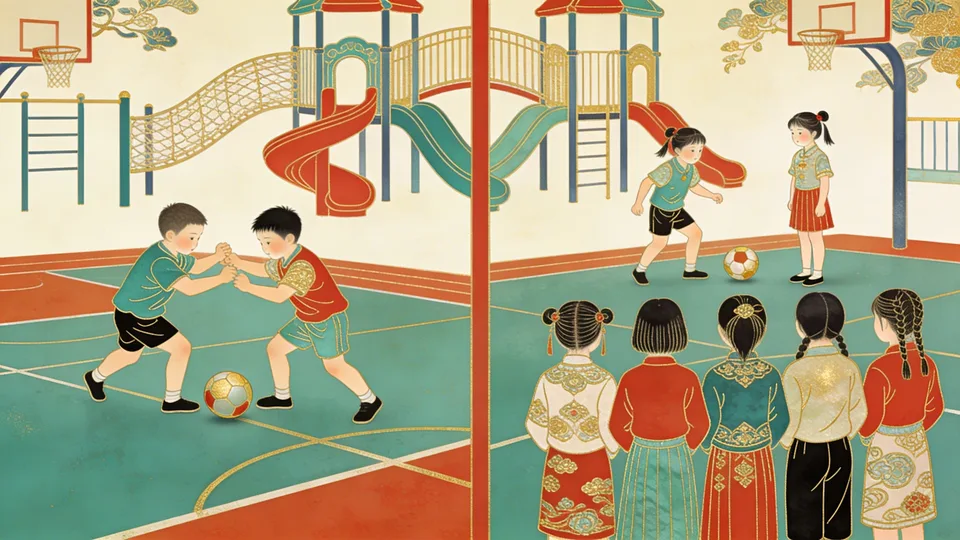
When two girls fight over a toy, the winner is the one who ends up alone.
Two boys fight over a toy. One wins, and ten minutes later they are playing together again. Two girls fight over a toy. One wins, and the other one’s friends stop talking to the winner for a week. The boys competed over the object. The girls competed over the relationship — and the relationship didn’t survive.
The easy reading is that boys are competitive and girls are not, or that girls are simply catty. Joyce Benenson’s Warriors and Worriers suggests something more structured: both sexes compete hard, with architectures so different that each misreads the other’s competition as either absent (women) or pointless aggression (men). Men form cooperative groups that compete against out-groups. Women exclude other women in individual competition for mates, resources, and family investment. Why would the girls’ version take that shape?
Competing without being seen
Underneath it sits a deeper asymmetry: a mother absolutely must not die. If she dies, she kills not only herself but all her dependent children, so risk-aversion is a survival requirement rather than a personality trait. A woman who competes overtly risks retaliation, which risks injury, which risks her children. So women compete while minimizing the risk of retaliation, and the strategy escalates in three steps.
First, deny that the competition exists: preach equality while maneuvering for advantage, because no one can retaliate against a competitor they cannot identify as competing. This is why female social groups enforce a norm of sameness. The moment someone appears superior, even accidentally, the group perceives a threat, and the girl who won the toy appeared superior. Second comes social exclusion, forming alliances to isolate the target. It requires no physical risk, is hard to defend against, and carries plausible deniability: the target is not attacked, she is simply no longer invited. Direct assault comes last, because open confrontation risks abandonment and counter-retaliation, costs that are existentially dangerous for someone whose survival depends on social bonds.
The result: any sign of competition, and the relationship must end. The same reflex explains the well-documented finding that women especially dislike female bosses. A female boss has visibly succeeded in competition, the exact condition that triggers equality enforcement, so the discomfort is less about her competence than about the hierarchy being visible.
Why the boys can make up
Male competition differs in one crucial respect: competition does not destroy friendship. The boys could fight, lose, and resume playing because their groups are coalitional. Boys flexibly allow another boy to hold higher status if he improves group performance, and their friend groups tend to grow over time, absorbing useful members. The evolutionary pressure on men was not to be the strongest individual but to be part of the strongest group, so status inside it stays negotiable.
Each architecture shows its cost in groups. One-on-one, girls work harder than boys; in groups, boys work harder than girls. In a female group, dissent feels like hierarchy, and hierarchy triggers the exclusion reflex, so the desire to avoid conflict starves the group of the information it needs to decide well. Male groups pay the opposite price in open fights. Neither strategy is superior — each is optimized for a different risk profile, and each produces its own characteristic pathology: male groups tolerate too much open aggression, female groups tolerate too little honest disagreement.
The silence
The female architecture is invisible by design, since its function is to compete without being seen to compete. That means the most consequential competition in a mixed environment is often the kind nobody is talking about. The excluded girl does not get a fight scene. She gets silence, and the silence is the weapon.
Seeing this does not make it disappear, but it makes it legible, which is the first step toward navigating it honestly. Assertiveness points toward what that might look like: a woman who respects both herself and others can hold competitive ground without triggering the exclusion reflex, or at least survive triggering it. Whether a group of women can learn to treat open disagreement as something other than a bid for rank is the harder question.
References:
- Joyce F. Benenson, Warriors and Worriers: The Survival of the Sexes