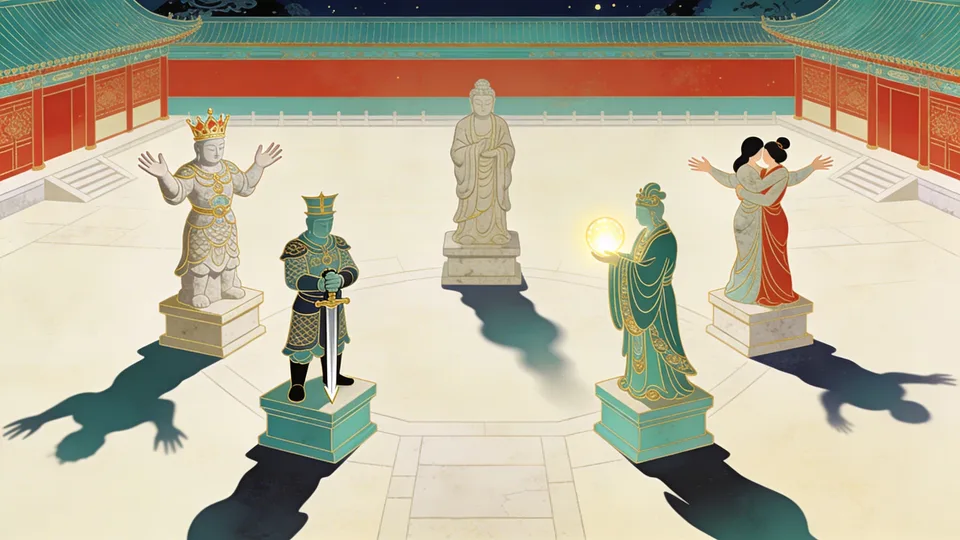
The King, Warrior, Magician, Lover framework (Moore & Gillette) maps mature masculine energy into four archetypes. Each archetype has a full form and two shadow forms — an active shadow (inflated, grandiose) and a passive shadow (deflated, collapsed). The shadows are not separate pathologies. They are what happens when the archetype’s energy is accessed without the maturity to hold it.
The Four Archetypes
The King
Mature form: Provides order, integration, and generativity. Blesses and promotes others. The King’s core function is not to dominate but to create the conditions under which everything in the kingdom can flourish. De Mello’s “real king” has no inner turmoil — not because turmoil was conquered but because the need for proof was never there.
Active shadow — The Tyrant: Exploits and abuses others. Fears hidden weakness and attacks others’ strengths. This is the narcissistic structure mapped onto authority — grandiosity as compensation for a fragmented core, with everyone sorted into threats or subjects.
Passive shadow — The Weakling: Lacks centeredness and security. Projects King energy onto others, abdicating responsibility. This is neediness in its most structural form — the self has no internal throne, so it outsources sovereignty to whoever seems strongest.
The Warrior
Mature form: Aggressive, decisive, clear-thinking. Operates with emotional detachment and transpersonal commitment — fights for something larger than personal gain. The Warrior’s clarity comes from having already decided what matters.
Active shadow — The Sadist: Cruel, destructive, hatred of the weak. Desperate fear of the feminine and of vulnerability. The Sadist is the Warrior’s energy without integration — force applied without purpose, aggression without the restraint that makes it useful.
Passive shadow — The Masochist: Unable to defend himself psychologically. Allows abuse. Self-punishing behaviors. This maps onto the self-abandonment pattern described in emotional-wisdom — abandoning yourself to avoid being abandoned by others, taken to its logical extreme.
The Magician
Mature form: Master of knowledge and technology. Initiates others into understanding. Detached and reflective — sees systems from the outside. The Magician’s gift is the ability to stand apart from what everyone else is embedded in and name what is actually happening.
Active shadow — The Manipulator: Withholds information to control others. Uses knowledge as power rather than gift. Detached and cruel. This is the outlier-genius failure mode — extraordinary cognitive architecture wielded as a weapon rather than integrated with feeling.
Passive shadow — The “Innocent” One: Avoids responsibility. Hides truth. Envious of others’ achievements. Performs ignorance to avoid being held accountable. The passive Magician shadow is a locally-optimal strategy — feigning powerlessness to avoid the burden of what you actually know.
The Lover
Mature form: Sensual, passionate, empathetic, connected to all things. Appreciates beauty. The Lover is the archetype of aliveness — the capacity to be touched by the world and to touch it back.
Active shadow — The Addicted Lover: Lost in sensations. Eternally restless. Lacks boundaries. Possessed by the unconscious. This is desire unmoored from self — the dopamine system running without a governor, chasing intensity because the wound needs feeding.
Passive shadow — The Impotent Lover: Unfeeling, sterile, flat affect, depressed, sexually inactive. This is depression as archetype — the shutdown of the capacity to feel, the system that chose numbness over the vulnerability that connection requires.
The Boy Archetypes
Each mature archetype has an immature precursor — the boy version of the same energy. These are not pathologies in childhood; they are developmental stages. They become pathological only when a man remains stuck in them:
- The Divine Child (immature King) — source of life and magical potential, but its shadows are the High Chair Tyrant (grandiose, arrogant, childish) and the Weakling Prince (withdrawn, depressed, lacking vigor)
- The Hero (immature Warrior) — enables assertion and independence, but its shadows are the Grandstander Bully (performing superiority) and the Coward (avoiding all confrontation until violent eruption)
- The Precocious Child (immature Magician) — curious and eager to learn, but its shadows are the Know-It-All Trickster (manipulative, envious) and the Dummy (performs dullness, grasps more than shown)
- The Oedipal Child (immature Lover) — passionate and yearning for connection, but its shadows are the Mama’s Boy (overly dependent on the feminine) and the Dreamer (isolated, living in imagination)
Why the Shadows Matter
The framework’s real value is not in categorizing people but in recognizing that every dysfunction in this model is an archetype’s energy accessed without maturity. The Tyrant has King energy — he just cannot hold it without it corrupting. The Addicted Lover has Lover energy — he just cannot channel it without drowning.
This means the path to maturity is not suppressing the shadow but integrating the archetype it distorts. The Tyrant does not need less power — he needs the capacity to wield it for others rather than against them. The Impotent Lover does not need less protection — he needs enough safety to feel again.
Common Misread
The dimwit take is “just be a King and you’ll be fine.”
The midwit take is “these archetypes are just gender essentialism dressed up in Jungian language.”
The better take is that the framework maps recognizable failure modes onto their underlying energy sources. Whether you read the archetypes as literally masculine, as universal human patterns, or as metaphorical lenses, the shadow dynamics are real and precise. The Tyrant-Weakling axis, the Sadist-Masochist axis, the Manipulator-Innocent axis, and the Addict-Impotent axis all describe patterns that show up in clinical practice, in relationships, and in anyone who has watched themselves oscillate between inflated and collapsed versions of the same unintegrated capacity.
Main Payoff
The deepest insight is that active and passive shadows are not opposites — they are two faces of the same immaturity. The man who oscillates between Tyrant and Weakling is not switching between two problems. He has one problem: unintegrated King energy. The oscillation is the symptom. Integration is the cure.
The puer-aeternus is the man who never makes the transition from boy archetypes to mature ones — the eternal adolescent who preserves the charm and spirituality of the Divine Child at the cost of never accessing the King, Warrior, Magician, or Lover in their full form.
References:
- Robert Moore & Douglas Gillette, King, Warrior, Magician, Lover: Rediscovering the Archetypes of the Mature Masculine