When you say you hate yourself, ask which of you is talking.
“I don’t hate myself. One part of me hates the other part.” The critical part runs in the background, sharp and powerful, announcing how bad you are. The day-to-day part, the one who actually lives your life, just wishes it would stop. Anyone who has felt this has run into a problem with the ordinary picture of the self. If there is one “me,” who is hating whom?
The usual answers are a single self with a bad habit, or the contemplative claim that there is no self at all. Neither describes the experience very well. The first flattens it, and the second, however true, gives you nothing to do on a bad afternoon. There is a third option.
The claiming machine
Start with what the ego actually does. It is not a thing but a pattern of appropriation: the periodic claiming of this or that experience as “me” or “mine.” Things go on inside and outside the body, and the ego is what labels some of them as self. You do not need an ego to see, feel, think or act. You need one to claim that you are the one seeing, feeling, thinking and acting. A belief becomes mine, then becomes me. A role becomes mine, then me. A wound becomes mine, then me.
The claim is selective. Ego is identification with something and not everything, so drawing the line between “me” and “not-me” is an act of exclusion. The parts that get pushed out become what Jung called the Shadow. The inner critic is often one of these: a part the ego will not own, so it speaks as an attacker rather than as you. Reuniting the ego-self with the shadow means doing away with the concept of ego-self entirely, because it is unneeded boundary-setting.
The same logic explains why a “strong” ego is fragile. A strong ego has identified with many things and is unwilling to let go after the inevitable pushback of life, which puts it constantly on the defensive. Every extra claim is more surface area to defend.
One, None, or Many
So what model should replace it? No-self is the deepest account of the structure of experience, but as a practical model for social life it is a non-model, an express refusal to think in terms of separate selves. It does not help much when you need to make a decision, hold a conversation, or comfort a friend.
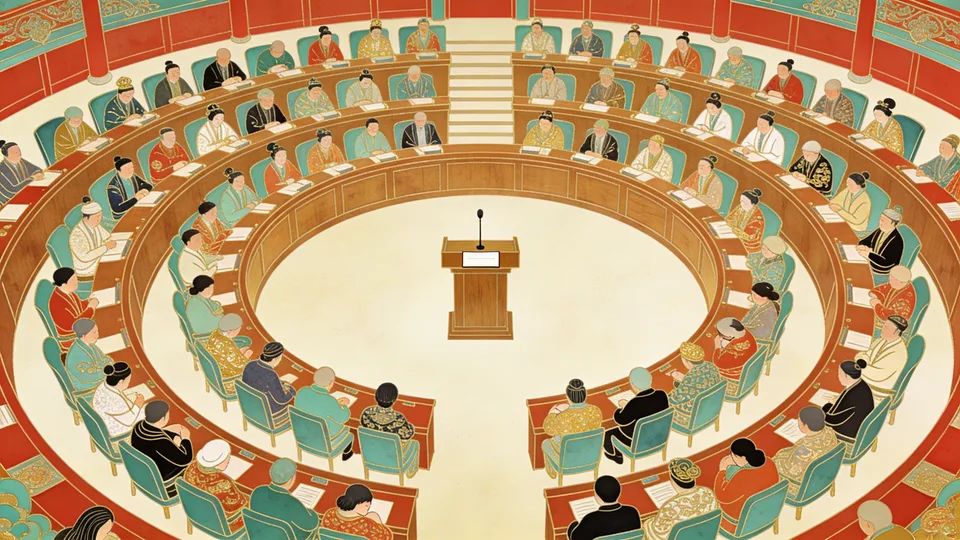
All models are wrong, but some are useful. The ego model (One) is both wrong and harmful. The no-self model (None) is truer but impractical. The remaining option is to see yourself as Many. Picture the mind as a parliament rather than a king: dozens of members, some loud, some quiet, some ancient, some new, debating, negotiating and occasionally overriding each other. What you call “I” is the speaker of the house reading the winning resolution into the record and claiming it was their idea all along.
This plays to our strengths. Humans are social animals with powerful machinery for modeling relationships between agents, and there is no reason to switch it off when the agents are inside us. “Being of two minds,” being torn between impulses — this is not something you can comfortably describe with an ego model. Whitman could:
Do I contradict myself? Very well then I contradict myself; (I am large, I contain multitudes.) — Walt Whitman, Song of Myself
Talking to the critic
Back to the part that hates the other part. Seen as one member of a parliament, it becomes something you can approach rather than something you are. Any part of yourself can be split off and interacted with. Internal Family Systems is the therapeutic version of this: treat parts as distinct entities with their own intentions, and help them talk to each other.
The critic rarely explains itself in words. It reacts to other people’s reactions, gives advice, performs, and expresses feelings only when the other person might appreciate the connection. It shows a general rule: not all parts communicate with thoughts. Much of what goes on inside arrives as emotions, gut responses and intuitions, below the level of verbal thought, and retreating into the thinking mind shuts those voices out. Still, inner behavior may be irrational but is never incoherent. There is always some reason the critic is doing what it does, and understanding that reason gives you a higher-resolution picture than “I hate myself.” Journaling, seen this way, is community organizing within the self.
The method has a trap, and it is the same trap as the ego. Keep the structures ephemeral. Give a part a permanent name and rigid edges and you have reified it, exactly as the ego reified “me.” Names tend to stick around and blind you to the ways a thing is made of other things. The looser you hold the labels, the more freely you can regroup the parts as the situation demands. That is the “fluid” in fluid plurality.
The attitude that makes all this work is less technical than it sounds. Treat yourself as you would a puppy: with understanding, patience, compassion, and willingness to look past mistakes. The aim is not to eliminate the ego but to loosen its monopoly, and to find that the parliament is more intelligent and more alive than any single ruler. The alternative to ego is not emptiness but ecology: parts in relationship, each distinct, none separate, all you. Which leaves a question worth putting to the critic next time it speaks up: what is it trying to protect?
References: