The voice that tears you apart after every presentation thinks it is keeping you safe.
You finish a presentation and the voice starts before you’ve sat down: you rambled, everyone noticed, you always do this. Most advice treats that inner critic as an enemy to silence, out-argue or replace with affirmations. Richard Schwartz, who developed Internal Family Systems (IFS), argues that this is exactly why it never goes away. Every part of our personality we do not love will become hostile to us. Going to war against a protector only makes it stronger, and if we hate or disdain our parts, we will hate anyone who reminds us of them.
So what is the critic, if not an enemy?
What the critic is protecting
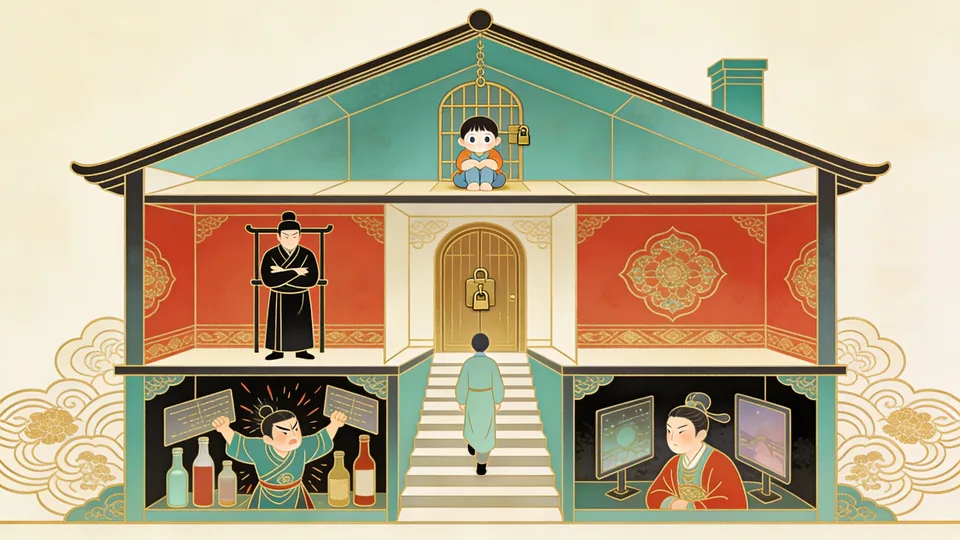
IFS pictures the mind as a family. Some members are young children who got hurt and were locked in a room. These exiles carry the most painful emotions and memories, frozen in time. Other members stand guard at the door. These managers work ahead of time to keep the exiles sealed away. When something slips past the guards anyway and the children start screaming, a third group, the firefighters, rushes in with whatever stops the noise: alcohol, binge eating, rage, distraction.
The critic is a manager. Somewhere behind it is an exile carrying a belief like “I am too much” or “I will be abandoned,” and the critic’s job is to make sure you never again do anything that would expose it. Attacking you before anyone else can is its strategy. It is crude, but it is protection, which is why fighting it fails: a guard who is attacked concludes that the danger is real and holds the door harder.
The one family member who could actually help is the Self, the core awareness whose qualities are calm, curiosity, compassion and clarity. But the parts locked the Self out years ago, because they believed it was too young to protect anyone. When a part takes over, IFS calls it blending: the critic’s voice feels like your own. Self has to rise as inner leader, or else the parts will drag you like an untrained dog.
Healing as retrieval
Accepting the critic does not mean approving of what it says. It means recognizing it as a protector rather than a defect, and asking its permission before going near the exile it guards. That is the sense in which there are no bad parts. Skip that step and the protectors push back: if a part carries the burden that the world is dangerous, it will start tearing you down when you begin to feel good enough about yourself to take risks. That is why growth so often triggers backlash.
When the Self does reach the exile, it is not eliminated or overridden. It is unburdened: the belief it carried is released and the part is free to take on a new role. So is its guard. When healed, the critic becomes your biggest fan. The one who kept you invisible now wants to help you shine.
Is any of this real?
The obvious objection is that this anthropomorphizes internal states, and there aren’t literally people inside you. Schwartz’s model doesn’t need there to be, because the parts model is not literal but operational — it works because it gives you a way to relate to internal states without being consumed by them. The alternatives are suppression, which strengthens the protectors, or flooding, which retraumatizes the system. IFS offers a third posture: relating to each part as a good parent relates to a frightened child, present and curious, unafraid of the feeling and not trying to fix it.
The same reasoning rules out a tempting shortcut. Meditation can give you a great deal of pure Self, but that access heals nothing and can make the exiles feel even more abandoned. Rising above the parts is itself a manager strategy, using transcendence to avoid the exile’s pain. Healing requires going down into the parts, not past them, which leaves the question the critic was always pointing toward: what is it so afraid you will find out?
References:
- Richard C. Schwartz, No Bad Parts: Healing Trauma and Restoring Wholeness with the Internal Family Systems Model