The harder you try to lose yourself, the more of you there is.
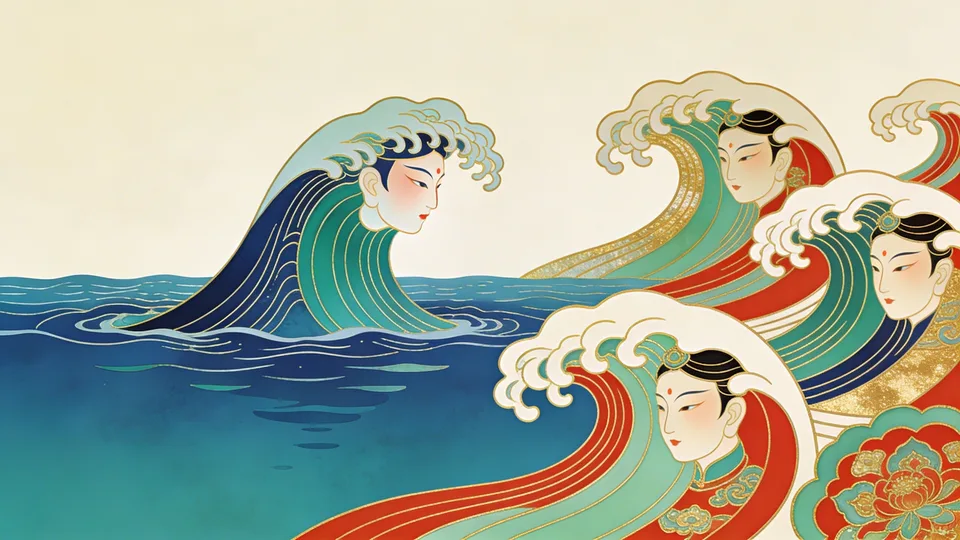
Ask most people where they came from and they will say, in effect, that they arrived: born into a world that was already here, a center of experience looking out at everything else. Alan Watts thought this was the founding mistake. We do not “come into” this world; we come out of it. Just as an ocean waves, the universe peoples. Each person is an expression of the whole universe at one unique focal point, and the feeling of being a separate “I” confronting an external world is a hallucination of our own existence.
The Book: On the Taboo Against Knowing Who You Are asks two questions that follow from this. Why does the hallucination hold so firmly? And why does every attempt to see through it make it stronger?
Separate only in name
Watts starts with something plain. An organism cannot be fully described without describing its environment: the motion of a leg makes no sense without the ground, and blood in the veins is not the same as blood in a test tube. A person can be killed by chopping off his head, but you can kill him just as effectively by separating him from his proper environment. The individual is separate from the world only in name, and when we forget that, we have been fooled by our names.
If the separation is only nominal, why does it feel so solid? Partly because society keeps it in place while depending on the opposite. Society is our extended mind and body, inseparable from us, yet it tries its best to convince us that we are individuals. Then it adds a double bind: “We demand that you love us because you want to and not because we say you ought to.” It demands spontaneity on command.
Why trying makes it worse
The double bind shapes a whole life. School prepares you for college, college for work, work for retirement, and when you finally reach the fruits of your labor, your body is failing. Every stage was only preparation for the next. If instead at every stage you had been able to play it as a game, you could find every stage fascinating. Watts names the root: for a life forced to be lived is not a life. Nothing fails like success, because to succeed is to force things to happen which are acceptable only when they happen without force.
The obvious response is to drop the ego, and that is where the trap closes. To try to be egoless is to try not to think of a monkey. The more we try to act without greed or fear, the more we notice that the trying itself comes from greed or fear. Saints called themselves abject sinners because they saw that their aspiration to sainthood was spiritual pride, the wish to admire oneself as a supreme success in the art of love.
Only by accepting the absurdity of the ego can it be dispelled, not through will. Go to a museum for “culture” and you gain nothing; meditate for awakening and you get nothing. Only when these attempts frustrate themselves do you see that the “I” trying to solve the problem is the problem. The car parable makes the same point: every technique for transcending the ego is another button on the dashboard, and getting out of the car has nothing to do with buttons.
Is it all just a game, then?
The obvious objection is that this collapses into “nothing matters, it’s all an illusion, so do whatever you want.” Watts’s answer is that the realization that life is a game does not make it less serious — it makes it more sincere. Playing is trivial when you play with toys, but sincere when you play an instrument. The game only turns into a fight when we forget that on and off, crest and trough, black and white belong to each other, and see the other side as an enemy to eliminate rather than a partner.
What actually goes wrong is not that we take life too seriously but that we barely notice it. The trouble, Watts says, is that awareness of our own existence is so impoverished that nothing seems more boring than just being, and this infinite hunger for an infinite future is the only disease. We gulp down undigested experience as fast as we can, always seeking and becoming, when the goal of action was always knowing and being.
Watts’s image for the whole arrangement is a game of hide and seek. Because there is nothing outside God, he has no one to play with but himself, so he pretends to be you and me and everything else. He hides so well that remembering takes a long time, and he doesn’t want to find himself too quickly, because that would spoil the game. The people we call clods seem to find nothing fascinating about being human. Their humanity is incomplete as it has never astonished them. The test is not whether you have seen through the game, but whether being alive still astonishes you.
References:
- Alan Watts, The Book: On the Taboo Against Knowing Who You Are