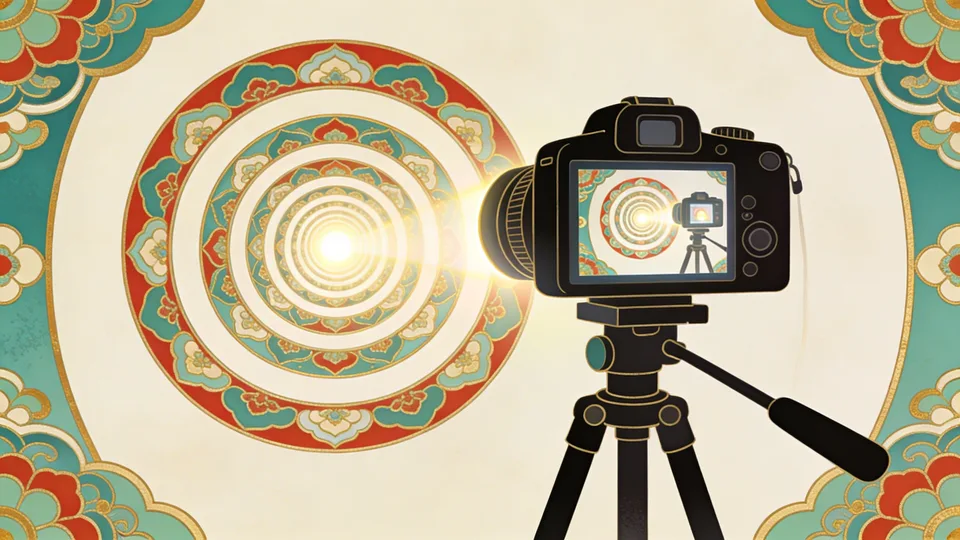
Point a camera at its own screen and you get a tunnel with nobody at the end of it.
When you introspect, it feels as if someone is in here, behind the eyes, looking out. Most of us take that feeling as evidence of a thing: a soul or an observer that has experiences. Douglas Hofstadter spent two books, Gödel, Escher, Bach and I Am a Strange Loop, arguing that the feeling is real and the thing is not. You don’t have consciousness. You are the strange loop.
Gödel, Escher and Bach each built loops, in logic, images and music. Hofstadter’s claim is that recursion of the self-pointer is tautologically the source of consciousness. A strange loop feels like movement upward but ends up back where it began, and the interiority of that loop is what being conscious feels like.
The camera and the screen
The simplest picture is a video camera pointed at the monitor showing its own feed. The image feeds back into itself, producing screens within screens that look like depth. The feeling “I’m in here looking out” is that depth. It isn’t evidence of an observer standing apart from the process; it is the process referring to itself. Consciousness is this loop made of symbols, and it tricks matter into thinking it is an “I.”
Loops that leak and loops that lock
If the self is a pattern rather than an object, it need not stay inside one skull. When you think deeply from someone else’s perspective, you borrow their self-symbol and briefly feel like them. Empathy is not just “understanding” — it is literally running part of another’s loop inside yours. Hofstadter wrote I Am a Strange Loop partly out of grief for his wife, Carol, who died in 1993, and he came to believe that a lower-resolution copy of her loop still ran in him. Souls are smeared across the people who internalize each other: spouses, best friends, mentors.
The same model explains why some selves get stuck. A loop stabilizes around whatever self-symbol it has, even a harmful one, and the symbol feels like truth because the loop keeps pointing at itself: “See, I am this way because I always have been.” Trauma is a byproduct of a heuristic system under stress, not a design goal. A child under threat settles on whatever self-pattern kept it safe, then keeps running that pattern long after the threat is gone.
It has the efficacy of a strategy designed by a baby. Because it was.
Like an attractor basin, the traumatized loop is a habit with momentum, and it values staying itself over serving any outside purpose. Self-acceptance, seen this way, widens the loop again: not by adding new content, but by loosening the self-reference enough that new patterns can form.
Does the loop make the self fake?
The obvious objection is that this explains the soul away: if consciousness is only a loop, nothing matters. But calling consciousness a strange loop does not make it less real; it makes it more interesting. The loop is not an illusion to be seen through but a pattern to be understood, and understanding it changes what it can do. A loop that knows it is a loop can widen, take in other loops, and loosen around its old injuries, not because it has free will in the metaphysical sense, but because self-reference lets it adjust its own parameters.
That is also where meaning comes from. Meaning is an attribute of narrative, which is created by consciousness. Meaning is not discovered but woven. A camera aimed at its screen produces only a tunnel. A loop made of symbols produces a life story as it runs, which leaves the question of how much of that story serves your genes, how much serves inherited trauma, and how much you would actually choose.
References:
- Douglas Hofstadter, Gödel, Escher, Bach: An Eternal Golden Braid
- Douglas Hofstadter, I Am a Strange Loop