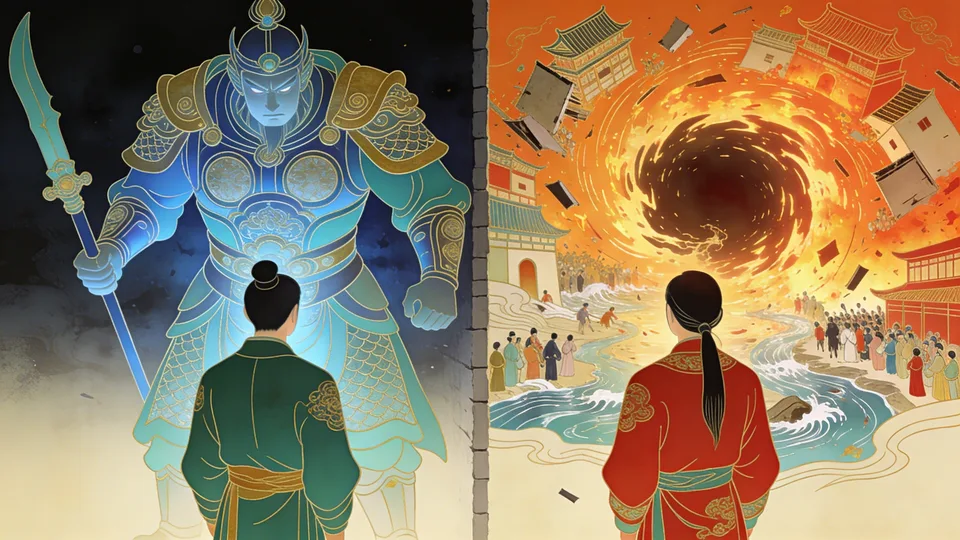
Americans fear Darth Vader. Chinese fear the day nobody is in charge.
“Why don’t you Chinese hate your government as much as we think you ought to?”
Kaiser Kuo answered a version of that question on Quora, and his point was that it reveals more about the asker than the asked. The modern Chinese party-state is a notorious violator of human rights: censorship, Tiananmen, Tibet, Xinjiang. Any thinking person can list the crimes. The question assumes those crimes should produce the same response in Chinese citizens that they would in Americans. They don’t. And the reason is not brainwashing.
Two nightmares
When Americans create their movie villains, they create Hitler and the SS again and again: Darth Vader and the Stormtroopers. The fear of the liberty-loving American is of a surfeit of authoritarianism.
The Chinese nightmare is of chaos — of an absence of authority.
That fear has a history. China suffered for over a century the predations of imperial powers, and liberalism never took hold because Chinese intellectuals, watching their civilization dismembered, concluded that sovereignty, unity and the means to preserve both mattered more than the franchise. By the mid-1920s, the overwhelming majority of Chinese intellectuals believed that an authoritarian solution was China’s only recourse. They were not stupid or servile. They had watched what chaos does to a civilization without a strong center. In the terms of the strong gods debate, the postwar West dissolved strong bonds to prevent tyranny, and modern China strengthened them to prevent chaos.
The bargain and its limits
What sustains it now is a bargain: “You stay out of politics, we’ll create conditions in which you can prosper and enjoy many personal freedoms.” On balance and to date, that bargain has delivered. Hundreds of millions left poverty. Most Chinese are pragmatic about it, putting the good (prosperity, comfort, sovereign dignity) and the bad (a censored internet, jailed dissidents, pollution) on the same scales.
That doesn’t make them credulous. No thinking Chinese person believes the Party is infallible, and most are quite cynical about official venality and factional struggle. But they don’t bandy words like “revolution” about casually. They tend to have a sober appreciation for what’s at stake, for the price that would have to be paid. They want reform, not revolution. And because the criticism is theirs, outsiders who join in often get the opposite of agreement. Most people who complain about their own parents get awfully defensive when a stranger offers the same complaint. This seems especially true with mothers.
The strongest objection is that this is just prosperity talking: wait until the economy fails. There is something to it, because the bargain is conditional, and a government that stops delivering will lose some of the patience it bought. But the objection mistakes the bargain for the whole story. Chinese support for their government is rational, conditional, and rooted in a different historical trauma than the one that shaped Western democracy. An American who can’t understand why a Chinese person tolerates censorship is making the same error as a Chinese person who can’t understand why Americans tolerate school shootings: each applies their own nightmare to the other’s reality.
So it isn’t that Chinese people don’t know what their government does. They know. They weigh it against what they know of the alternative, and the alternative, after a century of humiliation, civil war, famine and the Cultural Revolution, is not political theory but family memory of what happens when the center does not hold. The better question to bring home is not “why don’t they hate their government?” It is: what would you tolerate to avoid your worst nightmare?
References: