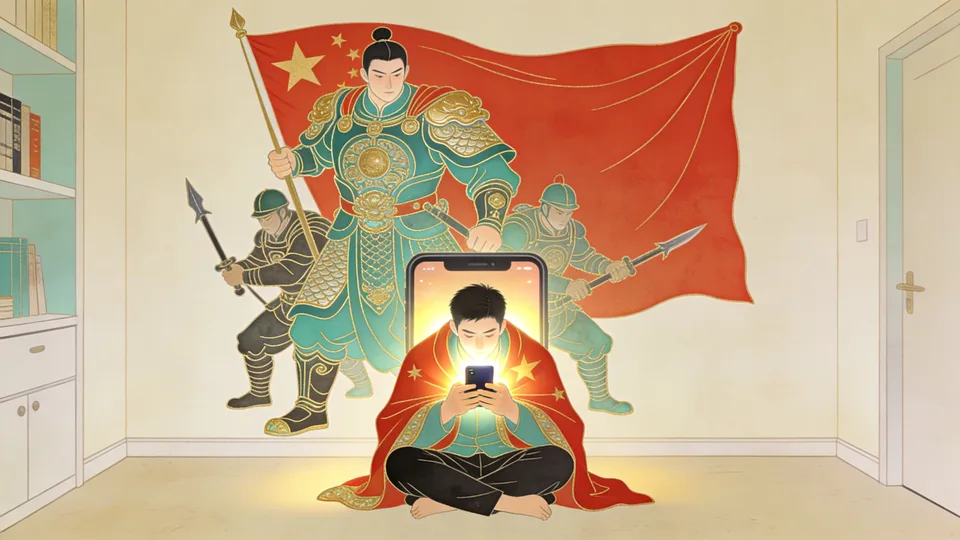
Give the angriest patriot online a green card and a girlfriend, and see how much patriotism survives.
When a Chinese actress marries a foreigner, the comment sections fill with young men calling her a traitor to the nation. Nobody is paying them. The original 五毛 (wǔmáo, “fifty-cent army”) were paid state actors posting pro-government content online; these men do the same work for free, often with more venom. Why would someone who gets nothing from the state defend it harder than the people on its payroll?
They are what Chinese internet slang calls the Spiritual Wumao (精神五毛): an ideological zealot, typically a socially isolated young male, who wraps himself in the flag not because the state pays him but because the flag is the only status marker he can afford. Nationalism is the cheapest form of status: when you cannot afford a mortgage, a car, or a wedding, wrapping yourself in the flag is free.
Borrowing the nation’s status
In an environment of extreme involution, the traditional milestones of male adulthood (homeownership, marriage, career progression) are structurally bottlenecked. A young man who realizes he is uncompetitive in that market faces a choice. He can double down and grind harder (内卷), or see through the game and withdraw (躺平). The Spiritual Wumao takes a third path, the one open to the uncooled mark: he sees through the game but cannot accept the diminished self, so he grafts his ego onto something that cannot be diminished. He cannot be a high-status individual, so he subsumes his identity into a high-status Leviathan, the State. The nation always wins, at least in narrative, and his identity, fused to it, shares the victory. “Who am I when I’m not good at anything?” becomes “who are we?”, which is far easier to answer because propaganda has already written the answer.
That explains the comment section. The toxicity is a purity spiral designed to drag high-status people down to his level. If speaking English, holding a foreign degree or consuming foreign media makes you a “traitor,” then his lack of all three suddenly makes him “pure.” And the actress who married a foreigner is, underneath the language of national betrayal, a case of sociosexual resource guarding. He hates the elites who emigrate not out of ideological purity but out of envy. The things he publicly condemns are precisely the things he privately craves. So the hypocrisy is structural: the ideology exists to reframe “I can’t have it” as “nobody should have it.”
Hence a simple test. If he received a green card, an apartment and a girlfriend tomorrow, how much of his patriotism would survive? Not every young nationalist fits this profile, and sincere patriotism exists; the test is for telling conviction apart from compensation.
The same man in the West
The Western incel runs the same operating system on different local constraints. Both are emergent psychologies of severe status deprivation under hyper-competition: the incel’s comes from social isolation, the Spiritual Wumao’s from economic involution. The incel blames women and “Chads” and demands that society restrain female choice; the Spiritual Wumao blames foreigners and cosmopolitan elites and demands that society restrain cosmopolitan mobility. Each builds an authoritarian moral framework that would artificially lower the price of romantic and social companionship, and each attacks markers it secretly wants. Nationalism and misogyny are both zero-cost status-signaling mechanisms for demographics priced out of every legitimate market. Both are also surrogate activities: policing purity online mimics agency without changing anything, so it can go on indefinitely while his material conditions stay the same.
Where the rage goes
Historically, regimes managed the energy of surplus, unpartnered young men through territorial expansion or labor-intensive industrialization. As China’s growth decelerates and its gender imbalance peaks, that energy has nowhere physical to go, so the state corrals it into digital nationalism, algorithmically amplified echo chambers that point the rage outward. The alliance rests on one illusion, eventual shared victory over the out-group, and the elites running the system treat the Spiritual Wumao as a hazard to be managed rather than a constituency to be served. They feed him cheap rhetoric while quietly moving their own assets out of reach.
The prediction, which is a guess rather than a certainty, is that the arrangement eventually inverts. As economic reality decouples from nationalist triumphalism, the Spiritual Wumao will realize the state is not going to provide him with a house or a wife. When the patriotic narrative starts to feel like management rather than membership, the mark’s rage turns from the foreign enemy to the domestic operator, and the same echo chambers built to point it outward can coordinate it inward.
Either way, the deeper problem stays hidden. The real problem is real — structural exclusion from adult milestones creates genuine suffering. But the toxicity ensures the suffering generates contempt rather than sympathy, which is exactly why the problem persists. Nobody wants to sympathize with the man attacking the actress, so nobody addresses the conditions that produced him, and the next generation’s version grows up in the same conditions, only worse.