The hermit in his cabin is hard to recruit. The man who can’t bear an evening alone is easy.
Hannah Arendt ended The Origins of Totalitarianism, a book about secret police, show trials and death camps, with an argument about loneliness. That looks like a strange place to land. Totalitarian rule seems to be a story of terror imposed from above and of true believers who carried it out, while loneliness seems like a private sorrow.
Arendt’s answer was that terror needs raw material, and loneliness supplies it. What prepares people for totalitarian domination in the non-totalitarian world is the fact that loneliness, once a borderline experience suffered in marginal conditions like old age, has become an everyday experience. Totalitarianism found a way to crystallize occasional loneliness into a permanent state of being. To see why that matters, you need her distinction between three ways of being alone.
Isolation, solitude, loneliness
Isolation is being cut off from others. It is sometimes necessary for creative work; even reading a book means turning away from the world for a while. You choose it, and you can always turn back.
Solitude is the capacity to keep yourself company: to carry on a dialogue with yourself, which is what thinking is. In solitude you are never truly alone, because you have yourself as a conversation partner. Arendt liked to quote Cato’s line: “Never is a man more active than when he does nothing, never is he less alone than when he is by himself.”
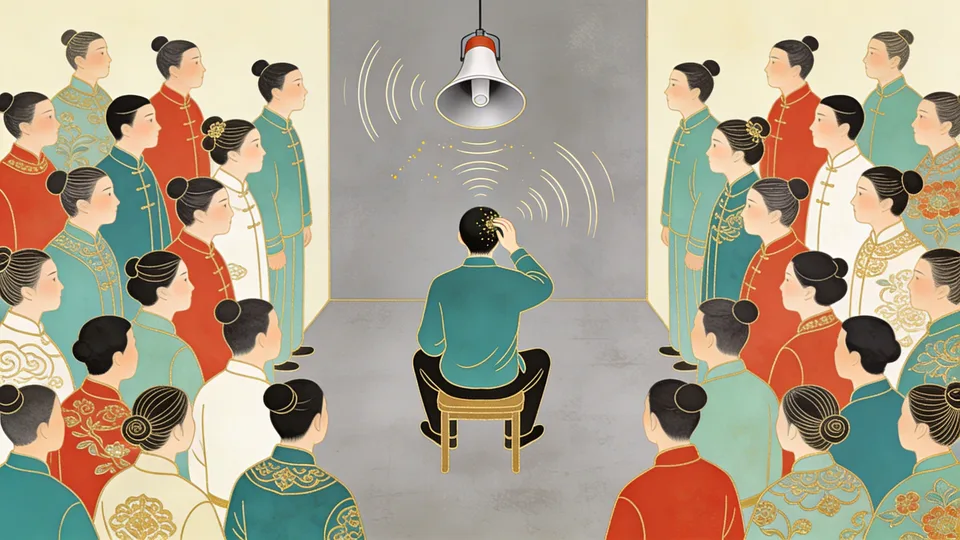
Loneliness is the loss of that inner companion. You can no longer carry on a conversation with yourself, because your ability to think has been compromised. This is one of the paradoxes of loneliness: solitude requires being alone, whereas loneliness is felt most sharply in the company of others. The hermit in a cabin may be in good company. The person at a rally of ten thousand may be the loneliest one there.
How ideology hollows out the self
Totalitarianism attacks both relationships at once. It uses isolation to deprive people of human companionship, so they cannot act together in the world, and it destroys the space of solitude, so they cannot think alone.
Ideology does the second job. An ideology does not explain what is; it explains what becomes, the hidden law of history behind events. It insists on a “truer reality” concealed behind the perceptible world, and it reasons by logical procedures divorced from experience. Once every event carries a secret meaning, your own experience stops counting as evidence. Instead, you are taught to distrust yourself and others, and to always rely upon the ideology of the movement.
Why would anyone accept that trade? Arendt’s answer is the fear of self-contradiction. Thinking can uproot every belief you hold, including the ones that gave your life purpose. Ideology spares you that risk by handing you finished thoughts, so you never have to face the silence in which you might contradict yourself. People who subscribe to ideology have thoughts, but they are incapable of thinking for themselves. And that inability to think, to keep one’s own company and make meaning from experience, is what makes them lonely.
So when Arendt talks about loneliness, she means more than a feeling. She means a way of thinking that has come loose from reality. We think from experience, and when we no longer have new experiences in the world to think from, we lose the standards of thought that guide us. That is why the ideal subject of totalitarian rule is not the convinced Nazi or the convinced Communist, but people for whom the distinction between fact and fiction and the distinction between true and false no longer exist.
The subject today
The Spiritual Wumao, China’s online nationalist, fits her description closely: a lonely young man who cannot keep himself company, cannot think from his own experience, and uses nationalist ideology to fill the space where a self should be. He is not really a true believer. Whether a claim is true matters less to him than whether it keeps the silence away, which makes him exactly the raw material Arendt described. No regime had to break him first. The loneliness came first, and the ideology arrived to fill it.
That is what makes her argument uncomfortable: it implies the temptation is ordinary. If you are not satisfied with reality, if you forsake the good and always demand something better, if you are unwilling to come face-to-face with the world as it is, then you will be susceptible to ideological thought. Totalitarian solutions, she warned, may well survive the fall of totalitarian regimes “in the form of strong temptations which will come up whenever it seems impossible to alleviate political, social, or economic misery in a manner worthy of man.”
Why company isn’t the cure
The obvious remedy for loneliness is more company, and that is exactly the remedy the movement sells. Fascism feels great — it is wonderful to lose your identity into a group of people with clear purpose and achieve specific goals. The crowd ends the loneliness by dissolving the self that was lonely.
If Arendt is right, the loop runs both ways: organized loneliness destroys the ability to think, and the inability to think produces loneliness. What breaks it is neither isolation nor togetherness but solitude, the restored capacity to sit with yourself and think from your own experience. That makes Self-Acceptance a political matter as well as a personal one. How does a society teach people to bear their own company, when so much around them offers to fill the silence instead?
References:
- Hannah Arendt, The Origins of Totalitarianism (1951)
- Samantha Rose Hill, For Hannah Arendt, totalitarianism is rooted in loneliness, Aeon