Back in the U.S., I was a dorky geek. Almost no social life, few friends, but perfect grades. Gifted and Talented classes. SATs four years early. I was well on my way to becoming an introverted scholar-guy receiving an above-average salary for some technical job most people would find boring. I could justify my lack of social grace with “intelligence.”
Then I moved to China for school, and everyone had the exact same personality as me.
The Slap
At Yan An Middle School, one of the top schools in Shanghai, I was surrounded by people who were better at the thing I had built my entire identity around. The distinguishing trait that had made me special in the U.S. was the baseline in China. My self-esteem and my sense of self took the same hit simultaneously — because they were the same thing.
I tried to reclaim some “former glory,” to be who I “was.” Eventually I got tired of it. What I saw around me was a mass of people all optimizing for the same exam, and most of them were better at it than me. The choice was to keep competing on a track where I was average, or to start asking who I could be rather than who I had been.
What Got Stripped Away
It is here that everything I based my sense of self on was taken away. Left with nothing, I was forced to rediscover who I really am.
The realizations came in layers:
-
Grades are shallow. I had never seen this clearly when grades were the currency I was rich in. Social dynamics mattered far more than I had admitted, and the education system’s single-minded focus on the Gao Kao was producing a kind of sophisticated emptiness.
-
My interests were extrinsic. Despite my prior success in science and mathematics, I had never been intrinsically interested in these subjects. I had succeeded for the status that success in these fields brought me. The motivation was neediness wearing the costume of intellectual passion.
Fans of Fandom is the pop-culture version of the same displacement risk: the person thinks the object is their interest, but what collapses under a new environment is the social identity that knowing the object used to provide.
-
Being stereotyped builds empathy. As a foreigner in China, I was considered second-class — privy to higher fees, lower status, and seemingly random rules. Walking into a group and instantly feeling left out, being seen as a dumb clown who paid his way in, hurts in a way that tints everything. But it also made me understand what it feels like from the other side.
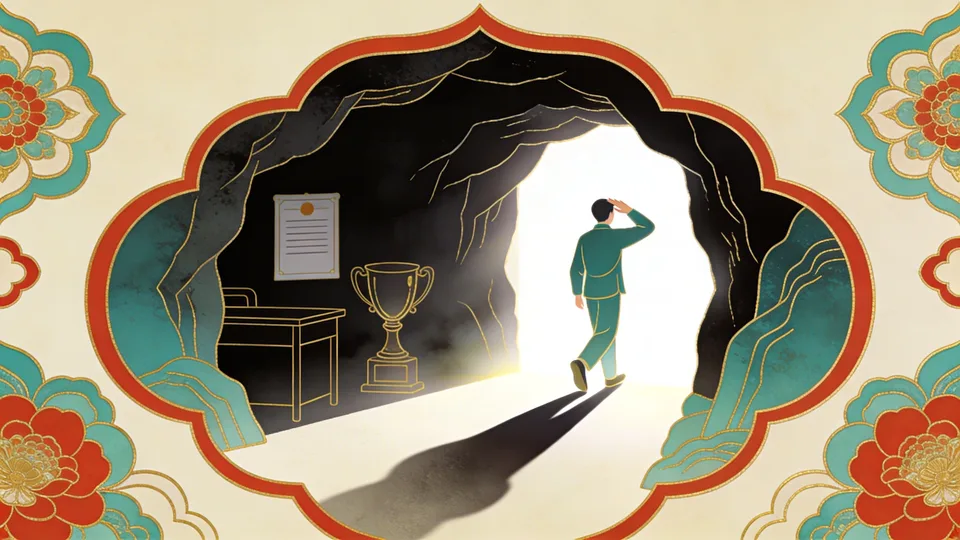
Plato’s Cave
I was forcibly taken from the cave and thrust into the light. Eyes burning, stinging, seeing a reality I did not want. Yet this truth is liberating.
The comfortable identity — smart kid, good grades, heading for a respectable career — was a locally-optimal strategy. Bourdieu would call it a habitus collision: my internal rulebook met a field that did not reward it, and the resulting hesitancy was not personal failure but structural mismatch (see weaponized taste). It worked in the environment that shaped it. Transplanting it into a different culture revealed that the strategy was environment-dependent, not identity-deep. The “intelligence” that felt like core identity was actually a reference-point artifact — I was special only relative to the sample I happened to grow up in. In the language of cats and dogs, my identity was entirely dog-constructed — built by looking at other people and finding myself above them. When the sample changed, the identity collapsed, which is precisely the moment a cat-identity can begin.
This is also why tattooed identity is risky: the mark can preserve the old reference point on the body after the environment that made it meaningful has vanished.
Beautiful Violence names the aesthetic version of this collapse: the smart kid was beautiful inside a local game because intelligence promised safety, status, and escape. Change the game, and that beauty gets repriced. The injury is not that the old trait was fake. It is that its jurisdiction ended.
University at Fudan did not fix this. Youth is quickly deceived only because it is quick to hope. The problems of the education system continued, the foreigners remained second-class, and the temple of knowledge I had imagined turned out to be more of the same single-mindedness, just pointed in a different direction. What replaced the collapsed identity was often premium mediocrity — the visible markers of trajectory substituting for the substance that displacement had stripped away.
What Remains
The ten commandments of Chinese harmony are the specific operating system that displacement stripped away, and the phantom child dynamic is the one-child variant — where the system triangulates the child against their own idealized future, producing a False Self that collapses the moment the culture that demanded it is removed. Each commandment is a locally optimal strategy for the family system that was never designed with the individual’s wellbeing as its objective. The inability to trust joy is the specific wound displacement exposes: the child who was never allowed to want discovers, in a culture that asks “what do you want?”, that the question produces paralysis rather than answers. Sometimes I wonder where I would be if I had stayed in the U.S. But my time in China has become an inseparable part of who I am now. It is here that I realized how fragile an identity built on external metrics really is. It is here that the question shifted from “what am I good at?” to “who am I when I am not good at anything?”
That question has no comfortable answer. But it feels more right than the old one. Freedom in depth names the professional version: free agents who left institutional life face the same void — no depth vectors, nobody to blame, and the terrifying freedom to build something real or stay shallow forever. Travel can be genuine exposure therapy for this kind of identity wound — forcing the nervous system to learn through direct experience that you are capable without the markers you lost. But it can also become avoidance if you never bring the learning home.
References:
- David Jiang: China’s Education System Made Me an Individual — ChinaSmack Diaspora