The banker in London, the designer in Berlin and the engineer in San Francisco may be one culture in three costumes.
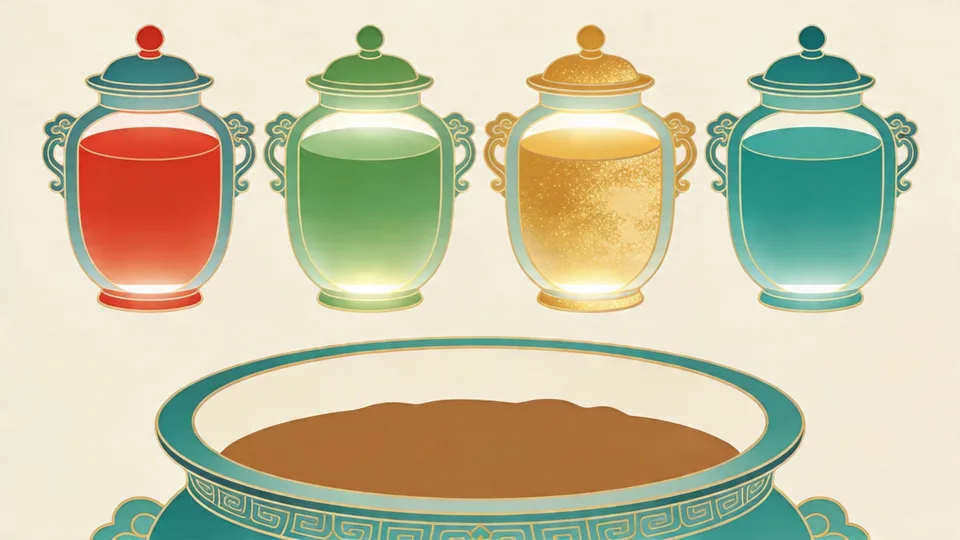
Take four colors of Play-Doh: red, blue, green, yellow, each in its own container. That is diversity: four distinct configurations, each with its own properties and its own hard boundary. Now tip them all into one container and start mixing. For a brief moment it looks like a beautiful rainbow. But mixing only runs one way. The colors blend, the boundaries dissolve, and what you end up with is a single uniform lump of brown. To keep four colors, you need four containers.
The post-war cosmopolitan settlement wants the rainbow without the containers: every culture flourishing, and every barrier between cultures dissolved. Can you have both? The Play-Doh says no. Diversity and integration are mutually exclusive over a long enough time horizon. In human societies, the container is what gets called racism once you strip away its moral valence and look at its structure: in-group preference, boundary friction, out-group exclusion. Whatever else it does, it works as a semi-permeable membrane that preserves cultural variance against mixing. That is a structural diagnosis, not a defense of prejudice.
Why the containers mattered
Cultural variance depends on the energy barrier to interaction. For most of history that barrier was geography: mountains, oceans, distance, untranslated language. High barriers meant distinct cultures, dialects and religions, each evolved under isolation. Cultures are fragile ecosystems of local norms, calibrated to particular climates and histories, and they persist only because the people running them were insulated long enough to develop a coherent shape.
Cheap flights, global supply chains, the internet and machine translation drive the physical barrier toward zero, which is the same as tipping the Play-Doh into one container. If distinct cultures are to persist anyway, the psychological and social barriers must rise to compensate. That is why nationalism, religious revivalism and rigid sectarianism have intensified alongside globalization instead of dissolving in front of it. They work like artificial gravity, generated by a system trying to keep its local variance from collapsing into the global mean.
What survives the mixing
So the cosmopolitan settlement does not deliver diversity. It delivers pseudo-diversity: a surface of difference in skin colors, foods, festivals and aesthetic costume, sitting on a single substrate that is liberal, consumerist, individualist, secular and market-shaped. The Indian software engineer in San Francisco, the Korean designer in Berlin and the Brazilian banker in London do not represent three civilizations preserved through globalization. They represent one global civilization wearing three culturally coded skins. The interior software has converged; the phenotype has not.
The cosmopolitan elite calls this diversity. It is the opposite — the visual residue of cultures that no longer exist as distinct organisms. The general rule is that frictionless integration guarantees homogenization. In-group preference acts as a culture’s immune system, and a culture stripped of it does not become more open. It becomes vulnerable to whatever is ambient, which under globalization is the universal substrate.
The cost of the alternative is real, and it is the strongest objection to everything above. People aggregate with those who look, speak and think like them, and the friction between such groups produces real violence and ugliness. It is also the only mechanism that has ever preserved cultural variance at scale. The brown lump is peaceful, and it is sterile. A vibrant world of distinct peoples is also a world often at war. There is no escaping that trade-off, only managing it.
Watch the boundaries
True diversity would mean irreconcilable disagreement about morality, theology and what counts as a person: cultures that practice intense patriarchy, reject human rights, consider markets sinful or punish blasphemy with violence. The cosmopolitan project does not defend these cultures. It assimilates them while keeping their markers as decoration, and the charge of “racism” works as the solvent that dissolves their boundaries. It is the same move the post-war project made at home against communal bonds, traditional faith and national myth, scaled up to the world. The Global Village is an empire that refuses to call itself an empire. It does not want pluralism. It wants assimilation.
The most reliable test of any system’s real view of diversity is how it handles its own boundaries, not what it says about other people’s. Harvard preaches the dissolution of national borders and admits 5% of applicants. Davos preaches free movement of labor and runs through metal detectors and snipers. The Vatican preaches universal brotherhood and is itself a walled city-state with a standing army. The elite keep a tight membrane around their own networks, capital and children’s marriage prospects because they understand intuitively that boundary dissolution is the solvent. Do not listen to what a system says about diversity. Watch how it handles its own boundaries.
Unless human neurobiology changes so that pattern recognition no longer feeds threat-response and resource competition, in-group preference will reassert itself one way or another. The open question is the form. It could be managed pluralism: high social-energy barriers, mutual respect across maintained difference, a deliberate refusal of the solvent. Or it could be violent retribalization, arriving by collapse rather than design. The friction is the price of difference. A civilization that refuses to pay it gets a single uniform color, and is then surprised when the people inside it stop being able to tell each other apart.