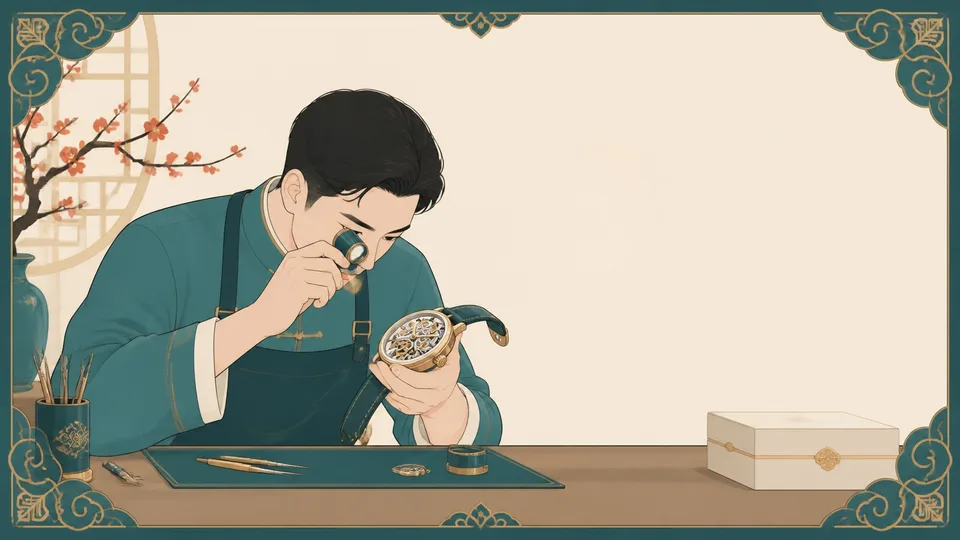
A mechanical watch leaves the boutique on two wrists. One owner keeps checking resale prices, photographing the logo, and scanning the room for who recognizes it. The other begins noticing the sweep of the seconds hand, learns why the movement loses time, meets a watchmaker, and eventually cares more about the mechanism than the brand.
The object is equally expensive. The purchase may even have begun with the same mixture of beauty, envy, curiosity, and status. What changes is the direction of attention after the purchase. One watch keeps returning attention to the owner: What does this prove about me? The other sends attention outward: What is this, how was it made, and what can it teach me to notice?
Luxury is healthy when acquisition ends the market’s role and begins an apprenticeship to the world. It becomes corrosive when acquisition is asked to settle the owner’s identity but instead creates a need for the next certificate.
The Market Must Eventually Leave the Room
Luxury goods combine several kinds of value that ordinary goods often keep separate. A coat can be warm, beautifully cut, historically interesting, scarce, recognizable, and expensive at once. Because these values travel together, status can borrow the language of beauty while beauty borrows the urgency of status.
Weaponized taste describes the social mechanism: money buys the time and access required to acquire cultural fluency, then presents that fluency as evidence of superior being. Luxury makes this conversion unusually legible. The logo, waiting list, price, and controlled supply let an object certify rank before anyone encounters its material qualities.
A useful private-showroom test removes those supports. Imagine that nobody can know what you own, every logo disappears, resale becomes impossible, and money stops being the constraint. Which objects still exert a pull?
The test does not reveal a metaphysically pure desire. Taste is learned, and even private preferences carry social history. But it separates two operations that usually arrive fused. Recognition needs an audience and a hierarchy. Attention can survive alone with the object. If the desire evaporates as soon as recognition disappears, the purchase was mainly a request for social ontology: proof that the owner occupies a particular place in the world.
That request is not contemptible. Humans are status-sensitive creatures, and public symbols help strangers coordinate. The problem is asking a positional object to provide a non-positional answer about whether a life matters. Relative rank cannot settle that question because every settlement changes the reference group and starts the audit again.
The Purchase Sends Attention Inward or Outward
After acquisition, a luxury object tends to become either a mirror or a door.
The mirror returns the owner’s gaze. Its condition, recognition, resale value, and comparison set become reports about the self. A scratch is no longer damage to metal; it is damage to the image the metal was hired to maintain. A newer model does not merely add an option; it threatens the verdict delivered by the old one. The object becomes what True Wealth calls an audit interface, continuously measuring whether arrival is still intact.
The door sends attention beyond the owner. A chair leads into joinery, proportion, forestry, and the history of domestic life. A shoe leads into leather, gait, repair, and the compromises between elegance and use. A ceramic bowl leads into clay, heat, regional technique, and the hand of a maker. The owner may still enjoy status, but status is no longer the object’s terminal function. The object enlarges the field of perception.
This is why genuine connoisseurship often becomes quieter over time. The novice needs visible markers because the novice cannot yet perceive much else. Training creates more dimensions of judgment, so the loud proxy matters less. Taste becomes audited attention: the capacity to notice form, test it against use, and remain corrigible when beauty conceals a defect.
The distinction is visible in verbs. The mirror is displayed, compared, protected, upgraded, and explained. The door is used, studied, maintained, repaired, shared, and sometimes worn out. Neither list proves motive, but together they show where the relationship is moving.
Consumer Capitalism Sells Recurring Arrivals
The purchase initially rewards both paths. Research narrows the field, anticipation intensifies, payment commits the choice, and unboxing stages a small ceremony of arrival. Then the nervous system habituates. Dopamine is better at energizing pursuit than sustaining contentment, so the acquired object soon produces less psychic voltage than the approach toward it did.
At that point the object must acquire a second life or the buyer must acquire a second object. Apprenticeship gives it a second life. The watch becomes a practice of maintenance; the coat becomes part of an inhabited wardrobe; the bowl enters meals with particular people. Attention keeps unfolding because reality has more detail than anticipation could represent.
Without that unfolding, browsing resumes. Comparison restores the gap that possession briefly closed. The next purchase promises to finish the arrival that the previous purchase could only stage. Buying the feeling of progress follows the same structure in a hobby: a new tool recreates the emotional contour of advancement when actual mastery has become slow. Luxury generalizes the maneuver from competence to existence. The purchase says not only I am improving but I am becoming the person whose life has finally begun.
That promise is inexhaustible because arrival is not a product state. A market can sell milestones, but it cannot allow the status ladder to terminate. The moment one object becomes ordinary, another must restore distance. The buyer does not accumulate satisfaction; the buyer develops a higher minimum dose of exceptionality.
Meaning fails under the same direct pursuit. Meaning arrives at ninety degrees to absorbed activity; it accumulates while attention is committed elsewhere. When an object is bought to manufacture the experience of meaning, the relationship stays instrumental. The buyer watches for the feeling, notices its decay, and returns to the market. The search for meaning becomes the mechanism that prevents meaning from forming.
A Collection Needs a Form of Life
Objects can still participate in meaning. A tea set can organize hospitality. A table can gather the same people for twenty years. Clothing can make the body feel at home in public. A garden can teach seasons, restraint, and care. Costly materials have long surrounded worship, burial, celebration, and civic memory because humans use matter to give durable form to attention.
The healthy unit is therefore not the isolated trophy but the form of life around it. Taste becomes sane inside a life that can be inhabited and continued. Objects gain depth through repeated acts, relationships, skills, and responsibilities. They become ingredients in a world rather than exhibits in a private museum of the self.
World-building also limits consumption. Once a room, ritual, or practice has its own coherence, another object must answer to that coherence. It cannot justify itself merely by being rarer or more prestigious. Sometimes the right addition is expensive. Often the right addition is repair, subtraction, or leaving an empty space alone.
This supplies a stronger post-purchase test than asking whether the original desire was pure:
- Does the object deepen attention after its novelty fades?
- Does it create knowledge, practice, care, or shared ritual?
- Does it become easier to use and harder to perform?
- Does owning it reduce comparison, or install a new comparison surface?
- If it vanished, would the cultivated capacity remain?
The last question is decisive. A watch that taught attention leaves something behind when it is lost. A watch used only as a verdict takes the verdict with it.
Objects Cannot Deliver the Verdict
The moralistic rejection of luxury misses the human attachment to matter. Craftsmanship is real. Sensual pleasure is real. Rarity can preserve difficult work that mass production would erase. A life stripped of beautiful objects is not automatically deep, just as a costly room is not automatically shallow.
But an object can only carry the meaning produced through a relationship with it. It cannot originate the reason a life matters, because it cannot recognize, choose, forgive, or answer the owner. The more intensely it is asked to deliver that verdict, the more urgently it must be replaced when silence returns.
Beautiful things can tutor attention, hold memory, and give ritual a body. They can help build a world worth inhabiting. They become dangerous when they stop being parts of that world and are hired to certify the person standing at its center.
The clean dividing line is not luxury versus simplicity. It is whether possession returns you to the world with finer attention or turns you back toward the mirror for another inspection.