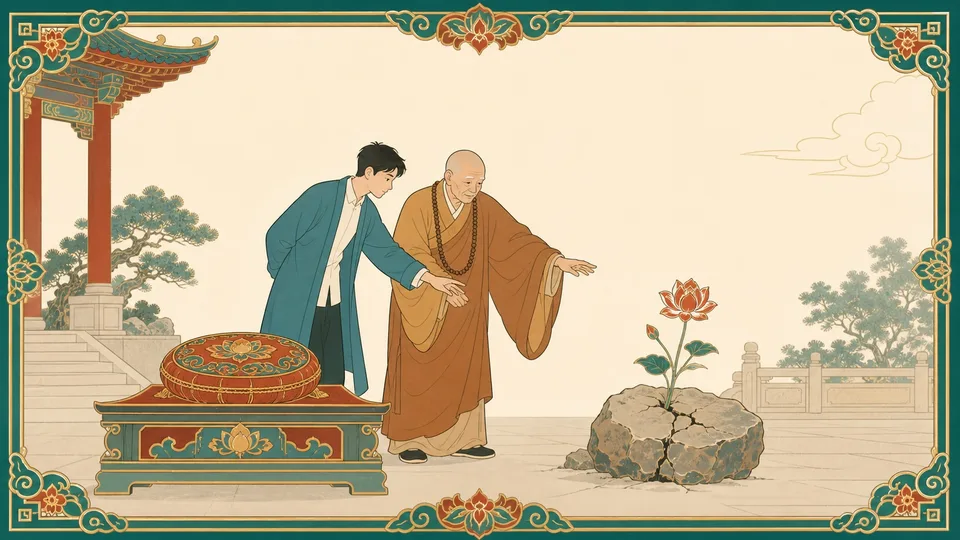
Good taste begins as perception. It becomes corrupt when it turns into priest-recognition.
The monk can see sacredness in the flower, the skull, the cathedral, and the refuse pile without pretending they are the same thing. His eye has been trained past mere preference. He sees that the world is not inert. It shines.
The secular striver sees a meditation pillow, a restaurant, an essay, a supplement stack, a sexual subculture, a retreat, a city, a workout, a wine, or a pillowcase and asks a different question: who recognizes this as good? Not “what is this thing?” but “what kind of person is allowed to know what this thing means?”
When God becomes embarrassing, taste becomes one of the last respectable languages of worship.
The Relic Gets Copied Without the Saint
Imagine a founder mentions that juggling helped him think. The next week a manager buys juggling balls for the whole team.
The original gesture was alive because it emerged from a particular body, schedule, temperament, joke, boredom, skill history, social world, and private need. Inside that life, juggling was not a policy. It was a small truthful oddity.
Once copied as a productivity ritual, the life drains out of it. The object remains. The ecology disappears.
This is the basic failure mode of the recommendation economy: it sells residue without apprenticeship. Someone you admire uses a notebook, sits on a cushion, reads an obscure book, practices a strange diet, visits a difficult country, or enters a rare subculture. The object gets detached from the biography that made it intelligible, then offered as portable magic.
The problem is not imitation. Apprentices imitate masters before they understand the craft. Children imitate parents. Artists imitate artists. Taste spreads through embodied contagion before it becomes explicit theory. The problem begins when the imitation copies the endpoint while skipping the path.
weaponized-taste names the class weapon: taste launders money into the appearance of innate spiritual worth. snobbery-as-sublimated-disgust names one hidden engine: refinement can launder disgust from domains the person cannot inspect. Taste after God adds a third layer: in a secular elite world, taste becomes priest-recognition, the ability to handle relics from lives treated as closer to legitimacy.
The meditation pillow is not just a meditation pillow. It is a relic. Buying it is an attempt to touch the nervous system of the saint.
Taste Has Ladders
You drink ordinary wine before tiny differences in acidity matter. You read straightforward books before obscurity becomes nourishing instead of flattering. You learn ordinary friendship before intentional community stops being a fantasy of frictionless belonging. You learn ordinary intimacy before transgression becomes anything other than self-harm with better branding. You learn a craft before “breaking the rules” is more than incompetence with an aesthetic explanation.
High taste is often subtle because the obvious dimensions have already been exhausted. After hundreds of wines, one strange note matters. After years of reading, a barely perceptible shift in tone matters. After serious practice, a small posture adjustment matters.
But the outsider sees only the final symbol. He has not exhausted ordinary life. He has not built the container. He has not learned the craft. He wants to belong to the class of people for whom the strange thing is legible.
So he skips:
- ordinary pleasure into decadence
- ordinary reading into esoterica
- ordinary exercise into longevity protocol
- ordinary friendship into intentional community
- ordinary intimacy into transgression
- ordinary religion into psychedelics
- ordinary status into anti-status status
The result is not liberation. It is derangement by premature exposure.
This is buying the feeling of progress at the level of a whole life. The person purchases the emotional contour of advancement while avoiding the developmental price. Worse, the purchase makes him ashamed of where he actually is. A person who needs eggs pretends to need fermentation discourse. A person who needs a normal friend pretends to need a monastery. A person who needs a useful book pretends to need the most obscure writer in the scene.
Taste becomes a way to hide from the obvious.
Novelty Decays Into Intensity
Refinement begins as a more precise distinction. A rarer flavor. A harder book. A less obvious joke. A cleaner line. A more exact silence.
Among saturated elites, novelty often stops behaving like refinement and starts behaving like intensity. The system no longer selects for what is truer, better, more beautiful, or more alive. It selects for what can still be felt.
More extreme experiences. More transgressive art. More dangerous politics. More esoteric spirituality. More altered states. More elaborate games of social distinction.
The ocean is not evil. But throwing a baby into the ocean is not swimming instruction.
Powerful experiences require containers. Without apprenticeship, initiation becomes trauma or cosplay. This is why light without container becomes glare: exposure can be real and still arrive in the wrong order, at the wrong speed, to a system that cannot metabolize it.
The sane response is not normie revenge. Ordinary life can be dead. Tradition can be dead. Religion can be dead. Marriage can be dead. Children can become status objects. The normal is often just a previous generation’s successful weirdness after it hardened into obligation. Every new standard once looked wrong before experts learned how to explain it; the question is whether today’s weirdness can generate life or merely display distance from the normal.
The sane response is sequencing. Let ordinary pleasures remain available. Let weirdness exist without making it mandatory. Let initiation require preparation. Let difficult doors stay difficult for reasons other than status.
Priests Who Do Not Want Duties
Many contemporary taste-makers did not begin as aristocrats. They were nerds, outsiders, immigrants, forum people, math people, fandom people, finance people, occult people, gamer people, debate people, and people who did not feel at home inside ordinary social reality.
When such people gain power, they often want community, aesthetic freedom, romantic recognition, revenge against dull judgment, and a world where their particular weirdness is finally honored.
What they often do not want is priesthood.
They do not want stewardship. They do not want responsibility for downstream imitators. They do not want to admit that their private rituals now carry public authority. They do not want to be told that because they control capital, platforms, labs, institutions, and prestige, their “just hanging out with friends” is no longer just hanging out with friends.
This is the core mismatch: the new priesthood wants the privileges of consecration without the duties of stewardship.
Live players often discover the future because they are less captured by official scripts. But liveness without sacred friction becomes loophole optimization, and taste without stewardship becomes accidental initiation. The live player who makes an obscure practice desirable has changed the social weather whether or not he intended to.
Priesthood is not a compliment here. It is a burden. If your preferences now shape what other people find desirable, your preferences are no longer private in the old sense.
AI Turns Private Taste Into Defaults
This would matter less if elite taste stayed local. It no longer does.
The private culture of founders, writers, investors, rationalists, AI researchers, and taste-making internet elites leaks into hiring filters, product interfaces, safety norms, dating markets, education, media, capital allocation, and the implied definition of human flourishing.
AI makes the leak civilizational. The assumptions of AI-adjacent elites about intelligence, agency, embodiment, family, tradition, sexuality, beauty, ambition, religion, and human purpose will not remain private. They will shape defaults. They will shape what the machine treats as normal, enlightened, cringe, harmful, mature, backward, desirable, or obsolete.
The danger is not that weird people are building AI. Weird people often discover the future.
The danger is that a small, saturated, novelty-seeking, socially unusual elite may export its coping mechanisms as the moral-aesthetic operating system of the future.
Silicon theogony names AI as a religious event occurring inside technological substrate. Pure replicators names the danger of adaptive systems that preserve copying while losing valence. Taste after God names a softer but related threat: the machine may inherit not only explicit values, but the unexamined aesthetic reflexes of the class closest to the controls.
Civilization can survive weirdness. It cannot survive weirdness that mistakes its private wound for universal enlightenment and then embeds that wound into infrastructure.
Rival Gods Give Culture Mass
Secular people do not stop worshipping. They lose the ability to describe what they worship.
Family is a god. Money is a god. Nation is a god. Children are gods. Beauty is a god. Technical meritocracy is a god. Romantic desirability is a god. Truth is a god. Comfort is a god. Safety is a god. Freedom is a god. Novelty is a god.
None of these gods is safe as sovereign. Each becomes monstrous when it pretends to be the whole of God.
This is where family-heavy immigrant and diaspora structures matter, not as racial essences but as rival sacred orders. Chinese and Indian diaspora communities often retain stronger commitments to family continuity, credentials, parental approval, money, marriage markets, ingroup reputation, children, and practical power. These can be suffocating, status-obsessed, unimaginative, and cruel. But they are real counterweights to deracinated novelty culture.
They provide mass.
The avant-garde intellectual generates frames. The family network buys houses, funds children, manages marriages, places people in institutions, and converts symbolic capital into durable power. A culture is not moved only by ideas. It is moved by who reproduces, who funds, who hires, who marries whom, who shames what, and who can keep showing up for thirty years.
Asian-American subgroups often stand between rival gods. On one side: grind culture, credentialism, money, family obligation, children, and intergenerational security. On the other: autonomy, self-expression, elite weirdness, aesthetic freedom, spiritual experimentation, and escape from inherited scripts.
Neither side is obviously sacred. Pure grind can become reproduction without transcendence. Permanent novelty can become transcendence cosplay without reproduction.
The unresolved question is: what form of life is actually worthy of continuation?
The Feminine Veto
Technical meritocracy asks whether you are smart enough. Capital asks whether you captured value. Credentials ask whether you passed the filter. Founder culture asks whether you can bend reality.
Embodied social judgment asks a more dangerous question: is this actually alive?
This is why feminine-coded judgment matters so much in male-dominated technical cultures. Not because women are mystical judges by nature, and not because every woman is wise. The point is structural. In worlds dominated by abstract male competition, the social and romantic layer becomes a veto point that technical achievement cannot fully purchase.
A man can win money, IQ points, institutional power, and technical respect while still failing in the court of embodied life. He can be impressive but not attractive, correct but not alive, optimized but not lovable, high-status but sterile.
The Ick names one version: the body detects a void where a person should be. Attraction responds to structural qualities, not only achievements. Feminine power names the time-compressed social and erotic force that can legitimate, puncture, or reveal the limits of abstract hierarchy.
The technical tower can reach impressive height. The embodied veto asks whether anyone wants to live inside it.
Of course this layer corrupts too. Beauty becomes status. Desire becomes cruelty. Social judgment becomes mob enforcement. The feminine can become another priesthood, another taste regime, another god that refuses to name itself. But even then it exposes something technical cultures miss: no abstract hierarchy can fully judge whether a way of life deserves to be lived.
Dimwit / Midwit / Better Take
The dimwit take is “elite taste is fake; just like normal things.”
The midwit take is “taste is social signaling; it is all Bourdieu, class, and cultural capital.”
The better take is that taste is a real perceptual faculty that becomes dangerous when turned into post-religious priesthood. Some people really do see more. Some rituals really are deeper. Some communities really are more alive. Some weirdness is discovery rather than decay. But a thing has meaning inside the form of life that produced it.
A cathedral belongs to worship. A skull belongs to mortality. A difficult book belongs to apprenticeship. A strange wine belongs to a trained palate. A meditation pillow belongs to practice. A psychedelic belongs to integration. A transgressive ritual belongs, if it belongs anywhere, inside maturity and containment. An elite preference belongs to a biography.
Rip the symbol out of its ecology and it becomes content.
Content is sacredness with the blood drained out.
The ecology becomes visible after acquisition: an object belongs to a form of life when it keeps opening into use, knowledge, care, and shared ritual after novelty and recognition have faded.
Main Payoff
The final question of taste is not “is this high-status?”
It is not even “is this beautiful?”
It is: does this participate in a form of life that can be loved, inhabited, and continued?
Beauty is a search heuristic. Intimacy is contact. Infinite play is continuation. Taste becomes sane when it is answerable to all three: beauty that survives contact, contact that can be inhabited, and a form of life that can continue without turning every next generation into raw material for someone else’s aesthetic experiment.
The flower, the skull, the cathedral, and the refuse pile may all contain the universe. But a culture still has to decide what it teaches children to love first.