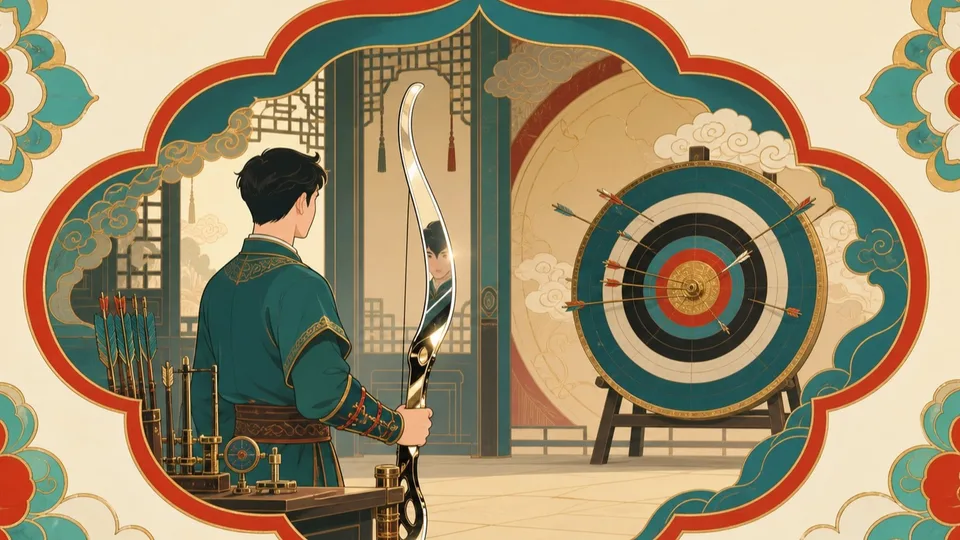
The most dangerous purchase in any skill-based hobby is often the “serious” upgrade. Not because the equipment is bad, but because it arrives at exactly the moment when real progress has stopped feeling linear. The person is no longer a raw beginner getting free gains every week. They are entering the long flat stretch where technique errors are subtle, the next improvements are slow, and the work becomes repetitive, embarrassing, and mechanical.
The purchase offers a counterfeit solution: it lets you feel the emotional climax of advancement without paying the developmental price of actual mastery.
Simple Picture
You start archery with forgiving club gear. The bow is mediocre, the arrows are mismatched, and this is good for your ego because every bad shot comes with an alibi. Maybe it was you. Maybe it was the equipment. The ambiguity protects motivation.
Then you buy the beautiful setup. Precision-machined riser, tuned limbs, proper arrows, the whole ceremony. For a week you feel transformed. You research, compare, optimize, purchase, unbox, assemble. The whole process feels like progress because it has the shape of progress: attention, effort, money, decision, payoff.
Then you shoot it.
And suddenly the machine is good enough that your flaws are no longer hidden. The release is bad. The alignment is bad. The expansion is bad. The misses are not random anymore. They are yours.
The gear did not make you worse. It removed the fog that was protecting you from accurate self-knowledge.
The Real Mechanism
There are three separate systems colliding here.
1. The Forgiveness Inversion
Beginner equipment often contains accidental mercy. Cheap, worn, or low-powered gear blurs the feedback. That blurring is frustrating in one sense, but psychologically useful in another: it keeps the learner from receiving a perfectly legible verdict on every failure.
High-end gear often inverts the forgiveness curve. It is less tolerant of bad mechanics, bad timing, and bad calibration. This is obvious in archery, where tuning, draw weight, dynamic spine, and release quality suddenly matter, but the pattern generalizes. In photography, coding, music, weightlifting, martial arts, and driving, the more precise the instrument, the less it hides the operator.
The operator experiences this as betrayal. In reality it is disclosure.
The amateur thinks capital can be converted directly into capability. The master knows capital mostly buys access to truer data. You do not buy a $2,000 bow to purchase points. You buy it to purchase an inescapable mirror. The equipment’s previous ability to lie to you was part of what made you comfortable. Premium gear charges you extra to remove that comfort.
The “worse results” are often the premium feature: high-fidelity punishment.
To reach the gold consistently, one must first know exactly why they are missing. You have purchased the privilege of total accountability.
2. The Dopamine Bait-and-Switch
The early phase of a hobby is dominated by steep returns. You go from total incompetence to visible competence quickly. That phase is rich in dopamine because the prediction errors are huge and frequent. Every week something clicks. Every session provides novelty and visible improvement.
Then the curve flattens. The gains become microscopic. What used to improve in a day now takes months. The nervous system experiences this as a withdrawal from the beginner’s reward schedule.
At that exact moment, gear acquisition appears as a perfect substitute. Researching the purchase produces anticipation. Ordering it produces commitment. Unboxing it produces ceremony. Configuring it produces the feeling of seriousness. The entire cycle recreates the emotional contour of early improvement without requiring any underlying transformation.
This is why the purchase is so seductive. It is not just consumerism. It is a neurochemical attempt to buy back the lost beginner slope.
3. Identity Without Exposure
The purchase also solves an identity problem. Once you own the real setup, you get to regard yourself as a real archer, serious lifter, track-day driver, race skier. The market has certified seriousness through objects.
The object is not condemned to remain a certificate. When luxury deepens attention, acquisition ends the market’s role and begins apprenticeship; the gear becomes a door into the craft instead of a mirror of seriousness.
But this is where the trap closes. Identity acquisition through gear is much safer than identity acquisition through exposure to failure. Buying the bow, race skis, track-day tires, heavy barbell set, watch toolkit, or manual espresso setup gives the psyche the social and self-narrative reward of commitment without yet forcing it through the humiliations that genuine commitment entails.
When the equipment then demands that the operator confront the actual gap, the ego suddenly faces a worse problem than simple mediocrity: it has already claimed the identity publicly. Now every bad result feels not like beginner struggle but like disconfirmation of the self-image that the purchase was supposed to stabilize.
That is why people often quit right after upgrading. The object completed the fantasy. Continued practice would only endanger it.
Tattoos are the body-level version of the same trap when they are bought to certify transformation before the transformation has become ordinary. The mark supplies the visible identity claim; the life still has to do the work.
Why Archery Is the Purest Example
Archery makes the pattern unusually legible because the physics are cruel and the feedback is immediate. A club bow can still let you have fun. A tuned personal setup introduces a new layer of reality: now you are not just a shooter but a mechanic. Limb weight, brace height, arrow spine, release, alignment, and tuning become visible constraints rather than invisible background.
The sport quietly changes genres. It stops being “hit target, feel flow” and becomes “submit to a precision system that reveals every inconsistency in your body.” The beginner thought they were buying a better toy. What they actually bought was a stricter judge.
The same structure appears anywhere the upgraded tool strips away compensations:
- A heavier barbell reveals bracing failures and bar path errors rather than rewarding aggression.
- A track car reveals poor line choice, poor braking points, and panic inputs rather than turning adrenaline into lap time.
- Stiff race skis reveal backseat stance and lazy edge control by throwing you around instead of letting you cruise.
- A straight razor reveals bad angle and pressure instantly because the tool has no safety buffer left.
The pattern is not that premium gear is fake. The pattern is that premium gear removes excuses faster than it creates skill.
Dimwit / Midwit / Better Take
The dimwit take is “the new gear was too hard, so the hobby stopped being fun.”
The midwit take is “they just needed better setup advice, more precise tuning, and the correct technical parameters.”
The better take is that the technical details matter, but they matter inside a deeper motivational trap. The person did not merely buy the wrong setup. They tried to use the market to solve a developmental problem. They reached the point where practice had become slow, ego-threatening, and plateau-ridden, and they replaced the threatened path of mastery with the safer path of consumption.
Technical mistakes can absolutely make the experience worse. But the core issue is that the purchase was being asked to do psychological work no object can do.
The Structural Twin of the Expert Beginner
The expert-beginner freezes at the plateau and redefines it as mastery. This trap does something slightly different but closely related: it uses the ritual of upgrading to avoid living inside the plateau long enough for a phase transition to occur.
The bridge to grokking is exact. Real skill often requires continuing long past the point where improvement is obvious. The visible signals flatten first. The underlying compression comes later. The person trapped by gear acquisition cannot tolerate that flatness. They need a new spike now. So they purchase a fresh source of anticipation rather than staying in the boring valley where the actual restructuring would have happened.
This makes the gear trap a locally-optimal strategy. It solves several proximate problems at once:
- It restores excitement
- It restores the feeling of seriousness
- It restores the fantasy of imminent breakthrough
- It postpones the humiliation of long-term plateau work
Which is why it is so hard to escape. It genuinely works at the level it was chosen to solve.
Why It Feels So Crushing
The emotional violence of the experience comes from accountability suddenly becoming legible. While the equipment was ambiguous, the learner could still believe they were “basically good” and only waiting for the proper instrument. Once the proper instrument arrives and the results remain mediocre, that belief dies.
The purchase does not merely fail to improve performance. It destroys the fantasy that performance was being externally suppressed.
That collapse is often misread as loss of interest. More often it is loss of alibi.
This is also why the trap disproportionately hits people who built identity around early aptitude. If your self-concept is “I am naturally good at things,” the plateau is already offensive. A premium tool that proves you are not yet good is not just frustrating. It is narcissistically injurious. Quitting protects the self-story better than staying.
Main Payoff
Once you see this pattern, a lot of hobby attrition stops being mysterious. People do not quit because they discovered they do not love the craft. They quit because the craft finally stopped paying them in the currency they were actually there for.
They wanted one or more of the following:
- the fast dopamine of early visible progress
- the identity of being a serious practitioner
- the emotional safety of blaming weak results on weak tools
- the consumer thrill of optimization research
The upgraded gear removes all four at once. The dopamine flattens again. The identity is stress-tested. The excuses vanish. The research phase ends. What remains is the ancient, unglamorous substance of mastery: repetition, calibration, boredom, embarrassment, tiny adjustments, and months of work that do not look impressive from the outside.
That is the point where the hobby becomes real.
The practical lesson is simple: do not interpret the urge to upgrade as evidence that the tool is the bottleneck. Often it is evidence that the beginner dopamine curve has ended and the psyche is searching for a purchasable replacement. The power process clarifies what has gone wrong: the person has substituted a consumer ritual for the harder loop of goal, effort, and attainment. The object can mimic the motivational shape of that loop, but it cannot complete it.
The person who survives this transition is not the person with the best gear. It is the person willing to let the good gear expose them, bore them, and embarrass them long enough that the plateau finally turns into skill.