The feed doesn’t need to trap you. It only needs the anger you couldn’t show your boss.
A worker leaves the office exhausted, buys relief, scrolls until the feeling disappears, and returns the next morning needing relief again. Nobody forced any step of that evening. Still, the loop is so reliable that whole industries are built on it, and it feels less like a choice than like being run.
The usual explanation is that advertisers, bosses or bad elites built the machine to control us, so the cure is to wake up and refuse. That account has trouble with two facts. The system seems to run itself, with no one needing to push the worker toward the phone. And people who smash or flee one machine often end up building another. If power came only from the top, neither would happen. So where does the machine get its energy?
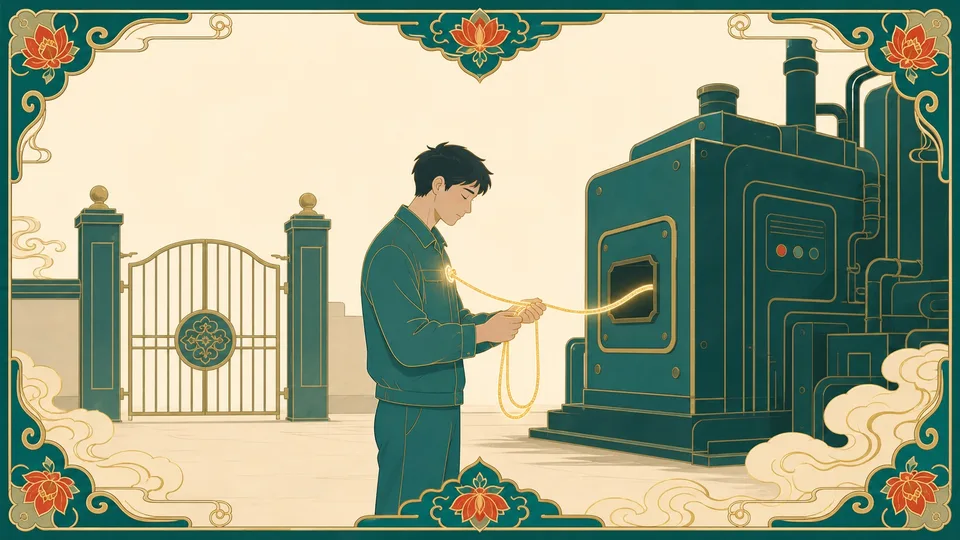
Lubomir Arsov’s film IN-SHADOW: A Modern Odyssey points to a psychological answer. The worker’s exhaustion is not the only thing being processed that evening. Under it sit feelings he has no place for: grief at a day spent on work he doesn’t believe in, anger he cannot show his boss, a need for company he would be embarrassed to admit. He does not use those feelings, so the system uses them for him, routing his pain back into participation.
The machine runs on energies people have exiled from conscious use. Fear becomes obedience, appetite becomes consumption, aggression becomes cruelty, shame becomes performance, and belonging becomes imitation.
Where the fuel comes from
The mechanism is the one described in shadow formation. A trait a person disowns does not disappear; it loses form, and a force without form ends up wielding the person instead of being wielded. The worker disowns his anger and grief, and the feed is waiting to absorb both. That is also why smashing one machine tends to produce another: the people who smash it still throw away the same fuel, and someone soon builds a new machine to burn it.
Power can exploit fear, vanity, and appetite only because those tendencies already have handles inside ordinary people. The worker’s evening is designed by someone, and he also keeps accepting it. Complicity does not mean blame. A person can say both this was done to me and parts of me accepted the bargain. The first sentence is true and gives no leverage. The second identifies the lever the person can actually reach.
Taking the fuel back
Reclaiming that fuel usually begins as breakdown: the evening the scrolling stops working. But a person can name every pattern in their life and change nothing, because comprehension without new behavior becomes its own cage. What the returning material needs is a job. Anger becomes a boundary, ambition becomes creation, fear becomes information. The force changes employment.
Redemption is not the defeat of darkness but the recovery of the life trapped inside it.
For the worker, this is modest. One evening he notices that the exhaustion is partly grief and lets it be grief instead of buying anesthesia. Later the anger he could not show his boss becomes a boundary about hours, and the need for company becomes a call to a friend rather than another hour of simulated belonging. None of this topples anything. It removes a few automatic transactions from one life. But the machine depends on those transactions being automatic, and when enough of them go missing, the institution has to change or expose the coercion that convenience hid. The world-machine weakens when people stop outsourcing their missing life to it.