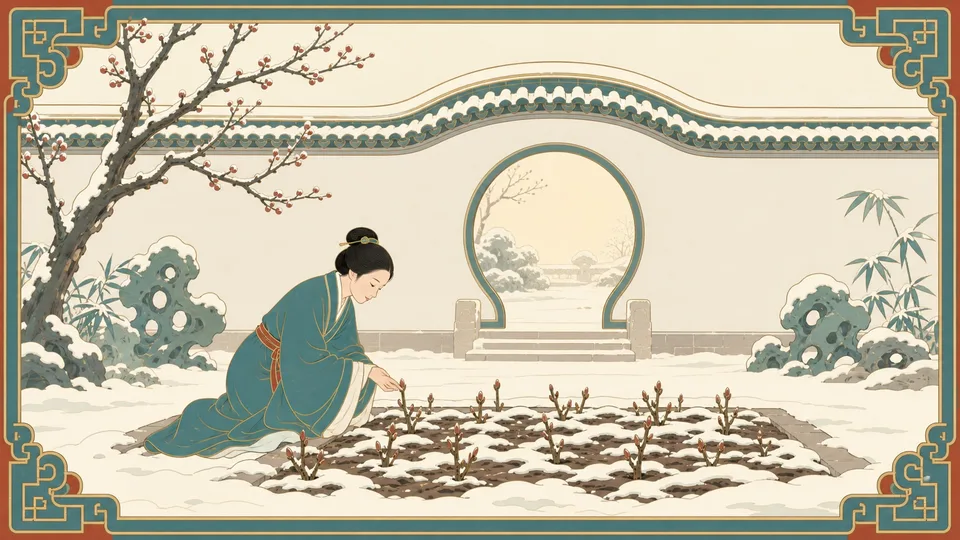
You can bury a fallen petal. You can’t bury the one that never opened.
Most of the sadness flowers carry in literature is the sadness of falling. In Dream of the Red Chamber, Daiyu gathers fallen petals and buries them, and the scene is among the most remembered in Chinese fiction because it makes impermanence visible. The blossoms had their brief sovereignty and then ended, and grief has something to hold.
“Where the flowers never bloom” sounds like the same kind of sadness. But nothing has been lost there. So why does the phrase land colder than a garden of fallen blossoms rather than gentler? What kind of grief attaches to something that never happened?
A flower that blooms and falls has entered time. A flower that never blooms has been held outside time, trapped before the first permission. Through a Chinese ear, then, the phrase names a place where spring has been withheld: beauty has not died, because beauty was never allowed to become actual.
The deepest grief is not failed beauty but prevented beauty: the life, era, person, or civilization that possessed the seed but never received the season.
Spring as permission
The coldness comes from what flowers mean in Chinese symbolic grammar. They carry 春: spring, youth, arrival, renewal, erotic timing, social possibility, the season when the world says yes. 花开, the opening of flowers, is more than a botanical event. It stands for fulfillment: love arriving, talent recognized, a thing entering its proper hour. So a flowerless place lacks something more basic than ornament. It is a place without arrival. The year turns, but spring does not come there. Daiyu in Prospect Garden can bury flowers because the flowers first existed. Here the tragedy happens upstream of loss, before the world has produced anything visible enough to mourn.
Weather, not character
The cruel misreading, common in cultures of self-improvement, is moralistic: if the flower never bloomed, perhaps it lacked discipline. The Chinese reading is more weather-sensitive. A flower does not bloom by willpower; it needs season, soil, rain, light, and timing. 命, usually translated as fate, is not a motivational poster. It is the total weather pattern surrounding a life. That is why the old idiom 英雄无用武之地, the hero with no place to use his abilities, lands so hard. The hero is capable. His tragedy is misplacement. A scholar can be brilliant and be born into an age that has no use for him.
This lets the phrase separate three experiences that people often collapse into one. Failure means the flower tried and did not hold. Impermanence means the flower bloomed and fell. Withheld spring means the flower never received the world it needed in order to appear. They are different wounds and call for different grief. Treating the misplaced scholar’s life as failure adds insult to fate. Treating it as impermanence, Daiyu’s kind of loss, gives it a consolation it did not earn, since nothing bloomed to be lost. The right grief is sharper: this was a beautiful thing denied its season.
The Daoist objection
The obvious human response is to accuse the world: why did heaven refuse this place? The Daoist response is more dangerous. Perhaps the accusation is another form of forcing. Perhaps “blooming” is a human projection, and the flowerless land is different terrain rather than a failed garden. Tao Yuanming left a minor official post to go home and farm, and his poem about picking chrysanthemums by the eastern fence became one of the most loved in the language. By the measure of an official career, his never bloomed. By his own measure, he found the rhythm his life actually had.
Not every absence is deprivation, and the demand that every seed bloom in the expected way can become sentimental tyranny wearing compassion’s face. But the Daoist correction does not erase the tragedy. It audits it, by asking whether this place is flowerless because it follows another rhythm or because something crushed the conditions under which its own rhythm could appear. If the land never wanted flowers, calling it barren is arrogance. If the land wanted flowers and received only winter, calling it “another form of existence” is cowardice.
So the Daoist question stays at the edge of the phrase. Perhaps the place without flowers is not asking for rescue, and the eye must learn to see winter without demanding spring. But if the soil is full of seeds and every silence feels like a bud held shut, then the phrase has already named the verdict. The flowers were not absent. They were waiting for a heaven that never came.