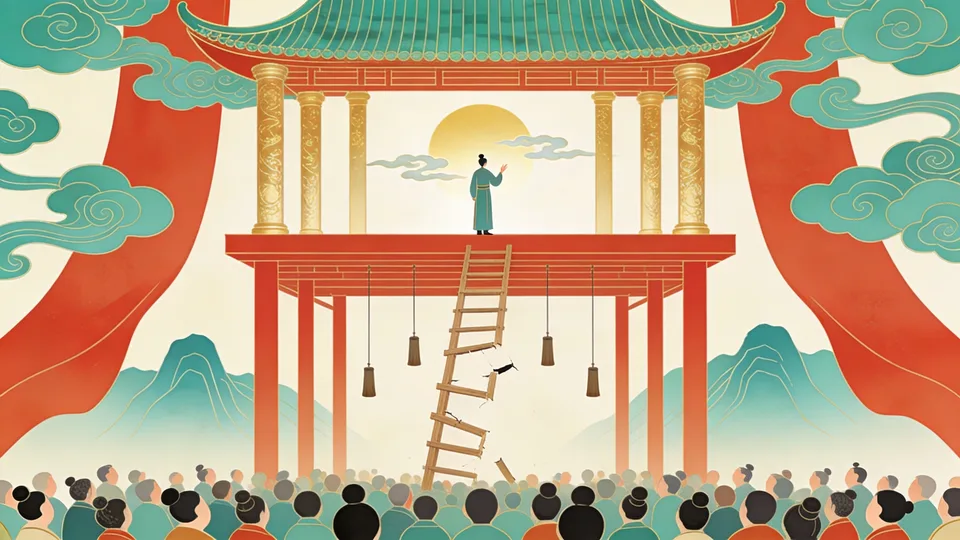
At the top, people rarely climb down. Usually something knocks them off.
Why do people keep climbing after the climb has stopped meaning anything to them? The executive who has wanted out for five years, the partner who keeps talking about teaching, the public figure who looks exhausted on every stage: from outside it looks like ambition, or a failure of nerve. The obvious advice is to just quit. Lots of people quit things.
Chinese has an idiom that sees the problem more clearly. 下不了台 literally translates as cannot get down from the stage. It names a social embarrassment, the moment you have publicly committed to a posture you can no longer back out of without humiliation. The structure it points at is more general and more brutal: the higher you have climbed, the more catastrophically any downward movement registers, until “stay where you are or fall to your death” is the only menu the geometry offers.
Why height locks you in
Picture climbing a tall stage in front of an audience that has watched you climb. Halfway up, stepping down would be embarrassing but survivable; a few people would notice, and most would shrug. Two-thirds of the way up, stepping down means losing face in a way that takes years to repair. Near the top, stepping down is no longer a move available to you. The fall would be visible to everyone you know, and the version of you the audience has been watching would die in public on the way down. So you keep climbing, not because the climb still means anything, but because the height has stopped offering descent.
The descent costs more the higher you are because it is read against the altitude: the higher the platform, the more visible the step down, and the more it looks like failure rather than choice. That makes a one-way ratchet. Each rung you climb raises the cost of the next descent, so every success deepens the trap without your noticing.
Three things tighten it. The audience has built its own stories around your trajectory, and your descent would break them, so their investment becomes pressure on you. You have built your identity around the climb too, so stepping down means killing the climber without knowing who comes next; the mask has fused to the face. And the years spent climbing become part of what a descent would forfeit, so the instinct to protect what you have already paid for never notices that the protecting is now what costs you. The climb manufactures, as a byproduct, the obstacle to its own reversal.
How deep the trap runs depends on the audience. Every status game has a 下不了台 zone — an altitude past which the descent is no longer a private decision but a public spectacle. Small audiences produce shallow zones and large ones produce deep zones. In face cultures, where the whole social technology makes vertical position load-bearing, the room starts holding you up. Once your altitude is high enough, people lie for you, subordinates absorb mistakes that should have been yours, and the institution routes around the truth to keep you on the stage, because your fall would damage the consensus itself. This is why high-mianzi failures look so much worse than low-mianzi ones — not because they are larger but because the system spent years preventing them from happening at all, which means by the time they happen the damage has compounded silently underneath.
Real trap or useful cover
Not everyone who says I would step down if I could is pinned by geometry. The trap is real, but it also makes good cover. The person who “could not possibly step down because of all they have built” is sometimes being protected from what lies underneath the achievement: a desire never faced, or an emptiness the climb has postponed. That is the safety trap hiding inside the stage trap.
The honest test is whether you can name what you would do at lower altitude that you cannot do now. If the answer is concrete and longed-for, such as I would write, I would raise the kid or I would go home, the trap is structural and you are genuinely pinned. If the answer is vague or absent, the trap is partly chosen, and the geometry is being recruited into a cope.
How people get off
The trap often becomes visible only after a forced descent: an injury, a firing, or a public failure that strips the altitude before the climber chose to give it up. The stories afterward almost always include some version of I am so much freer now. The freedom is real, and it came from the trap being broken from outside, because it could not be broken from inside. The climber would never have chosen the trade.
The sensible-sounding alternative is to keep going while planning a graceful exit. That advice is correct and unhelpful, because the exit keeps not arriving: the conditions for “graceful” are conditions the trap forbids. You cannot plan your way out, because the trap is a property of the geometry, not a property of your willpower or strategy, and the planning comes from the same system that built it. What is possible is to discover, while still on the stage, that the version of you who needs the audience to certify your descent is not the only version available. The certification is not coming. What remains optional is whether you keep needing the audience’s permission to move. Most exits from the stage trap are not graceful descents; they are quiet reorientations to a different game whose stage the climber has not yet built.
None of this makes the climber a fool. The climb that pinned you was rational at every step; the trap is what rationality assembles when each step is graded against the audience that has assembled around the previous step. The stage stays where it is. The trap was never the height. It was the requirement that every move be readable to the people who watched you climb, and releasing that requirement is the only descent the audience cannot witness.