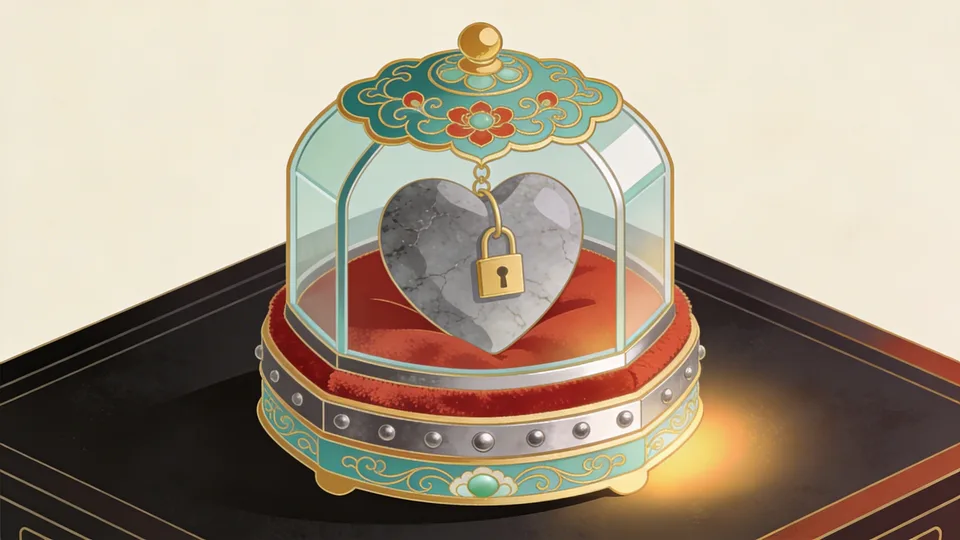
Put your whole body in a cast and nothing will ever break. That’s the problem.
After a bad heartbreak, deciding not to let anyone in again looks like the sensible lesson. The pain was real, the person who caused it is gone, and the only reliable way to avoid a repeat is to stop handing out the means to cause it. Most people who make this decision do not think of it as a gamble. They think of it as the absence of one: whatever else happens, at least nothing will break.
C.S. Lewis argues that this is exactly where the decision goes wrong:
There is no safe investment. To love at all is to be vulnerable. Love anything, and your heart will certainly be wrung and possibly be broken. If you want to make sure of keeping it intact, you must give your heart to no one, not even to an animal. Wrap it carefully round with hobbies and little luxuries; avoid all entanglements; lock it up safe in the casket or coffin of your selfishness. But in that casket—safe, dark, motionless, airless—it will change. It will not be broken; it will become unbreakable, impenetrable, irredeemable. The alternative to tragedy, or at least to the risk of tragedy, is damnation. — C.S. Lewis, The Four Loves
The puzzle in the passage is how anything can go wrong inside the casket. Nothing gets in, so what damages the heart? Lewis’s answer is that the heart does not need to be struck to be harmed; it only needs to be kept still. He frames this as theology, but the structure reaches well past it: the attempt to eliminate all risk produces something worse than the risk itself.
Why stillness damages what it protects
A body offers the plainest version. A broken bone heals, often stronger at the break than before. Now suppose that to prevent fractures you encase your whole body in a cast and leave it there. Nothing breaks. But after enough time the muscles atrophy, the bones thin, and the joints stiffen until they fuse. The cast did not protect the body from injury. It became the injury.
The cast and the casket fail for the same reason: risk and vitality share the same channel. The exposure that can hurt a system is also how the system keeps itself working. Many living systems need small stressors, and removing them does not leave the system at rest; it leaves it decaying.
The heart in Lewis’s casket is that kind of system. Someone who has stopped attaching to people has not frozen their capacity for love at its current level. The heart that never risks breaking doesn’t stay soft and intact. It calcifies. That is what Lewis means by “unbreakable, impenetrable, irredeemable”: it cannot be broken because it no longer bends.
When caution is right, and when it turns
The strongest objection to all this is that some caution is earned. A person who was badly hurt, or who grew up around people who were dangerous to love, is not being foolish when they move slowly.
Lewis’s passage is compatible with that objection, because he is not arguing against caution. He is describing a phase transition. Up to some point, self-protection preserves the self: it buys time to heal and to choose better. Past that point it begins to destroy what it was protecting, because the protected thing changes. The caution that began as a reasonable response to pain becomes the thing that prevents recovery from pain. The safe position and the dead position converge.
The difficulty is that the transition is hard to see from inside, because the casket speaks the language of good sense. “I’m just being careful” sounds like a boundary. But a boundary is a door with hinges on your side: you decide when to open it, and it still opens. So ask whether the protection still has a way to open. The heartbroken person who is moving slowly can say what would have to be true for them to trust someone again, and the conditions are ones the world could meet. The person in the casket has conditions no one could meet, or none at all, because the point of the arrangement is that the question never comes up.
Suppose the person who decided, after the heartbreak, never to let anyone in again keeps the promise for twenty years. They will have avoided a second heartbreak by becoming someone who could no longer be heartbroken, which is a different thing from being safe. That is why Lewis reaches for the word he does. A tragedy happens to you, and it leaves a heart that can still grieve and recover. The casket is something you do to yourself, one sensible precaution at a time. The alternative to tragedy is not comedy. It is damnation — the slow, airless, irredeemable kind that you chose on purpose because it felt like safety.
References:
- C.S. Lewis, The Four Loves