You can afford a shaky block. You can’t afford it in the bottom row.
Blue Origin’s motto, gradatim ferociter, means “step by step, ferociously.” Most people hear the first half and file it under caution: test everything, go slow, don’t blow up rockets. But a company trying to reach orbit cannot build only from parts it already trusts. So how do you build something ambitious enough to need untested parts without letting one of them bring the whole thing down?
Venkatesh Rao’s reading rescues the phrase from the cautious misread. It does not mean “go slow.” It means move as fast as your recoverability allows. The missing variable is the structure of the thing you are building. A fragile piece can be acceptable if its failure is contained, and an untested idea can be acceptable if the surrounding structure reveals its weakness before it becomes fatal. Gradatim ferociter is ambition with bounded collapse.
A tower of uneven blocks
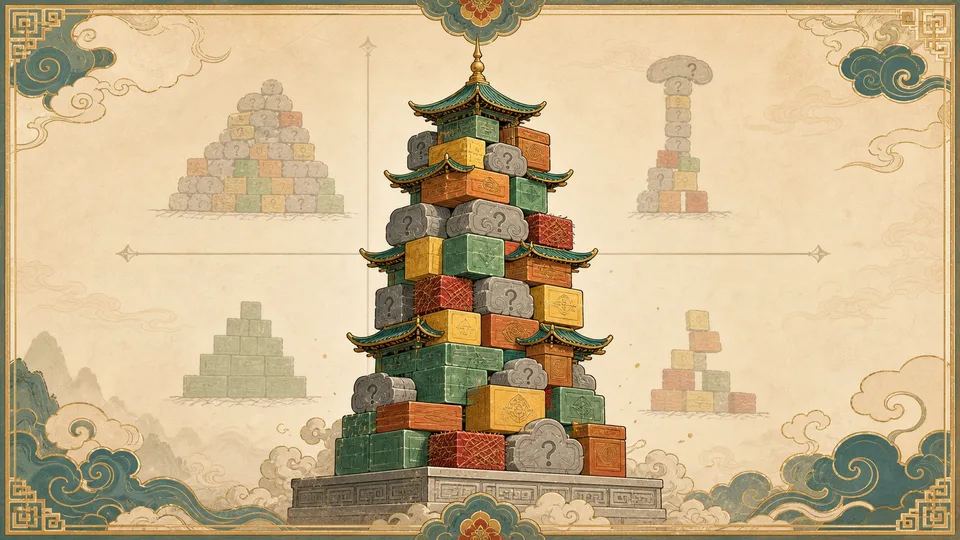
Rao’s picture is a tower built from blocks of different grades. Green A blocks are well-tested knowledge. Yellow B and orange C blocks are weaker but still usable. Red D blocks are shoddy knowns. Gray question-mark blobs are known unknowns: guesses, experiments, parts whose true grade has not yet been revealed. Fragility, on this view, is a property of how well something is known. An A is not merely more knowledge than a C; it is knowledge that has survived better tests.
Build only from green blocks and the tower is stable but short. That is stagnation, school-shaped excellence with no frontier. Build from cheap blocks you know are bad and you have junk. Throw everything together, tested and untested alike, and the tower gets tall fast and falls at the first serious shock, a house of cards. The fourth option is the one the motto names: accept the gray blobs, because ambition requires them, but place them where any one of them can fail without taking down the tower.
So the useful question about any fragile part is where it sits. A gray blob in a load-bearing line is dangerous. The same blob in a bounded experiment with redundancy around it is how you learn.
Why careful turns into fast
That is also where “ferociously” earns its place. “Slow is smooth, smooth is fast” makes sense inside the tower, because early slowness is information gathering. Each controlled step reveals more about the tower’s robustness margin. Maybe the gray blobs turn out stronger than expected. Maybe failures only cascade three blocks deep when you designed for eight. Now you have information you can convert into speed: shrink the safety margin and build faster without becoming reckless.
This is why the approach can eventually outrun both caution and chaos. The stagnant builder never puts up enough live structure to learn from. The house-of-cards builder learns, but often by dying. The gradatim ferociter builder learns in a way that keeps him in the game. In other words, the goal is not to prevent failure but to control the depth of failure. You should know roughly how hard you can fall and still continue.
Seeing the tower first
The limit on all this is that you have to see the tower first. You can only keep the gray blobs out of the load-bearing core if you know which lines bear the load, and in a new kind of rocket, company, or career that is often the thing you understand least. Appreciative modeling comes before robustness: look at the structure long enough to know what holds it up.
Then the test is plain. In the tower you are building, are the unknowns isolated and testable, or stacked in the core? If the worst plausible setback knocks you out permanently, you are building a house of cards. If you have eliminated every possible setback, you are probably not building anything ambitious enough. Which of those is your safety for?
References:
- Venkatesh Rao, Gradatim Ferociter, Contraptions, June 16, 2017