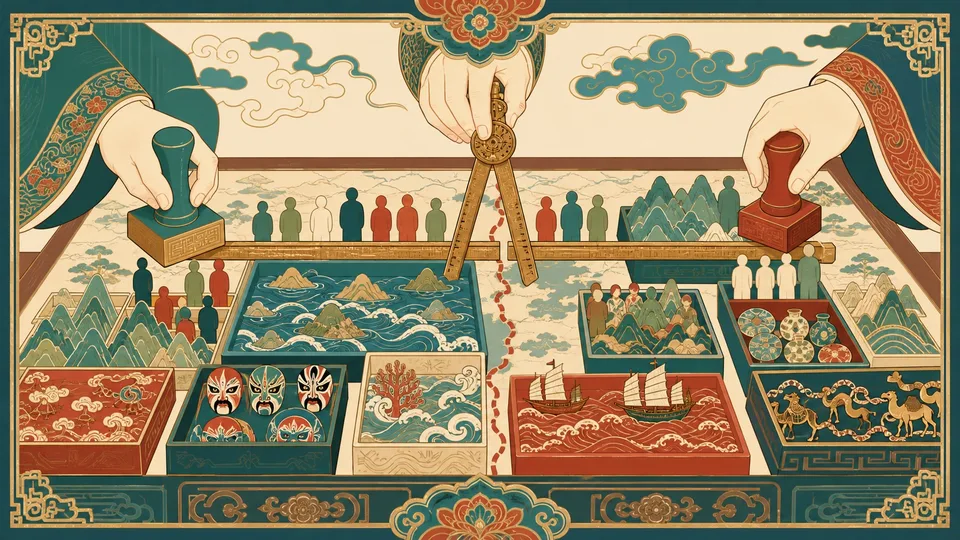
Swap ten Korean hires for ten Afghans, and on paper your company just got whiter.
Picture a company with 10 Pakistani and 10 Afghan employees. Under US diversity rules it might get classified as “too white” and sued for failing to hire enough Asian-Americans. A company with 20 Pakistanis, or 10 Pakistanis and 10 Koreans, would be fine. The reason, according to Richard Hanania, is that the government’s dividing line between white and PoC runs along the Afghanistan-Pakistan border, and nobody knows what to do about, for example, Uzbeks. (Hanania himself is Palestinian-American and seems salty about this.)
Scott Alexander’s review of Hanania’s The Origins of Woke is useful less as a grand origin story than as a case study in how official categories become absurd once the state routes liability, recognition and resources through them. The line looks ridiculous because it was never drawn from anthropology: racial categories are administrative software pretending to be anthropology. Once they become legally consequential, every weird boundary condition starts mattering.
How the buckets were drawn
Each bucket was a political compromise. They created the concept of “Asian-American” by combining the old category “Oriental” with Indians, Pakistanis, Thais and others. Then, under pressure from the Hawaiian delegation, they added Pacific Islanders to create an even more heterogeneous and meaningless category, “AAPI” (Asian American or Pacific Islander). Then, under more pressure from Hawaii later, they separated out “Native Hawaiian” again. The result is that Pakistanis, Koreans and Tongans are the “same race,” but Hawaiians and Samoans are “different races.”
They combined Mexican-Americans, Cuban-Americans and Puerto Ricans, previously three different groups viewed as “white lite” along the same lines as Italians, into the new race “Hispanic,” adding in all of South and Central America for good measure. Then black activists worried that some blacks would reclassify as Hispanic and they would lose constituents, so Hispanic was redeclared an “ethnicity” you could have alongside a different race. A white Spaniard from Spain and a white Spaniard from Mexico got treated as different ethnicities, while a white Spaniard from Mexico and a Mayan from Mexico got the same one.
Even though Arabs and Muslims are one of the most discriminated-against groups in the country, especially after 9/11, they did not have good lobbyists, so they got classified as white.
Why the absurdity sticks
These would be census trivia if lawsuits, hiring targets and funding did not run through them. The schema sees compliance buckets before it sees people, histories, languages, religions, regions or civilizational difference, so the company in the opening is judged by its boxes: the bureaucratic form of Pseudo-Diversity. The label becomes morally charged because the database makes it operational.
The category is not ridiculous despite being official. It becomes powerful because it is official, then everyone has to pretend the ridiculousness is science, justice, or common sense. The Uzbeks are still waiting to learn which side of the line they are on.
References:
- Scott Alexander, Book Review: The Origins Of Woke, Astral Codex Ten
- Richard Hanania, The Origins of Woke