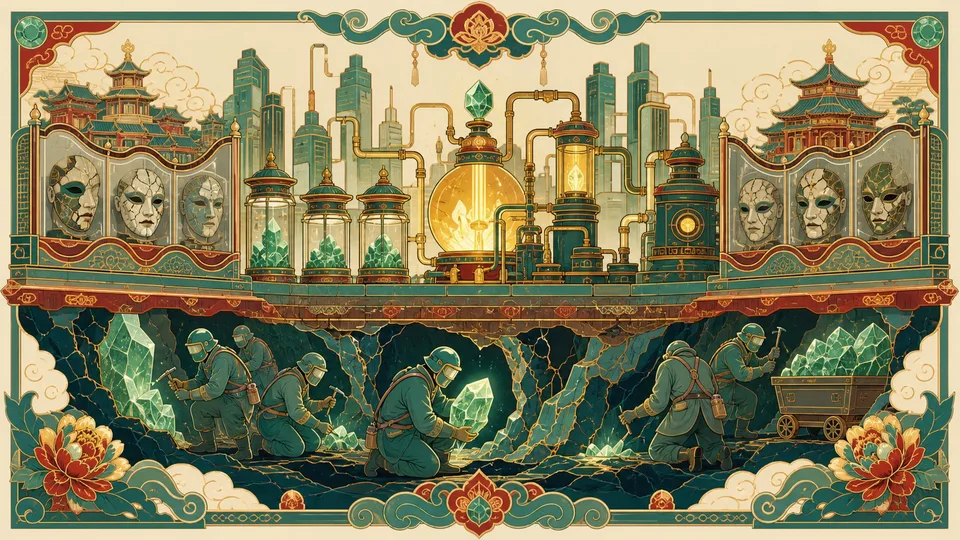
Truth is not a universal good. It is an industrial input. In the wrong organization it behaves less like light and more like acid: it dissolves the stories, status arrangements, roadmaps, brand promises, and incentive structures that make the company coherent enough to operate.
Most companies are profitable and stable because they sit on top of complex illusions. They do not merely tolerate these illusions. They depend on them. The market believes the strategy is coherent. Employees believe the promotion system is fair enough. Customers believe the product is more necessary than it is. Executives believe the plan because disbelief would paralyze execution. Investors believe the narrative because everyone else does.
Truth is toxic to organizations that cannot mine it, contain it, and refine it into profit.
Simple Picture
Imagine truth as radioactive ore. Buried in the ground, it is powerful but useless. Dug up carelessly, it poisons the miners, contaminates the town, and makes the land uninhabitable. Only a specialized operation can turn it into energy: surveying, protective equipment, ventilation, containment vessels, processing plants, waste protocols, and a grid that can actually use the output.
Most companies are not mines. They are villages built on top of ore deposits. A founder, analyst, engineer, or customer support person can stumble onto something true and still harm the organization by bringing it above ground. Not because truth is bad, but because the organization has no machinery for processing it.
The question is not “is it true?” The question is: what system receives this truth, what does it dissolve, and what productive transformation can absorb the release?
The Illusion Stack
Companies run on stacks of coordinated fiction.
The product story says the thing matters. The recruiting story says joining is a rational path to growth. The strategy story says the company knows where it is going. The management story says decisions emerge from competence rather than politics. The equity story says sacrifice today will be rewarded tomorrow. The culture story says the work has meaning beyond salary.
Some of these stories are fraudulent. Many are not. They are load-bearing because they let strangers coordinate under uncertainty. A company cannot hold a town hall every morning and say: “We are mostly guessing, half the roadmap exists to satisfy internal constituencies, our valuation depends on a story that must remain emotionally intact, and several important people are in their roles because removing them would trigger a political settlement crisis.”
That might be more true. It would not be more operational.
The normalcy field of a company translates chaos into familiar categories: goals, quarters, performance reviews, customer segments, launch dates, principles. These are not neutral descriptions. They are stabilizers. They prevent everyone from experiencing the raw indeterminacy of the enterprise at once.
This is why crude “radical transparency” often fails. It mistakes exposure for understanding. It uncovers the ore without building the refinery.
Why Most Firms Cannot Use Truth
Truth becomes valuable only when the organization can convert it into action without destroying the coordination layer that made action possible.
Most companies cannot do this because their immune systems classify truth as attack. The person who names a real constraint threatens the local fantasy that people are being rewarded for competence. The person who identifies customer indifference threatens the product romance. The person who shows that a metric is fake threatens the manager whose identity is built on improving it.
This is not merely cowardice. It is structure. In moral-mazes, truth is dangerous because the local game is not reality-contact but superior-contact. A fact matters only after it has been routed through power. An accurate statement that embarrasses the wrong patron is less useful than an inaccurate statement that preserves the chain of confidence.
The company therefore develops an epistemic allergy. True statements cause swelling: meetings proliferate, language becomes careful, accountability is diffused, the messenger is redescribed as “negative,” “not strategic,” “low EQ,” or “not a culture fit.” The system is not trying to find out whether the statement is true. It is trying to stop the reaction.
This is the organizational version of technical debt as ignorance. Every unprocessed truth becomes knowledge debt. The company still ships. The dashboards still update. The all-hands still sounds plausible. But the gap between the operating story and the underlying reality widens until every future decision pays the tax of prior non-recognition.
Truth Requires Refineries
A truth-refinery has at least four parts.
Containment. Raw truth must be kept from detonating status systems before anyone knows what to do with it. This means small rooms, confidentiality, careful sequencing, and leaders who do not use facts as weapons against internal enemies. Containment is not suppression. It is the difference between a lab and a spill.
Translation. Truth rarely arrives in usable form. A customer complaint, incident review, failed experiment, or dissident memo is ore, not metal. The organization needs people who can translate observed reality into models that preserve enough complexity to be true and enough compression to be actionable. This is the appreciative-to-manipulative bridge.
Protection. Truth-miners need political cover. If telling the truth reliably destroys careers, only fools and martyrs will do it. The organization must protect the people who bring back unpleasant data long enough for the data to be processed. Otherwise the mine closes and the company returns to decorative analytics.
Monetization. The final test is whether truth can be turned into advantage. A company that discovers a painful truth but cannot change product, pricing, hiring, positioning, infrastructure, or capital allocation has not mined truth. It has only made itself sad. Truth that cannot enter the profit engine becomes a morale hazard.
This is why some organizations talk constantly about truth while being structurally unable to use it. They have dashboards, surveys, postmortems, research teams, customer calls, and strategy offsites. But the facts are not connected to any mechanism that can change the company. The rituals exist to reassure everyone that reality has been consulted.
Tech and AI as Truth-Mining Businesses
The strongest tech companies are unusual because their production process can sometimes absorb truth directly.
A software company can discover that users behave differently than expected and change the interface. A search company can learn what people actually ask for and improve relevance. A marketplace can discover hidden preference curves and alter matching. An AI company can ingest vast amounts of human residue and convert patterns into models that produce new leverage.
This makes tech look truth-loving. Often it is not. It is truth-selective.
Tech companies love truths that can be converted into product, prediction, automation, or distribution advantage. They hate truths that undermine the legitimacy of the game itself: that users are addicted rather than empowered, that metrics are Goodharted, that internal promotion is political, that the product replaces judgment while marketing itself as augmentation, that the model’s competence depends on harvesting unpriced human context.
AI sharpens this distinction because AI is a truth-mining machine wrapped in a normalcy field. It extracts statistical structure from human behavior, language, taste, labor, and institutions. It turns the residue of civilization into manipulative models. But the appreciative truth of what is being mined is often too destabilizing for the companies doing the mining.
An AI lab can profit from patterns in writing without wanting to know what writing is for. It can profit from prediction without wanting to ask what kinds of human agency prediction displaces. It can profit from synthetic companionship without wanting to know whether loneliness has become a resource deposit. It can profit from evaluation benchmarks without wanting to know whether the benchmark is a theater where the institution performs control.
The business wants the ore, not the ontology.
The Priesthood Problem
Truth-mining creates priesthoods because dangerous ore requires specialists. Not everyone gets access to the raw feed. Not everyone can interpret it. Not everyone is allowed near the refinery.
This is necessary and corrupting. Priesthoods protect knowledge from public stupidity, but their isolation makes them vulnerable to internal plague. A truth-mining organization faces the same double bind. It needs a protected class of people who can handle destabilizing information without leaking it crudely into the company. But that class quickly learns that control over truth is control over reality.
The priesthood can then become less interested in mining truth than in managing access to it. “Trust the process” becomes a veil. Safety protocols become status protocols. Confidentiality becomes cover for narrative maintenance. Expertise becomes the right to decide which truths count as mature enough to be seen.
The failure mode is not secrecy. Some secrecy is real containment. The failure mode is when containment stops serving transformation and starts serving insulation.
Dimwit / Midwit / Better Take
The dimwit take is “companies hate truth because they are run by liars.”
The midwit take is “great companies embrace radical transparency and data-driven decision-making.”
The better take is that truth is a high-energy material. It is valuable only inside an organization designed to withstand the heat released by contact with reality. Most companies are stable because they are insulated from too much truth at once. Their illusions are not accidental bugs but coordination infrastructure. Strip them away without replacement supports and you do not get honesty. You get collapse, paralysis, factional warfare, or cynicism.
The rare company does something harder. It builds protocols that let truth enter without becoming spectacle. It protects the people who find it, translates it into models, connects those models to action, and absorbs the damage done to old narratives by creating better ones. It does not worship truth as a moral abstraction. It industrializes truth as a dangerous input.
Main Payoff
Before bringing truth into a company, ask whether the company has a truth-processing stack.
Can the truth be contained without being buried? Can it be translated without being neutered? Can the messenger survive? Can the organization change something real? Can the old illusion be replaced by a better structure before it is destroyed?
If not, truth will behave like a toxin. It will poison the teller, alarm the hierarchy, and corrode trust without improving decisions. This is why many profitable companies remain profitable: they are not accurate representations of reality. They are stable fiction-processing machines.
The companies that matter in the next era will be the ones that can mine reality without being killed by what they find.