For custom decks, see tarot.theory-a.com.

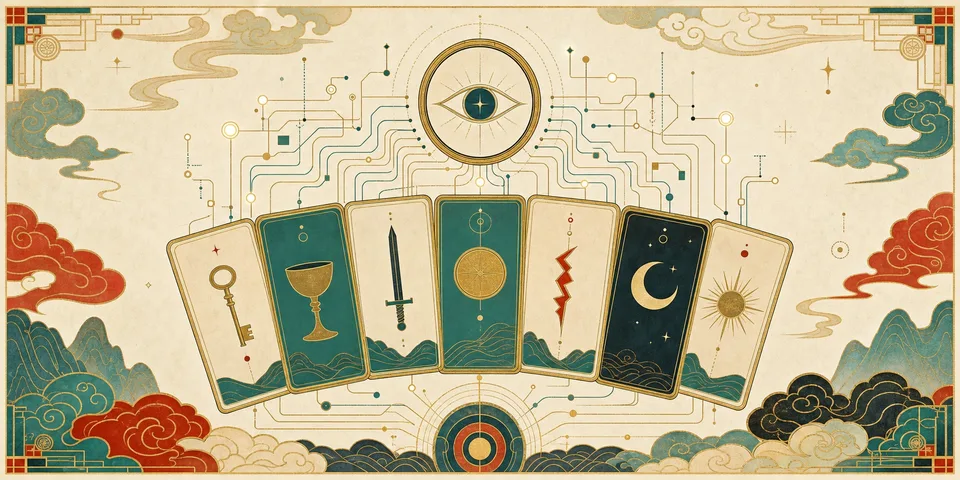
Tarot does not need to be a supernatural messaging system to be useful. The cards can be understood as a structured projection surface: a compact deck of archetypal prompts that lets the mind look at its own situation from angles it would not have chosen voluntarily.

The useful claim is not “the universe arranged the cards.” The useful claim is: randomness gives the mind permission to consider material its ordinary defenses would have filtered out.

Tarot is debugging for internal dialogue.

Chance of at Least 1 Ace with X Cards

  • 5 cards: 24%
  • 10 cards: 43%
  • 12 cards: 50%
  • 15 cards: 58%
  • 25 cards: 80%
  • 33 cards: 90%

Simple Picture

ELI5: when you are stuck inside a story, you keep asking the same question in the same way and getting the same answer. Tarot shuffles the question. Each card says, “try seeing it from this angle.” The value is not that the card knows the future. The value is that the card breaks the monopoly of your current interpretation.

The illusion of an external force can help because it lowers defensiveness. If a friend says “you are avoiding the obvious,” the laser of judgment burns. If a card says “The Hanged Man,” the same observation arrives indirectly. Judgment scatters into symbol, and symbol can illuminate without immediately triggering self-protection.

Archetypal Lenses

Every tarot card represents an idea, meme, role, tension, or recurring human situation. The deck is a compressed library of human patterns: beginnings, mastery, temptation, collapse, grief, patience, victory, attachment, judgment, renewal.

The cards act less like answers and more like lenses. A situation can be viewed through The Tower as breakdown, Temperance as integration, Seven of Cups as fantasy overload, Four of Pentacles as control, or The Hermit as deliberate withdrawal. None of these is “the truth.” Each is one facet of the elephant.

This is the blind men and the elephant move applied inward. A trapped mind usually grips one part of the situation and calls it the whole. Tarot forces facet rotation.

Our internal dialogue shapes temperament, passion, resilience, and outlook. The stories we tell ourselves become the operating system through which new events are interpreted. Tarot interrupts that operating system by introducing a symbolic prompt that was not generated by the current story.

Belief as Interface

Belief is not only a proposition about reality. It is an interface for interpreting raw data.

The same abstract painting can become “two people embracing” once the viewer believes the painter intended figures. The belief changes what the data affords. Likewise, a tarot reader’s value is not that they access hidden machinery in the cosmos. Their value is that they bring a belief system, symbolic vocabulary, and interpretive discipline strong enough to turn random cards into useful reflection.

This is why the trick shows up under many names:

In one circle it is chaos magick. In another it is marketing, advertising, ritual, therapy, or placebo.

The shared mechanism is belief-mediated reframing. A placebo can change pain because meaning changes physiology. Advertising can change desire because symbols reorganize attention. A ritual can change behavior because it gives the mind a transition object. Tarot sits in the same family: it uses symbol, randomness, and belief to alter the frame through which a person perceives their own situation.

This links to load-bearing-illusions. The point is not that every useful belief is literally true. The point is that some fictions are interfaces. They let a mind do work it could not do by direct command.

Why Randomness Helps

A stuck mind is not short on thoughts. It is short on surprise.

When a person is caught in depression, addiction, obsession, the need to win, or the need to prove themselves, the internal dialogue becomes repetitive. Each new fact is processed through the same story and returned as confirmation. This is trapped priors in symbolic form: the prior eats the data before the data can update it.

Random cards are useful because they are not optimized by the stuck prior. They are external enough to disrupt the loop, but ambiguous enough that the mind must participate in interpretation. That combination matters:

  • pure advice triggers resistance
  • pure randomness produces noise
  • symbolic randomness invites interpretation

The card does not tell you what is true. It forces you to reveal how you are making truth.

A Debugging Spread

The clean secular frame is to use tarot like a debugger stepping through a program:

Motive Facet Immediate Past Action Result Lesson Meta Lesson

Motive: what desire, fear, or hidden incentive is driving the situation?

Facet: what angle have I not been willing to consider?

Immediate Past: what recent pattern is still shaping the present?

Action: what concrete move is being invited or avoided?

Result: what outcome is likely if the pattern continues?

Lesson: what local update is this situation trying to teach?

Meta Lesson: what deeper belief, identity, or operating system is being debugged?

This spread avoids fortune-telling. It treats the draw as a structured inquiry into perception, motive, and next action. The question is not “what will happen?” but “what am I not seeing because my current story has become too familiar?”

The Developer Mind

Programming trains a person to surrender beliefs repeatedly. You believe the bug is in one place, then logs prove otherwise. You believe an abstraction is clean, then production traffic exposes the edge case. You believe you understand the domain, then the customer workflow quietly humiliates the model.

Good engineering requires ongoing belief revision under contact with reality. Tarot-for-hackers works because it formalizes the same humility at the level of the self. You do not possess a high ground from which to decree certainty. You are confronted daily by pressure to understand more than you currently understand.

The secular tarot posture is therefore not credulity. It is disciplined uncertainty.

Tarot is a way of practicing the constant realization that there are things you do not understand.

Common Misread

The dimwit take is “tarot predicts the future because magic.”

The midwit take is “tarot is fake, so only irrational people use it.”

The better take is that tarot is a symbolic cognition tool. It is useful when it loosens trapped-priors, surfaces hidden motives, expands the frame, and converts judgment into reflective distance. It is harmful when it replaces agency, outsources responsibility, or turns ambiguity into false certainty.

The test is pragmatic: after the reading, do you see more clearly, act more honestly, or hold the situation with more dimensions? If yes, the tool worked. If you merely feel mystified, special, doomed, or dependent on another draw, the tool has captured you.

Main Payoff

Tarot works without woo when treated as archetypal debugging. The deck is a set of symbolic probes. The shuffle supplies entropy. The spread supplies structure. The interpretation supplies belief-mediated reframing. Together they create a temporary interface through which the mind can examine its own stuck stories without meeting them as direct accusation.

The cards do not need to know anything. They need to make you notice what you already know but could not yet say.

Compact Card Keywords

Major Arcana

CardKeywords
0 The Fool 🌀beginning, risk, innocence, leap, open path
I The Magician ✨agency, tools, will, translation, skill
II The High Priestess 🌙intuition, silence, hidden knowledge, threshold
III The Empress 🌿fertility, embodiment, nurture, abundance
IV The Emperor 🏛️structure, authority, order, protection
V The Hierophant 🕯️tradition, teaching, institution, initiation
VI The Lovers 💞choice, union, values, attraction, alignment
VII The Chariot 🛞direction, discipline, drive, victory
VIII Strength 🦁courage, gentleness, integration, restraint
IX The Hermit 🏮solitude, study, inner light, withdrawal
X Wheel of Fortune 🎡cycles, chance, timing, reversal, flux
XI Justice ⚖️truth, consequence, balance, accountability
XII The Hanged Man 🙃pause, surrender, inversion, new perspective
XIII Death 🦋ending, release, transition, composting
XIV Temperance 🧪integration, moderation, blending, repair
XV The Devil ⛓️bondage, appetite, compulsion, false necessity
XVI The Tower ⚡collapse, revelation, rupture, liberation
XVII The Star ⭐hope, renewal, guidance, clean water
XVIII The Moon 🌫️dream, fear, ambiguity, subconscious
XIX The Sun ☀️clarity, vitality, joy, exposure
XX Judgment 📣reckoning, awakening, call, review
XXI The World 🌐completion, wholeness, integration, arrival

Wands

CardKeywords
Ace of Wands 🔥spark, desire, initiative, creative ignition
Two of Wands 🧭planning, horizon, ambition, strategic choice
Three of Wands 🚢expansion, waiting, export, future pull
Four of Wands 🎪celebration, homecoming, stability, shared joy
Five of Wands 🥊friction, contest, practice, energetic clash
Six of Wands 🏁recognition, victory, public confidence
Seven of Wands 🛡️defense, pressure, standing ground
Eight of Wands 🏹speed, messages, momentum, acceleration
Nine of Wands 🩹endurance, vigilance, guarded resilience
Ten of Wands 🧱burden, overcommitment, carrying too much
Page of Wands 🧨exploration, enthusiasm, experiment
Knight of Wands 🐎pursuit, heat, boldness, volatility
Queen of Wands 🐈charisma, warmth, confidence, magnetism
King of Wands 👑vision, leadership, command of fire

Cups

CardKeywords
Ace of Cups 💧opening, feeling, grace, emotional beginning
Two of Cups 🫂mutuality, bond, repair, meeting
Three of Cups 🥂friendship, celebration, belonging
Four of Cups 🫙dissatisfaction, refusal, inwardness
Five of Cups 🕳️grief, regret, fixation on loss
Six of Cups 🧸memory, childhood, sweetness, return
Seven of Cups 🫧fantasy, options, illusion, overwhelm
Eight of Cups 🌒departure, disillusionment, seeking depth
Nine of Cups 🍯satisfaction, wish, pleasure, fullness
Ten of Cups 🌈harmony, family, emotional completion
Page of Cups 🐟sensitivity, surprise, tender message
Knight of Cups 🛶romance, pursuit of feeling, idealism
Queen of Cups 🪞empathy, receptivity, emotional wisdom
King of Cups 🌊steadiness, compassion, mature feeling

Swords

CardKeywords
Ace of Swords 🗡️clarity, cut, truth, decisive thought
Two of Swords 🚪stalemate, blocked choice, guarded mind
Three of Swords 💔heartbreak, grief, clean pain
Four of Swords 🛏️rest, recovery, truce, mental stillness
Five of Swords 🧊conflict, hollow victory, bad faith
Six of Swords 🌉transition, passage, leaving turbulence
Seven of Swords 🕵️strategy, evasion, theft, hidden move
Eight of Swords 🪢constraint, helplessness, mental cage
Nine of Swords 🕯️anxiety, rumination, midnight mind
Ten of Swords 🪦ending, collapse, no-more-denial
Page of Swords 🔍curiosity, vigilance, sharp observation
Knight of Swords 🌪️attack, speed, argument, forceful mind
Queen of Swords 🪶discernment, boundaries, honest speech
King of Swords 🧠judgment, law, strategy, mental authority

Pentacles

CardKeywords
Ace of Pentacles 🌱seed, opportunity, material beginning
Two of Pentacles ⚙️juggling, adaptation, resource balance
Three of Pentacles 🛠️craft, collaboration, apprenticeship
Four of Pentacles 🔒control, holding, scarcity, possessiveness
Five of Pentacles ❄️hardship, exclusion, material fear
Six of Pentacles 🤲generosity, exchange, patronage, imbalance
Seven of Pentacles 🌾patience, investment, slow growth
Eight of Pentacles 🔨practice, skill, repetition, mastery
Nine of Pentacles 🪴independence, refinement, earned ease
Ten of Pentacles 🏡legacy, family, durable wealth
Page of Pentacles 📚study, opportunity, beginner discipline
Knight of Pentacles 🐢diligence, reliability, slow progress
Queen of Pentacles 🍞care, practicality, embodied security
King of Pentacles 🪙stewardship, resources, stability, provision

References: