A company can have more money, more talent and more process than you, and still be dead.
Picture a company that began with a founder who saw a need up close: customers she knew, a problem she had lived with, a product she could describe before it had a name. Twenty years later the company has far more money, smarter employees, better processes, and a dashboard for everything. Then the market shifts, the company does what it knows how to do, only harder, and a competitor with a tenth of its resources walks around it.
Why do richer, smarter, better-organized players lose this way? We usually judge a player by what it has: talent, capital, status. Samo Burja’s distinction between live and dead players looks at something else. A live player can do things it has not done before. A dead player is running a script. The difference is not intelligence, resources, morality, or status. It is whether the player can make a novel move when reality stops matching the inherited playbook.
Where the script comes from
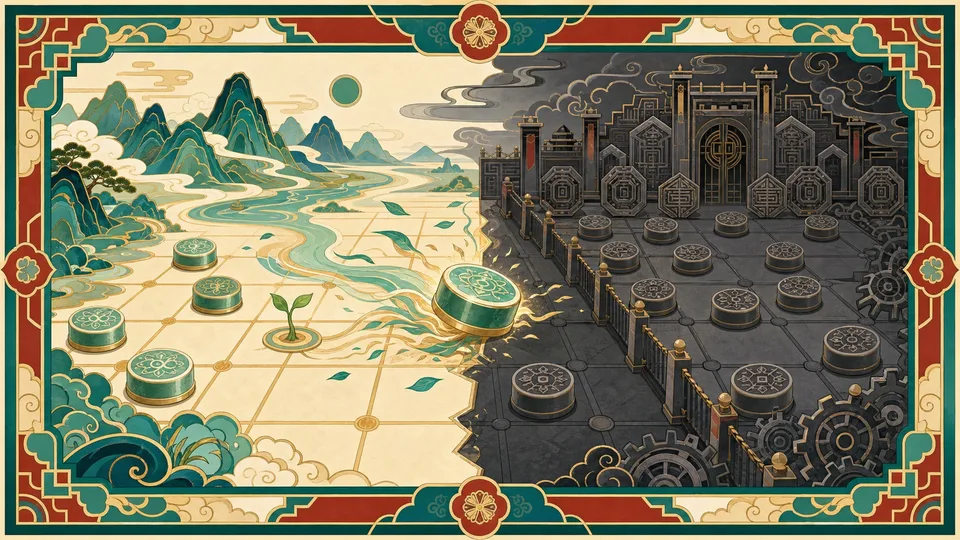
The founder was live because the company was born from her direct contact with a need. She was its source: she knew what the thing was for, so when circumstances changed she could ask the question again and get a new answer. Her successors inherited the artifact without the contact. They know the product, the metrics, and the precedents, but not the reality behind them. In the garden’s terms, a live player acts from contact with reality; a dead player acts from contact with representation. The live player updates from the world. The dead player updates from the dashboard, the precedent, the rulebook, and the performance of what someone in their role is supposed to do.
Liveness needs three things at once: reality contact, the ability to see what is happening without waiting for the official model to permit it; freedom of motion, enough autonomy and slack to act on what you see; and consequence ownership, the willingness to be revised by results instead of hiding inside process.
As the company grew, each of these came loose. Coordination moved into forms, committees, and incentives, which put layers between seeing and acting. The people closest to customers learned that reporting what they saw only created trouble, so feedback was filtered before it reached anyone who could act. And because every decision passed through process, nobody owned the result. None of this made the company idle; dead players are often busy and well-funded. Their deadness shows in what their actions depend on: precedent before acting, process in place of judgment, legible metrics treated as reality. They can optimize within a frame but cannot choose a new one.
When the script still works
That should make anyone wary of sneering at dead players. Scripts work when the world repeats, and in a stable market the dead company can dominate for decades, because its process is cheaper and more reliable than anyone’s judgment. The danger arrives when conditions shift and the dead player doubles down on the very moves whose success depended on the old environment.
Nor does liveness belong to founders or disrupters as a type, because liveness is not aesthetic novelty but consequence-bearing contact with reality. A founder can go dead once success hardens into self-imitation. A bureaucrat can be live if they preserve judgment under constraint.
So what do you do about the company? Arguing with its official self usually fails, because there is no one inside the role authorized to be surprised. The useful move is to find its live edge: the team that still ships, the operator who still owns consequences, the employee who still talks to customers and acts on what they hear. Whether you mean to rescue the company or bet against it, the question is not who is important. It is who can still do something they have not already been scripted to do?
References:
- Samo Burja, Great Founder Theory