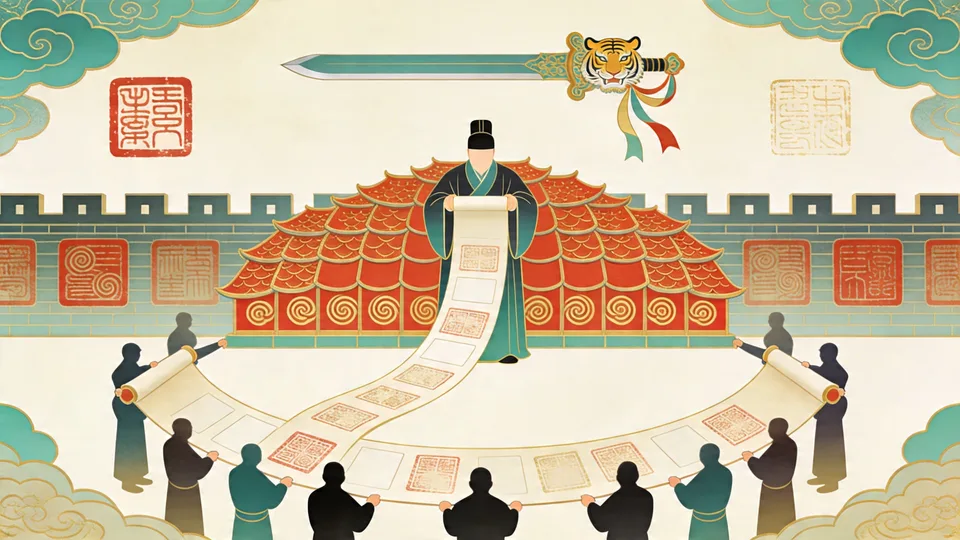
When failure costs more than success pays, the paper trail becomes the product.
An engineer spots a serious risk in a launch plan and writes a warning email. She copies twenty people: her manager, two directors, someone from legal, a VP. Nobody acts on it, the launch goes ahead, and three months later the risk lands. At the post-mortem her email is the most important document in the room, because it proves she said so, not because it changed anything. Twenty people saw the warning and none acted, so the fault lives in the network rather than in any one person. There is no single neck for the guillotine.
The usual reading is that this is fear or laziness, and that the cure is braver people or leaner process. But the engineer was neither lazy nor cowardly; she found the risk and said so in writing. So why do capable people in mature organizations end up putting more effort into the paper trail than into the work, and why does every campaign against it fail?
When losing costs more than winning pays
Every decision produces two outputs: the actual result, and a paper trail of who signed off on what. While an institution is expanding, resources are abundant and “move fast and break things” dominates, because the marginal value of a win outweighs the marginal cost of a failure. As it matures and hits saturation or stagnation, market reality caps the upside, while the downside of lawsuits, regulatory fines, PR disasters and talent flight becomes existential. Cover Your Ass is what an organization settles into once the cost of a mistake exceeds the reward for success. Its focus shifts from value creation to liability management.
Look at the engineer’s options under that payoff. Had she stopped the launch on her own authority and been right, she would have gained little, since averted disasters are invisible. Had she been wrong, she would have owned the failure alone. Even acting rightly, she would have threatened the hierarchy, because right action without sign-off is worse than wrong action with sign-off. The email was the correct move. The same arithmetic makes a dysfunctional product with a perfect audit trail strictly safer for the employee than a revolutionary product built through handshake deals and undocumented shortcuts. Over time the measure eats the thing it was meant to measure, and what gets optimized is traceability.
The familiar rituals follow from that. “Per my last email” does no informational work; it is a filing against a future blame event, and the correct reply is a paper trail of one’s own. Approval laundering, getting sign-off from a VP who has not read the document, gives the VP a feeling of power and the employee a get-out-of-jail-free card. Each exchange produces armor rather than decisions.
Why reform bounces off
Documentation is not worthless. Written decisions and tickets do keep projects honest, and the people who say process ensures quality are describing something real. The trouble starts when the trail stops serving the work and begins to replace it, and that shift is driven by the payoff, not by attitudes. CYA is not a cultural defect but a correctly-priced hedge in an organization where the payoff curve has gone asymmetric.
So culture work, process reform and pep talks miss. Streamline the approval flow and the engineer will still copy twenty people, because the copies were never about approval. CYA is the symptom of a problem no one will name: the organization has stopped being able to reward wins, and can only punish losses. Until that asymmetry changes, every intervention against defensive behavior will be correctly ignored by everyone below the executive layer. Reform from inside is also unlikely, because the people who would enact it are the ones whose survival depends on the current equilibrium.
That leaves a personal test: if you are spending more energy on the paper trail than on the work, you are already inside a dying institution. The engineer has run the numbers once and chosen the email. The next time she sees a risk, the question for her is no longer how to fix the place, but which kind of losing she prefers: optimize the trail and stay, or do the work and leave.
References: