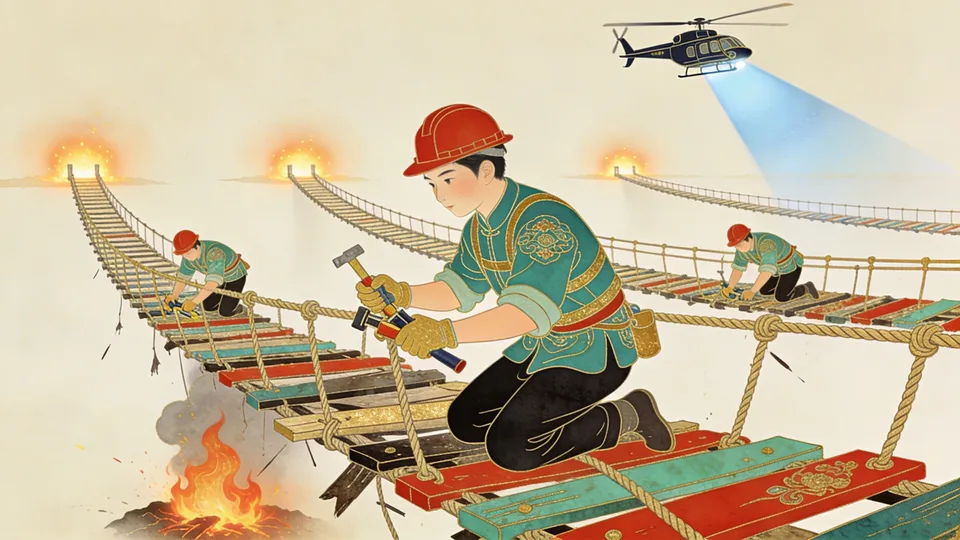
The company paid a fortune for an outsider to say what its own engineers had been saying for months.
Michael Allar made a living as an Unreal Engine “firefighter,” an outside engineer that game studios called in, at great expense, when a project was about to burn down. On almost every engagement, within moments of his arrival, every engineer was telling him everything that was wrong with management, the company, and the development process. The engineers had been trying to communicate these problems for months, and nobody above them had acted.
If the people closest to the work already knew what was wrong, why did the studio need to hire an outsider to find out? And why do the same kinds of companies call the same kinds of consultants for the same emergencies, year after year?
How juniors get locked in
The fire usually starts with a hiring shortcut. A team that cannot find or afford a senior engineer extracts senior-level work from juniors instead. The juniors build systems held together by rubber bands and chewing gum, tightly coupled and understood only by their creators. Each creator becomes the only person who can maintain what they built, so every system adds a permanent responsibility to someone already stretched, and a junior who spends their days keeping a fragile system alive never gets the exposure that would make them the senior the team lacks.
With ten or twenty systems built this way, the project depends on every engineer at once, since anyone who leaves takes their piece with them. Eventually a critical issue surfaces too late to fix internally, the firefighter is called, and afterward the team hires new juniors and starts again. The organization destroys its own capacity to produce the thing it most desperately lacks.
The fires themselves are often trivial. At one client, temporary cache files tracked in source control and distributed to the team caused the game engine to skip audio generation, breaking all the audio. Any senior engineer would have fixed it on sight. Without one, it caused months of finger-pointing, potential lawsuits, and a hostile work culture. The cost of not having the role always exceeds the cost of paying for it.
Why nobody fixes it
That explains the fires, but not why the engineers’ warnings never prevented them. At another studio, the producer had no engineering knowledge and kept assigning tickets to the wrong specialists, gameplay fixes to network engineers and rendering tasks to gameplay engineers. Every engineer had raised it, and every report was ignored. One network engineer spent three months learning animation graphs because that was what the ticket said: a way to improve themselves without improving the company.
What follows is Albert Hirschman’s sequence from Exit, Voice, and Loyalty. Engineers try voice first, and when every report turns into zero action, they settle into “clock in, clock out, it’s not my problem.” That is how the enthusiastic company-first worker converts into the disengaged clock-puncher, out of rational despair rather than laziness. Then comes exit. When Allar laid the ticket problem out for upper management, their first question was, “Who is giving up this information?” They wanted to punish the feedback rather than fix the problem. He was dismissed. A month later the engineering team had gone from seven people to two, and a month after that to zero. The company hired all new juniors.
So “hire better engineers” misses that these juniors were set up to fail, and “pay down the technical debt” misses why the debt keeps accumulating. The trap is an organizational feedback failure: no senior was present to prevent the bad systems, and the warnings that might have stood in for one had nowhere to go.
To be fair to management, the original choice looks sensible from inside: seniors are scarce and expensive, juniors are available, and the project runs fine for months. But the bet pays off only if no trivial mistake cascades, and the cache files show how fragile that assumption is.
The way out requires two things these organizations are structurally bad at: listening to juniors and investing in growth before the fire starts. Both pay off invisibly, since a leader must be technical enough to appreciate the problems that didn’t happen, while the rescue is visible and dramatic. The engineers who greeted the firefighter with their list of problems were offering the cheapest fix the company would ever get. The companies that most need to take it are the least able to, because their budget is going to firefighters.
References:
- Michael Allar, Confessions of an Unreal Engine 4 Engineering Firefighter