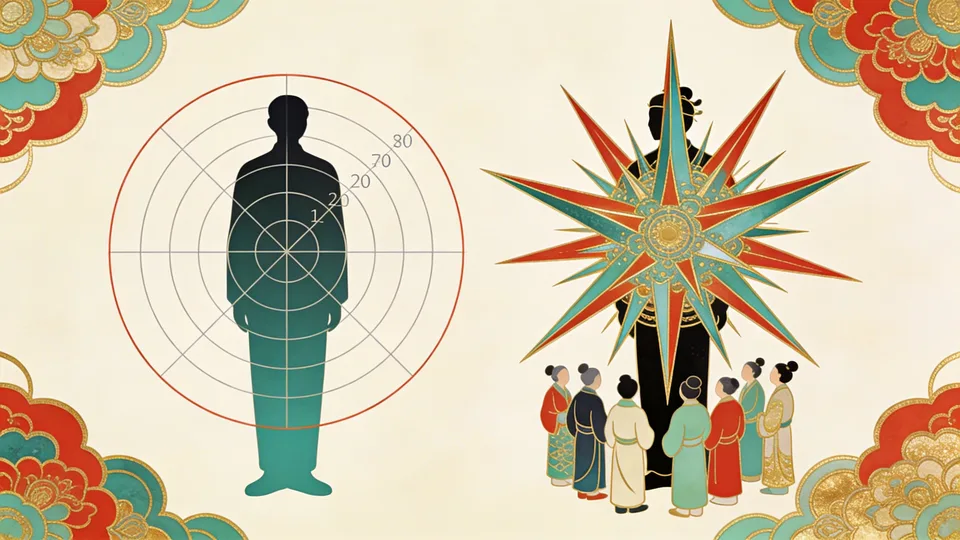
Your performance rating says more about your manager than it does about you.
Picture the annual review. Five colleagues have rated you on a list of competencies, the averaged scores show two “development areas,” and the plan is to fix them. Every part of it is designed to be objective. Marcus Buckingham and Ashley Goodall argue in Nine Lies About Work that almost every assumption behind it is false, because it treats people as instances of an average, to be measured against a standard and corrected toward it.
What a rating measures
Each of those five raters has an idiosyncratic pattern, some generous and some harsh, so a rating says at least as much about the rater as about you. Noise plus noise never equals signal. The authors’ fix is to stop asking people to judge qualities in someone else, which they can’t do reliably, and ask how they themselves react to that person. “Would you promote this person today?” tells you more than any 360-degree assessment, because it is a question the rater can answer truthfully. The pursuit of objectivity is the bug, and reliable subjectivity the feature.
When someone asks “where do I stand?” they are not asking for a generic rating. They are asking “where do I stand with you?” The first question you are unqualified to answer. To the second, your truth is unimpeachable.
The limit is that this leans entirely on the team leader: a manager who pays no attention can answer “would you promote her?” honestly and still be wrong about her.
Spiky people
Now the two “development areas.” The review assumes the ideal employee is well rounded, but the best people are spiky, and the spikes are where the value is. A strength is not something you’re good at. A true strength is something that energizes you. It is far more appetite than ability. Lionel Messi kicks almost solely with his left foot, and that made him one of the best rather than a predictable one. The same logic reframes work-life balance, because the question is less how many hours than which activities feed you and which drain you: What we all wrestle with every day is not work and life but love and loathe. You are at your healthiest when your contribution leaves you with more energy, not less.
Spikes need somewhere to fit, which is why people care which team they’re on more than which company. Culture demands conformity; a team can arrange itself around the particular people in it. The essential magic of a team is that it makes weirdness useful. This is the scale at which work and belonging actually happen.
Attention instead of feedback
If ratings are noise and weaknesses the wrong target, what should a manager give people? We aren’t looking for feedback. We’re looking for an audience. That is the real lesson of the Hawthorne effect: the workers responded to attention and caring, not to the lighting conditions.
Recognition is not just praise. To re-cognize a person is to spot something valuable in them and then to ask about it, an ongoing effort to learn who she is when at her best. It is close to what Carl Rogers meant by attending to a person rather than evaluating one. If you see somebody doing something that really works, stopping them and replaying it to them is arguably your highest-priority interrupt.
Attention also has to be frequent and come with information, since leaders who hoard context get compliance, not judgment. Trust can never emerge from secrecy. Frequency creates safety. A weekly conversation does more than any annual form, because it is where the manager learns who the person is.
The book turns the same lens on leaders, since nobody follows a competency model. Leadership is not a thing — it cannot be measured in the abstract. The only determinant of whether anyone is leading is whether anyone else is following. People follow spikes, which leaves the uncomfortable question for anyone holding the review form: are you measuring the people on your team, or paying attention to them?
References:
- Marcus Buckingham and Ashley Goodall, Nine Lies About Work: A Freethinking Leader’s Guide to the Real World