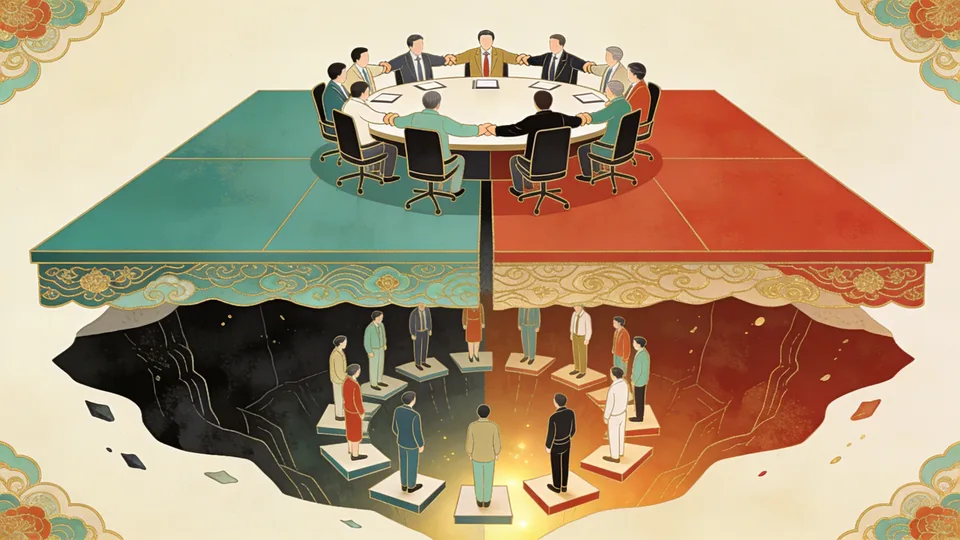
Your old boss and your next boss work at rival companies, and they’re on the same side.
Ask what fascism is and most people reach for nationalism, racism or the far right. Michael O. Church argues those are symptoms rather than the disease. The disease itself fits in one sentence:
Fascism encourages power to congeal while the people are divided against each other.
The inverse of democracy
Democracy establishes competition for and within power to prevent unaccountable monopolies. Citizens cooperate toward shared goals such as roads, a fair legal environment and peace, while those who hold power must compete. An election is a nonviolent revolution: the loser leaves, and everyone learns something about the will of the people.
Fascism reverses both flows. The people are put into endless competition for jobs, status and survival, while power colludes. Elites still fight each other, but it must happen in secret, behind a social barrier, because the low must never see the reticence or in-fighting among the high.
That arrangement is unstable. People won’t tolerate endless competition unless certain conditions are imposed. Fear of a made-up enemy works for a while: bordering nations and ethnic minorities can be demonized, and walls that serve no purpose can be built. When people wise up, the endgame is a story of national or racial superiority, which might persuade them to tolerate authoritarianism at home in exchange for conquest abroad. That is why nationalism and racism show up so reliably: they are symptoms the disease needs.
The office version
Church’s sharpest case is the workplace. Suppose you once said something critical about a manager at Google. Two years later you apply to an investment bank. Why would a manager at an investment bank care? There is no connection between investment banking and web search. Yet the reference check works against you, because a manager will take the word of a manager at a competing company over the account of the person who lived through it. The companies compete; their managers protect each other.
The same logic explains the rule that you must never bad-mouth a former employer. One disgruntled employee telling the truth does almost no damage to a company. The rule exists because the fascist element believes that even the most harmless dissent must be punished, so that the unified front of management never visibly cracks.
It also explains which managers get promoted. Fascism has no hatred for what is female, yet it seeks to obliterate what it perceives as feminine. It crushes whatever it reads as weak: the vulnerable, cautious, artistic, spontaneous or nurturing. So managers who invest in mentorship and employee development get derided for doing “female work” or “womanaging,” while abusive “tough” managers rise.
Put together, these destroy every way the system could learn. In Hirschman’s terms (Exit, Voice, and Loyalty), voice is punished, exit is controlled because references follow you across companies, and loyalty is coerced rather than earned.
Is this hyperbole?
The strongest objection is that calling a company fascist cheapens the word. Nobody is jailed for a bad reference, and you can always quit. That is true, and the difference in stakes is enormous. But fascism is a structural pattern, not a historical period. The question is whether power congeals while the people are divided, whether dissent is punished, and whether the powerful protect their own across institutional lines. A system can show that pattern without anyone wearing a uniform.
Church’s verdict on Google: dissent there is valued insofar as it is ineffectual. When it has effects and executives take notice, the person gets fired. Managers rarely know the difference between low and high performers. They fire whoever costs them time.
The question is not whether it can happen here. The question is whether it already has, and you simply work there.
References:
- Michael O. Church, Fascism, and What I Learned by Struggling Against It