A year of hitting every goal can leave you less alive than when you started.
Most self-improvement plans are written by a younger version of you. At twenty-five you decide what growth will look like: a promotion, a marathon, a reading list. Then you spend years closing the gap between the person you are and the person you imagined, and you measure your seriousness by how much the closing hurts. If it hurts, you must be trying. If it feels easy, you must be slacking.
What if the pain is telling you something else? Venkatesh Rao argues that nothing is as self-limiting as a fixed idea of “growth” imagined by a younger you. Life is not a self-improvement project. It is a series of challenges to meet with creativity.
Two kinds of burnout
Internal burnout is when you accumulate an interestingness debt: you do what is necessary to live, and it slowly drains your will to live at all. External burnout is the mirror image, a survivability debt: you do what is necessary to stay interested in living, and it slowly drains your ability to stay alive at all.
Most people only recognize the external kind, the frantic overwork that crashes the body. Internal burnout is quieter. Years of doing things that function but do not engage produce a low-grade deadness, and because the person keeps hitting targets, they look fine from outside while the will to live leaks away inside. That is why pain is such a bad gauge. Making enduring pain your indicator of serious effort is the masochism that pain as organizing principle warns against: if “constant pain” is your sign of trying hard enough, you are doing it wrong.
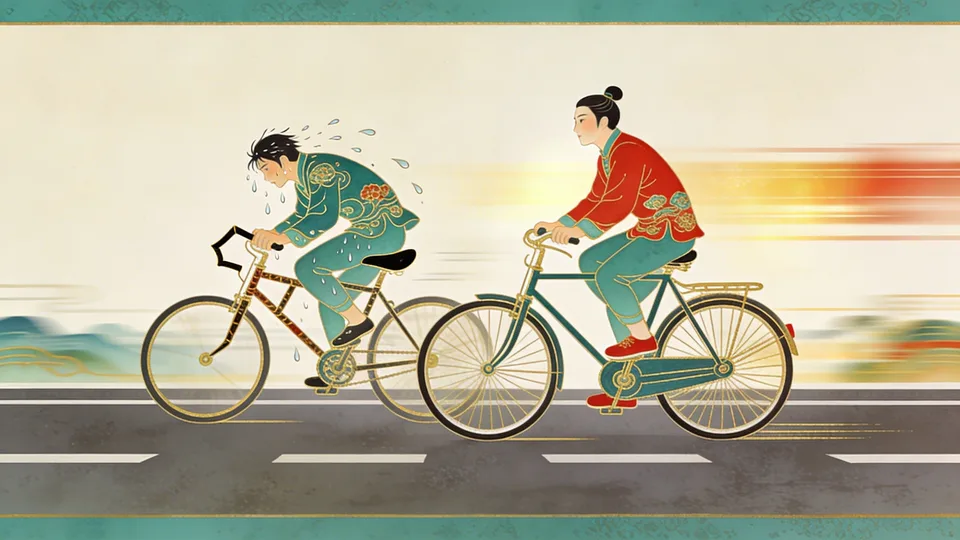
Think of it as finding the right bicycle. On the wrong one no amount of pedaling helps: every mile is exhausting and the scenery is ugly. On the right one you forget you are pedaling. A year spent searching for the right bicycle is not wasted if in a few sacred weeks you tasted the effortless joy of finally riding it. So judge your year not by your perfection score but by how often you found yourself effortlessly lost in the right thing.
Why serious people can’t play
The obvious remedy is to play more, and the people who most need it often can’t. Among entrepreneurs, one difference between the curious and the median is that median entrepreneurs literally do not know how to play. The only way they know to “play” is in an intense, hyper-competitive way that is “training” or “skills acquisition” for “real” life. Keith Johnstone, in Impro, traces the habit to school, which taught them that the first thought must be rejected for a “better” one, so they grow into adults who cannot accept anything without evaluating it first.
Real play works differently. Play is significance alchemy: it transforms the meaningless into the meaningful, not by adding meaning from outside but by engaging with full attention. Seen this way, the distinction between play and work is the symptom, not the disease. When work requires constant willpower, the direction is wrong. When play produces effortless output, the direction is right. The point is not to avoid effort but to find the effort that does not feel like effort.
The price of changing direction
None of this is free, and the cost is the best reason people stay on the wrong bicycle. To experiment on yourself is to be open to changing in unscripted ways, and your social world changes with you. You may come to despise old friends and admire people you once despised. You will have to repeatedly overcome the fear of being an outcast, and resist the seduction of false promises of communal belonging. You will hurt others despite your best efforts to be gentle, and be hurt despite your best efforts to be stoic.
Past a certain point, then, the path to wisdom is paved with acceptance, not ambition. The practical advice is plain: do whatever most energizes you, produce a lot of output, and let the work and opportunities find you, because chance favors the mind seeking different, not just more. The plan written at twenty-five asked how to grow. The question that replaces it has no plan attached: “what do I do with the unexpected person I find I have turned into?”
References:
- Venkatesh Rao, various essays on Breaking Smart and Ribbonfarm