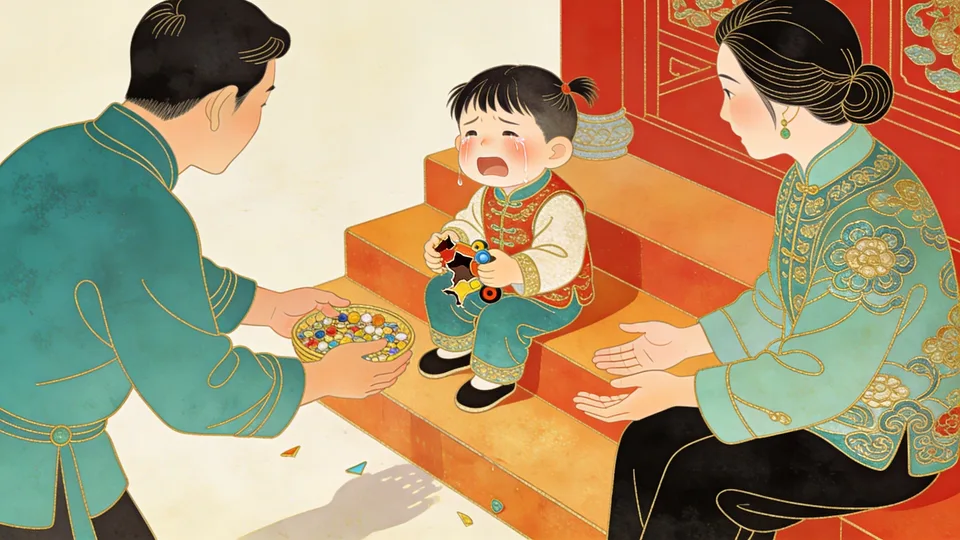
A child takes no for the toy better once someone admits how badly he wants it.
A child in a shop wants a toy, hears no, and starts to cry. The parent’s instincts all sound reasonable: “You have plenty of toys.” “Don’t cry, it’s not a big deal.” Each one tries to fix, shrink or explain away the feeling, and each one tends to make the crying worse.
Adele Faber and Elaine Mazlish start from a parent noticing what those responses add up to: Not only were all our conversations turning into arguments, I was also telling my children over and over again not to trust their own perceptions but to rely on mine instead. “It’s not a big deal” tells the child his feeling is wrong, and he hears that he is wrong for having it. So why does the sensible answer backfire?
Acknowledge, don’t agree
Children don’t need to have their feelings agreed with; they need to have them acknowledged. The parent doesn’t have to think the toy matters. It is enough to say, “You really wanted that one.” The child’s experience has been seen, so he no longer has to prove it by crying harder.
The more you try to push a child’s unhappy feelings away, the more he becomes stuck in them. The more comfortably you can accept the bad feelings, the easier it is for kids to let go of them. This is Rogers’ acceptance turned into a sentence at the shop counter. When it is missing, a child who is repeatedly told his feelings are mistaken learns to stop bringing them to you, and eventually to stop trusting them at all.
Entitled to be miserable
Some of the pressure comes from the parent’s own distress. A mother who suffers over her child’s suffering creates a double bind: the child is upset about the toy, then more upset because she is upset, and he feels guilty for not being happy, as if there was something wrong with him for having feelings. One mother in the book puts the alternative plainly:
I want my kids to know that they’re entitled to be miserable without their mother falling apart.
If you want to have a happy family, you had better be prepared to permit the expression of a lot of unhappiness.
Feelings and limits
The obvious objection is that this is permissive parenting that will produce entitled children. But acknowledging the wish doesn’t mean buying the toy. The book’s finding runs the other way: When we accepted our children’s feelings, they were more able to accept the limits we set for them. So acknowledging feelings and setting limits are not in tension — they are complementary. “You really wanted that toy, and we’re not buying it today” gives the child both: his desire is real, and so is the limit.
In one of the book’s examples, a parent wrote the item a child wanted on a “wish list.” Even though the child knew it was not going to happen, he seemed to appreciate that his longing was taken so seriously. A child, it turns out, can give up the toy more easily than he can give up being heard, which raises the question of how many adult arguments are really about the second thing.
References:
- Adele Faber and Elaine Mazlish, How to Talk So Kids Will Listen & Listen So Kids Will Talk