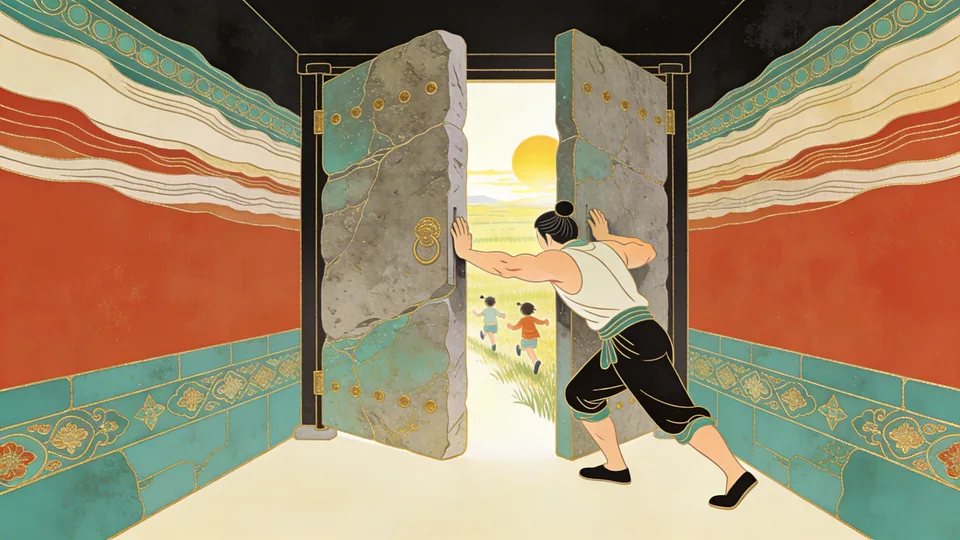
Nobody in particular holds the gate shut. That is why it is so heavy.
Burdened as a man may be with the weight of tradition, he can yet prop open the gate of darkness with his shoulder to let the children through to the bright, wide-open spaces, to lead happy lives henceforward as rational human beings. — Lu Xun, “What is Required of Us as Fathers Now” (1919)
The traditional answer to what a parent owes a child ran the other way: parents give life and sacrifice, and children spend their lives repaying the debt. In 1919 Lu Xun asked what fathers owed instead, and answered with the image above: a father who cannot dismantle the corridor of tradition or lighten its weight, but can brace his shoulder against the gate long enough for his children to pass into the light. The gate does not stay open. It closes behind them. But they are through.
Why can’t an awakened father simply tear the corridor down?
Nobody holds it shut
Lu Xun’s answer came a year earlier, in an essay interrogating female chastity. Is the virtue painful? Extremely painful. Do women desire it? They do not. Everyone fears it will attach to themselves or their family. Does it benefit anyone? It benefits neither self nor others. Then why does it persist?
Because principles vaguely transmitted by the majority of ancient people, however unreasonable, carry the power of history and numbers, and they use it to crush whoever displeases them.
In these anonymous, unconscious murderous hordes, countless people have perished throughout history. — Lu Xun, “My View on Chastity” (1918)
No single person enforces the tradition, which makes it harder to resist than any tyrant. You can argue with a tyrant. You cannot argue with history or negotiate with numbers. Each generation adds weight to the gate. The ten commandments of Chinese harmony work this way: honor your parents, endure hardship, continue the family each look reasonable alone, and together they devour individuality and call it love.
Reproduction is no favor
To hold the gate, the father also has to give up the claim that made the old arrangement feel just, and Lu Xun cuts it at the root. Eating nourishes you, and you owe yourself no gratitude for it. Reproduction produces children, and it is no favor done to the children either. Parent and child walk the same long road of life, differing only in sequence, so a parent who demands repayment for the child’s existence is indistinguishable from a thief who made his fortune with stolen money and now demands respect.
What the father owes instead, Lu Xun reduces to three duties, in order. Understand: a child’s world is fundamentally different from an adult’s. Guide: elders should be counselors, not commanders, and should not demand that the young support them. Their task is to give the young strength, morality and a free spirit — the power to swim in the world’s new currents without being submerged. Liberate: children are both me and not-me. Because they are me, the parent owes them the ability to stand on their own. Because they are not-me, the parent releases them completely, giving them entirely to themselves.
What goes through the gate
The easy reading is “reject everything old,” but the father in the corridor is made of the tradition too. Lu Xun’s image points somewhere harder: tradition is not a single thing to accept or reject but a gate that must be held open. Some of what passes through is wisdom worth keeping. Much of it is accumulated weight that crushes the living to honor the dead. The father cannot tear the gate down, but he decides what the children carry through it.
That is why, for Lu Xun, the revolution had to reach even the fathers. A parent who has not sorted what is alive in his inheritance from what is dead weight becomes part of the gate. A century later the question still stands: which of your certainties about your children is wisdom, and which is only the weight you were handed?
References:
- Lu Xun (鲁迅), “My View on Chastity” (我之节烈观, 1918)
- Lu Xun, “What is Required of Us as Fathers Now” (我们现在怎样做父亲, 1919)