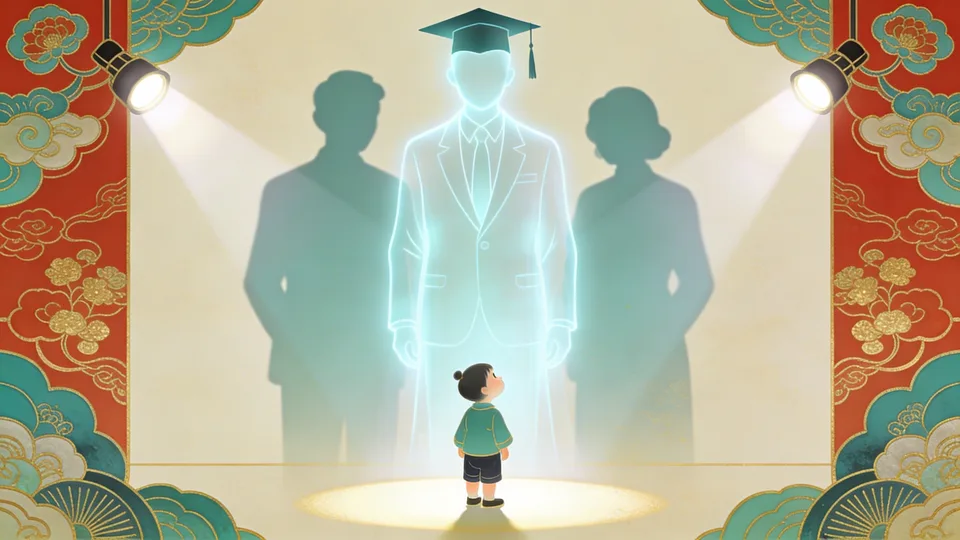
The hardest sibling to compete with is the one your parents imagined.
“We ate scraps so you could learn piano.” Picture an only child hearing that at fourteen. What is she supposed to say back? She can’t argue, because the scraps were real. The usual reading is that these parents are strict, and that better parenting technique would fix it. But the pressure doesn’t come from a technique. It comes from the shape of the family.
In a family with several children, the Identified Patient dynamic has somewhere to land: one sibling becomes the problem and another the success. In a single-child family there is no sibling to triangulate against, so the parents triangulate the child against a phantom: the Child’s Future Potential. The triad becomes Mother, Child and the Gaokao, or the Ivy League admission, or the lucrative marriage. The child is not antagonized for who they are, but for the terrifying possibility that they might fail to become the phantom. She is fighting a ghost with the full backing of the state, the culture and the bloodline: a better version of herself, with the career and spouse that would justify her parents’ sacrifice. She can’t kill it, because her parents built it, and she can’t become it, because every achievement moves the goalposts. She can only perform an increasingly elaborate impersonation while the real self retreats further inside.
The invoice
Whatever love sits inside the sentence about the scraps, it also works as an irrefutable invoice. The unspoken rule is that the child’s life is a crowdsourced asset, and the shareholders expect a return. Every meal skipped goes into a ledger the child can never repay, because repayment is not the point. The debt makes rebellion impossible: you cannot reject the expectations of someone who visibly suffered to give them to you. This is the gratitude-as-guilt commandment of the harmony machine, and it works because an unpayable debt produces permanent compliance.
The system’s operating fiction is “Everything we do is for your own good” (都是为你好), and the parents mostly believe it. Their blind spot is that they cannot tell the child’s wellbeing apart from their own terror of social obsolescence. Their fear of poverty and their need for status get laundered through the language of care and handed to the child as love. The system genuinely believes its control is protection, and it is blind to the fact that it is cannibalizing the child’s psychological future to subsidize the parents’ emotional present.
Why she can’t be weak
The single-child structure also removes every safety valve that might limit the pressure. In a multi-child family the shadow can be spread across siblings: one carries the failure, one carries the success. In the 4-2-1 structure, one child carries everything: every fear, every aspiration, every unprocessed wound from two parents and four grandparents. If that child fails, gets sick or dies (the 失独家庭, or Shidu families, are those who lost theirs), the whole structure collapses into a black hole of meaningless despair.
The child knows this intuitively, so she is not allowed to be weak. Her suffering is an unacceptable risk to the system, which denies it until catastrophic failure. She is monitored constantly, but for performance rather than for pain, so she is seen constantly and known never. Her parents were looking at the phantom the whole time.
Because she cannot rebel openly without destroying her parents, and therefore herself, she survives by building a hyper-compliant False Self to carry out the family’s directives, while the True Self retreats into an exile so deep that she loses contact with it. The weight is not survivable in its original form, so the child restructures her psyche to bear it. The False Self is not a flaw; it is an engineering solution to an impossible load.
The adult who can’t say what she wants
In adulthood the result looks like massive external success alongside profound emptiness and a persistent sense of fraudulence. Above all she cannot identify her own desires. She was never asked what she wanted, only told what she should want, and her parents did more than forbid her joy: they vetoed the faculty that produced it. The crisis often arrives with a move to a culture that rewards individual desire, where “what do you want?”, which should be the simplest question in the world, produces paralysis.
Recovery begins with telling the invoice apart from the love, because both exist. The sacrifice and the love were real, and so was the consumption: the system ate the child’s autonomy and called it care. The hardest part is not rejecting the phantom but grieving it, accepting that the person her parents needed was never a person at all, only a container for their fear. Then comes the terrifying work of discovering what she wants for the first time, with no template and no permission.
Later she faces a second decision, the mirror of the first: whether to build a phantom of her own. The bloodline ends describes one answer, recognizing the trap from above and declining to hand it to a child who cannot refuse it. Whether a child can be raised by such a parent without a ghost beside it is the question that refusal leaves open.