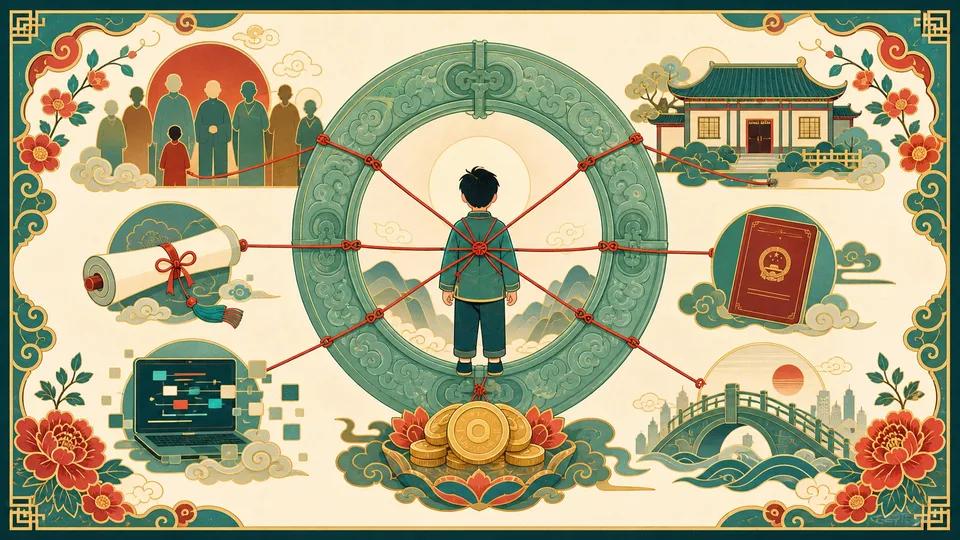
In many Chinese families, the child becomes the family’s concentrated long-duration asset: pension, status vehicle, migration option, marriage-market instrument, and proof that parental sacrifice “meant something.”
This does not mean Chinese parents do not love their children. Often they love intensely. The corruption begins when love is bundled with a claim: I suffered for you, therefore I own part of your future. That is where love curdles into debt.
Simple Picture
Healthy parental investment says:
I invest in you so you have more freedom.
Corrupted parental investment says:
I invested in you, therefore you must become the asset I imagined.
The second version is not merely strict parenting. It is a household balance sheet wearing the face of love.
The Family Balance Sheet
In Chinese family life, old-age support, filial obligation, emotional intimacy, housing, education, and status are not cleanly separated. The family is not only a love unit. It is also a private welfare state.
That makes the child financially and symbolically load-bearing. In a one-child structure, the load stops being diversified across siblings. One child carries parents, grandparents, inheritance, elder care, face, lineage, and sometimes migration optionality. This is the phantom child trap with a balance sheet attached: the real child is compared against a future-bearing ideal self who can redeem everyone else’s fear.
Striver Curse names the personality residue of this balance sheet: the child internalizes the exam-and-status machine so deeply that even after becoming safe, credentialed, or rich, they cannot metabolize winning into safety.
Your “failed diversification” frame is the cleanest version. When parents do not trust pensions, stocks, property, the job market, the state, or their own old-age security, they allocate to the one asset they can morally justify buying: the child’s future. Education becomes capital-as-time converted into filial promise. Human capital becomes retirement planning. Love becomes leverage.
The Future-Sorting Machine generalizes this beyond the Chinese household: once elite careers and asset ownership monopolize what counts as “the future,” the child must be pre-sorted into those tracks before reproduction feels morally defensible. The family balance sheet becomes a civilizational audit.
Beautiful Violence names the psychological charge underneath that audit: the child is beautiful because the child lets the family imagine a future in which sacrifice becomes meaningful. When the child refuses or fails that future, the reaction is not sized to the event. It is sized to the collapse of the promise.
The parent is not simply asking, “What is this child suited for?” The parent is often asking:
- What path is legible enough that relatives cannot criticize it?
- What credential preserves family status?
- What career lowers old-age risk?
- What migration route keeps an escape hatch open?
- What outcome proves our sacrifice was not wasted?
These are understandable questions. They are also not the same as seeing the child.
Risk Transfer
The household is trying to solve a real asset-liability mismatch. The liabilities are old age, medical bills, housing, family face, and the fear of downward mobility. The assets are savings, property, credentials, guanxi, and children. When the formal assets look fragile, the child absorbs the residual risk.
That makes the family a tiny risk warehouse. The parents warehouse market risk, policy risk, migration risk, and elder-care risk inside a moral contract. But unlike a financial warehouse, the contract has no clean price discovery. Nobody can say, “This much tuition bought this much claim on the child’s future, and no more.” So the price is set emotionally, after the fact, by guilt.
This is where the system becomes non-ergodic. A family can survive one bad stock, one bad apartment, one bad job market. But in the one-child version, a bad child-career fit can become an absorbing state: the family cannot diversify around it, and the child cannot simply walk away without being treated as the asset that defaulted. ergodicity is not an abstract market concept here. It is the difference between a failed bet and a failed life.
Legibility Beats Fit
In a high-mianzi environment, fit is private information and legibility is public insurance. The child’s actual temperament is hard to explain at dinner. A foreign degree, a CS job, a civil-service post, a medical title, or a house is socially auditable. Everyone knows how to score it.
So parents often choose the path that minimizes criticism from the audience, not the path that maximizes aliveness in the child. This is legibility-and-power inside the family: the visible metric captures the invisible person. Once the family has committed to a legible track, deviation becomes not exploration but evidence that the child is making the family unreadable.
The desired behavioral product is the smooth child: talented enough to appreciate, compliant enough to allocate, and quiet enough that the family never has to negotiate with a private desire.
CS Abroad
Computer science abroad is the perfect fantasy asset because it appears to convert every anxious input into every desired output:
Chinese savings or property capital → foreign degree → foreign salary → visa or PR option → family face → old-age security → proof the sacrifice was worth it.
It is not just a major. It is a synthetic household product.
That is why mismatch produces such violence. If the child is not suited to CS, the parents do not experience a normal problem of fit. They experience a balance-sheet crisis, a migration-option crisis, and a narrative crisis. Admitting “we made a bad concentrated bet” would mean marking down years of sacrifice, status planning, and parental identity.
So the loss gets moralized. The child is not mismatched; the child is lazy. Not poorly fitted; weak. Not trapped in a bad allocation; ungrateful. Market risk gets reclassified as filial failure.
This is stories-as-assets at family scale. The story of the child’s future creates the spending, discipline, tutoring, housing, and immigration choices that make the story look inevitable. When the story breaks, the family needs cooling, but there is no socially acceptable way to say, “Our beloved asset underperformed.” So the failure is transferred into the child’s character.
The child bears the basis risk. The family bought “CS abroad” as if it were a stable instrument, but what actually arrived was a particular nervous system, in a particular labor market, under a particular visa regime, with particular aptitudes and limits. When those do not line up, the mismatch is real. Calling it laziness is just refusing to mark the position to market.
When mismatch is recoded as mental defect and the family can purchase an institution to enforce that accounting, the balance sheet becomes a purchased exorcism: the child is treated so the investment thesis never has to be revised.
The Carrying Cost Children Feel
The cruelest version of the investment structure is not open coercion. It is concealed misery.
Parents go to absurd lengths to give their children advantages in stupid games: school districts, tutoring, enrichment, application polishing, résumé padding, social comparison, credential ladders. They exhaust themselves buying optionality for the child, then try to hide the exhaustion under a perverted idea of selflessness: do not let the child know how much we sacrificed.
But children are not fooled by the performance of okayness. They may not understand mortgages, immigration, school rankings, elder care, or the parent’s private fear of status collapse. They do understand faces, tone, withdrawal, resentment, sighs, impatience, and the deadness in the room. They know enough to understand that the parent’s misery is somehow related to them.
The parental-burnout literature makes this explicit. Dubois, Mallien, Lahaye, and Aujoulat interviewed children of exhausted parents and found that children noticed parental burnout through bodily and emotional signs even when they lacked adult language for it. Some children pointed to themselves or their own behavior as possible causes of the exhaustion. Many responded by becoming quiet, staying out of the way, helping with siblings, or trying to make the parent happy again. A separate WSU study on parental emotion suppression found the same general shape at the physiological level: trying to hide stress from children does not make the stress disappear from the dyad; children can still pick it up, and suppression can increase stress transmission.
This is the hidden invoice written into the child’s nervous system: my advantages are making my parents suffer. The parent thinks silence protects the child from guilt. Often it does the opposite. Silence gives the child no clean explanation, so the child supplies one from the only causal map available: me.
The result is a child who experiences parental investment as contaminated care. The tutor is not just a tutor. The piano lesson is not just a lesson. The school application is not just an application. Each advantage arrives with ambient evidence that the parent is being consumed by the process. The child learns that receiving is dangerous because receiving creates suffering in the giver. Later, this becomes the adult who cannot enjoy support without feeling indebted, cannot rest without feeling parasitic, and cannot distinguish gratitude from guilt.
Local Variants
The same structure appears across Chinese society:
- The education arms race trains the child like an exam asset.
- 学区房 turns school-district housing into an education derivative.
- Marriage housing makes parental property wealth a marriage-market signal, especially for sons.
- Career funneling pushes civil service, medicine, finance, computer science, state-owned enterprises, and other socially auditable paths as low-variance assets.
- Overseas education bundles prestige, capital mobility, safety, and migration optionality into one morally legitimate channel.
- Filial elder care wraps an intergenerational transfer system in the language of virtue.
Each move is locally-optimal. Each solves a real risk. Together they produce a machine where the child is loved as a person and managed as a portfolio.
The psychological exhaust is emotional neglect in its most confusing form: the parents are hyper-present around performance and absent around personhood. The child is not ignored. They are monitored, financed, corrected, and strategized around. They are seen constantly as a position on the family balance sheet and rarely as a living center of experience.
Dimwit / Midwit / Highwit
The dimwit take is “Chinese parents are selfish and greedy.”
Wrong. Many are loving, terrified, and sacrificial inside a harsh status machine.
The midwit take is “It is just Confucian filial piety and family love.”
Also incomplete. That ignores pensions, property, visas, hukou, tutoring markets, elder care, gendered marriage pressure, one-child demography, and mianzi.
The highwit take is that Chinese family love often operates through an implicit household survival contract. The parent is simultaneously mother or father, investor, risk manager, pension planner, immigration strategist, and status-defense lawyer. The child is simultaneously beloved person and future-bearing asset. The tragedy begins when the asset role eats the person.
The worse-is-better reality is that this crude system works often enough to persist. It produces doctors, engineers, lawyers, coders, overseas graduates, and stable incomes. The survivors validate the model. The casualties are called ungrateful.
Straussian Reading
Surface text:
We only want what is best for you.
Hidden text:
You are the vehicle by which our sacrifice, old age, family reputation, and historical losses can be redeemed.
Deepest text:
We are terrified that everything we built is fragile, and we do not know where else to put that fear, so we put it into your life.
This is why the pressure feels uncanny. The parent says love. The child feels a lien on the soul.
Unspoken Rules
Sacrifice creates voting rights.
Fit is a luxury; legibility is safety.
A child’s success redeems parental suffering.
A child’s deviation invalidates the parents’ life strategy.
External shocks — bad job markets, visa changes, wrong majors, mental health collapse — are treated as personal weakness because the family cannot emotionally afford to mark the investment down.
Face turns private disappointment into public accounting.
Main Payoff
It is not wrong for parents to invest heavily in children. It is wrong to convert investment into ownership.
A child can owe gratitude, respect, and humane care. A child does not owe the parent the exact career, country, spouse, salary, or identity the parent projected onto them.
The classic bad version is simple: parents liquidate Chinese capital, convert it into foreign human capital, choose a legible high-status track, discover the child is not suited to it, watch the bet underperform, and call the underperformance a character failure.
That is not love. That is love plus leverage plus shame.
The adult child’s task is not to deny the love. It is to separate love from the fraudulent invoice. The parents may have given everything they had. They still did not buy equity in the soul.
This is the family-level version of Lu Xun’s gate. The awakened parent does not stop investing. They invest and then release. They give the child capability without converting capability into a lien.
References:
- Anne-Catherine Dubois, Zoe Mallien, Magali Lahaye, and Isabelle Aujoulat, Being Afraid of and for One’s Parents: The Lived Experience of Children Exposed to Parental Burnout, Social Sciences
- Washington State University, Everything is not fine: Kids can tell when parents suppress their stress