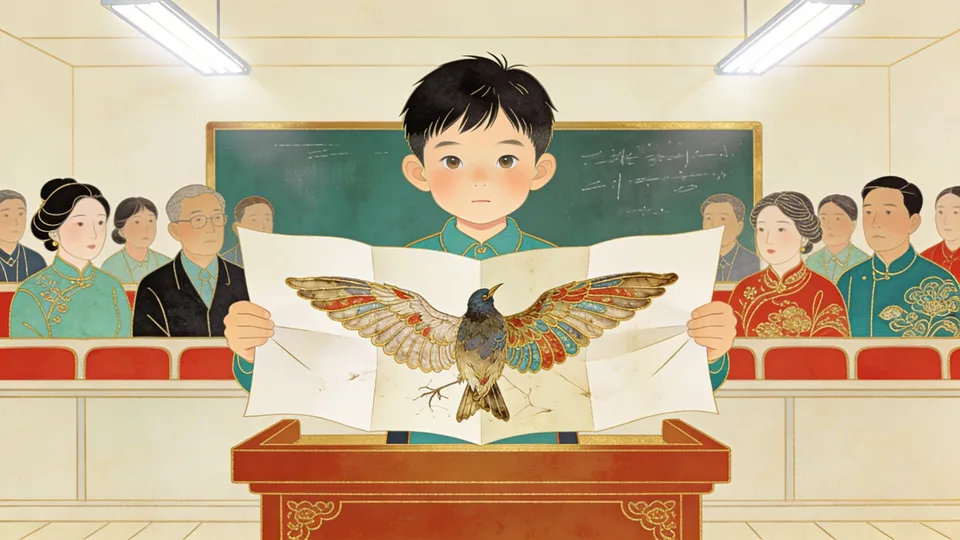
The textbook told him to write with sincerity. The exam marked him down for it.
我这辈子最讨厌的就是形式主义。
“The thing I hate most in this life is formalism.”
A 13-year-old boy in China makes videos calling out the fakeness in his school, his family, and the system that produces both. He is the child in the Emperor’s New Clothes. The fairy tale never says what happens to that child afterward; this boy is finding out.
What he sees
The school food is fit for livestock, yet the school runs a “clean plate” campaign. The baking class has no ovens and forbids using the school’s equipment, so students buy baked goods online. That is 形式主义 (formalism): the performance of education without its substance.
The performance extends to feeling. In compositions they cannot write anything too negative, but those are their true feelings. The textbook says to write with sincerity, and then the exam punishes sincerity. He says: “We elementary students have our own lives. We are not study-organisms.”
Home runs on the same rules. His parents fight constantly. He writes his father a letter and leaves it under the ashtray where his father smokes:
你们自己把自己的婚姻过得一团糟,还平时对我这样的一个孩子提各种各样的要求
“You’ve made a mess of your own marriage, and yet you make all kinds of demands on a child like me.”
When the boy makes his videos, his father says it is no different from suicide. It is a letter to parents written by a child who has not yet learned to be cold.
What it costs
A commentator on the video is harsh:
China’s primary education is a system that suppresses human nature. It is a process of making you accept, submit, get accustomed to lying, and gradually accept the unspoken rules of the ugly, the false, and the evil.
So independent spirit, when it appears, almost always comes through rebellion, because a good student in this system is virtually incapable of having independent spirit. The rule against negative compositions is where that training happens.
Then the boy unfolds a piece of paper.
那纸打开之后是一对鸟的翅膀,这个鸟已经死了。
Inside is a bird with outstretched wings, and the bird is dead. The commentator suggests the boy perhaps already knows he is that bird. He says as much himself: “I’m not sure how long I can keep holding these beliefs. Maybe I can hold onto them — but these things will grind away my edges.”
Against that stands one wish: 希望所有的受摧残的这个小树苗,都能够重生,能够长成了璀璨的花 — “I hope all these trampled saplings can be reborn and grow into brilliant flowers.”
He is 13, and he already suspects that hope is unlikely. What kind of society makes a 13-year-old the only one willing to say the clothes aren’t there?
References:
- 小孩哥 video, YouTube