Ask a child for a story and you get a dragon. Ask an adult and you get an apology.
Ask an adult on a stage to invent a story on the spot, and most will freeze, play for time, and finally offer something safe and dull. A young child just starts talking. The usual explanation is talent, or that grown-ups have more sense than to make things up in public. Keith Johnstone, who spent his career teaching improvisation, came to a harsher view. Many well-adjusted adults are bitter, uncreative, frightened, unimaginative, and rather hostile people. Instead of thinking of children as immature adults, it might be better if we thought of adults as atrophied children. They are damaged by their education.
What school teaches the imagination
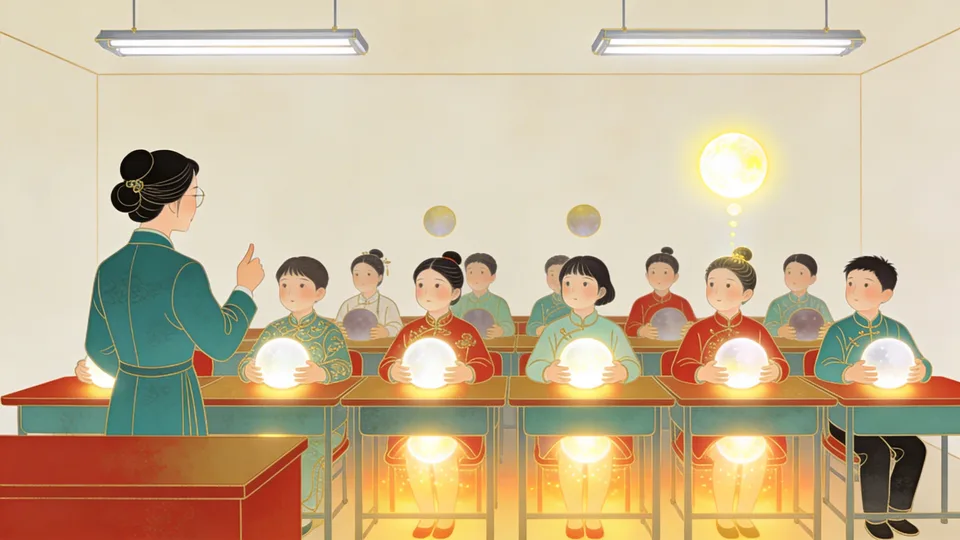
People think good teachers and bad teachers are engaged in the same activity, as if education were a substance that good teachers supply a lot of and bad teachers a little. This makes it difficult to understand that education can be a destructive process. A teacher who insists that only one flower is especially beautiful is being violent in the gentlest possible way, teaching children that the world has correct answers and wrong ones. Many children can operate creatively until they are eleven or twelve, when suddenly they lose their spontaneity and start producing imitations of adult art.
The damage is specific. Imagination is as effortless as perception, unless we think that it is wrong. What our educators taught us is exactly that: the first thought must be rejected in favor of a “better” one. The frozen adult on stage is not short of ideas. They are rejecting each one as it arrives, looking for one that is clever or original enough to survive judgment. But an artist who is inspired is being obvious, accepting first thoughts rather than weighing one idea against another, and striving after originality takes you far away from your true self and makes your work mediocre.
So the deadness most adults carry is not aging but damage, inflicted by an education that systematically punished the first thought, the honest impulse, and the willingness to look foolish.
Why the first thought feels dangerous
Why would anyone keep obeying lessons from school decades later? Because the stakes are social. We are pecking order animals, and that affects the tiniest details of our behavior. A first thought, said aloud, might be stupid or strange, and saying something stupid costs status.
Those transactions are mostly invisible. People will play one status while convinced they are playing the opposite. Being humble when receiving praise implies that the other person has bad taste: you haven’t seen what real quality is like. The humble person thinks they are being modest, but they are raising their own status by lowering yours. Hence Johnstone’s point that the status game is running in every interaction, and most people cannot see it because they are playing it.
Sanity itself, in Johnstone’s account, is part of the same game. Sanity is actually a pretense, a way we learn to behave, and we learn it because we do not want to be rejected by other people. Most people are secretly convinced that they are a little crazier than the average person, because they feel the energy it takes to maintain their own shields but not the energy others spend on theirs. The adult on stage is protecting that shield. Presenting as ordinary destroys their talent, but it spares them the horror of being laughed at against their will.
Saying yes
In a scene, this protection shows up as blocking. Each actor tends to resist the invention of the other, playing for time until they can think up a “good” idea, and their motto is “When in doubt, NO.” The actor who will accept anything that happens seems supernatural. Johnstone is honest that refusal has a payoff:
Those who say “Yes” are rewarded by the adventures they have, and those who say “No” are rewarded by the safety they attain.
What changes the scene is where the actors put their attention. When they concentrate on making the thing they give interesting, they seem in competition. When they concentrate on making the gift they receive interesting, they generate warmth.
Johnstone’s way of getting students there is to lower the stakes himself. The first thing he does on meeting students is play low status: if they fail, they should blame him, since he is supposed to be the expert. Failure is suddenly not so frightening. Many teachers try to get students to conceal fear, which always leaves traces such as heaviness, tension and lack of spontaneity. Johnstone tries to dissipate the fear.
That suggests a different diagnosis of the frozen adult. Instead of seeing people as untalented, we can see them as phobic. The imagination was never lost; it was guarded, so the cure is less a matter of trying harder to be creative than of Self-Acceptance applied to the first thought. And the guard has its reasons, because when you act or speak spontaneously, you reveal your true self, as opposed to the self you have been trained to present. Whether that is worth the risk is the question every “yes” on stage answers for a moment.
References:
- Keith Johnstone, Impro: Improvisation and the Theatre