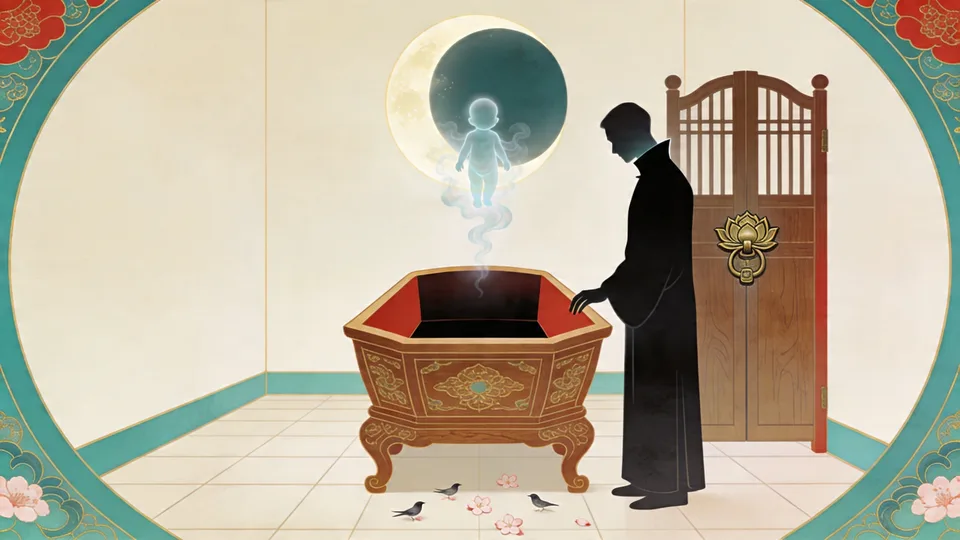
A child is the one person who can’t refuse to carry what you couldn’t put down.
Should someone who carries a family’s wound have children? The usual answer is hopeful: heal first, do the therapy, find a steady partner, and then you can break the cycle. The poem at the center of this note, The Little Me That Never Will Be, gives a harder answer.
Its premise is that you are already possessed. The ghost of the family trauma got into you long before you could consent, and it now runs the motor of your life from a room you have never been able to enter. The only question left is what you do with the hand that was dealt to you. You can replicate the pattern, making your suffering not in vain by routing it into a body that could not refuse you. Or you can be the last person the pattern ever occupied.
I want to pass the poison down, So in this flood, I do not drown alone.
But you, who gave this blood to me, Will never bounce them on your knee. The nursery remains a tomb, I bar the gateway of the womb. I want the child. I starve the want. I will not be a ghost to haunt The little me that never will be. The bloodline ends. The phantom’s free.
The urge to pass it down
The wound’s logic is strict: if the suffering had no inheritor, the suffering had no purpose. A child becomes the ledger entry that retroactively gives the pain a meaning it did not have before. My parents did this to me, and I will do it too, because the pain is what this family passes on.
The poem names the temptation: a little me, to bear the weight / to subconsciously replicate / this exquisite, familiar pain. “Subconsciously” is the giveaway. The conscious parent wants a better life for their children. The wound wants familiarity, and nothing is more familiar than your own pain, so it looks for a body that can carry it in the same register. A partner can be chosen for this. A child is even better, because a child cannot contest the frame, cannot leave, and cannot reveal in adolescence that the pain was contingent and could have been otherwise.
Underneath the wish is a fear. If the pattern stops with you, you are alone in it, and the deepest horror of generational trauma is being the one who had to carry it alone.
Why “heal first” doesn’t hold
The person facing this choice is often the phantom child of the previous generation, who spent their life performing for a ghost they could not become. Now the trap is offered to them in inverted form. They can build the nursery and tell themselves, and they will be partly right, that this time it will be different. They know the pattern. They will be softer. They will interrupt the transmission with awareness and therapy and the best of intentions.
The poem disagrees:
The knot is pulled too tight to tear, Despite the sterile, clinical care. Best of intentions, softest words, Cannot un-strike the slaughtered birds. The rot is in the marrow deep, A generational, silent sleep.
Intention does not reach the marrow. The body keeps the score below the language where intentions live, and the child inherits the score whatever the parent meant. The parent’s self-awareness does not inoculate the child. Sometimes it makes the transmission more elegant and harder to identify: warm and articulate on the surface, while the undertow pulls the child toward the same exit the parent knows by heart.
That is why “fix it first” is a near enemy of the real answer. It lets you feel wise while deferring the question. No human has been fully healed, no partner arrives unwounded, and the “done healing” state the plan is waiting for is one no living person has occupied. So the choice cannot wait for it: the healing never completes, and the choice about the bloodline has to be made while still possessed. You cannot un-possess. You can only choose whether the possession continues through you or stops at you.
Mercy or the safety trap?
There is a real objection. Refusing to have children to protect a child who doesn’t exist can be the safety trap in disguise: the heart in the casket, refusing risk because risk equals pain. The person who “doesn’t want to bring a child into this world” may also refuse every other kind of vulnerability, and the generational argument can be a well-dressed version of I am locking the door.
The test is whether the choice requires something difficult from you or lets you off a hook. If “the bloodline ends” is spoken as relief, with the obligation lifted and the attention restored to yourself, it is probably the casket. If it is spoken the way the poem speaks it, with the want intact and the child actively mourned, it is something else. The final stanza’s turn, I want the child. I starve the want, is the whole test. A refusal without grief is avoidance. A refusal with grief is a form of love that looks like absence from outside and feels like a burial from inside.
A second check: is the wound also being refused passage onto a partner, a colleague or a convenient enemy? If the only boundary is “I will not produce a successor,” the bloodline ending is a line item, not a conversion.
The phantom
So the bloodline ending does not end suffering. It redirects it. The child who would have carried it is spared. What remains is the phantom, the little me that never will be, and the slow work of grieving them honestly, without compensation or narrative cleanup, for the rest of your life.
The freedom in the poem’s final line — “The bloodline ends. The phantom’s free.” — is not a triumph. It is a burial rite the person conducts for themselves, in advance. No ritual or tradition exists for marking that a family is ending in this room, so the mourning has to be self-composed. The phantom that was waiting to be summoned into a small body is dismissed without a vessel. And it is done alone, which is the price, and why almost no one does it.