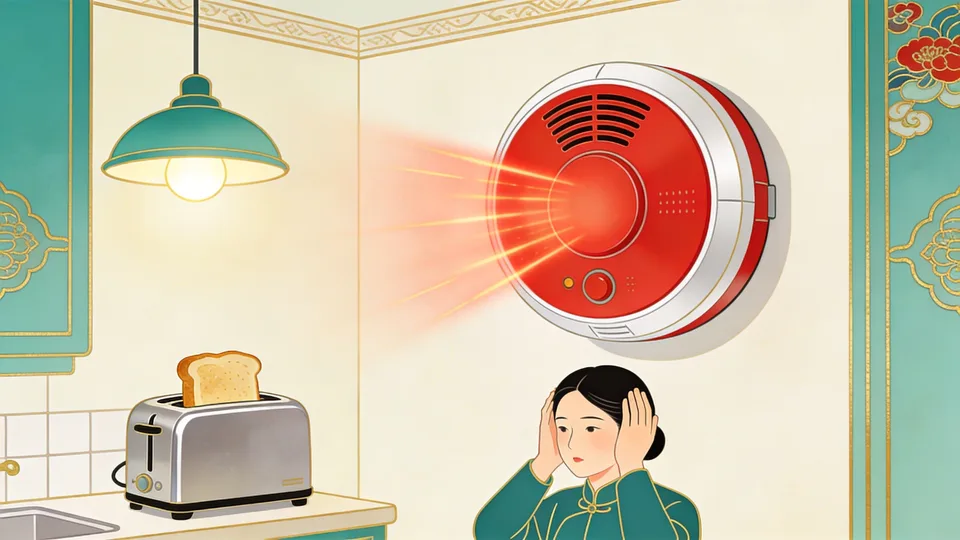
You can’t explain to a smoke alarm that it’s only toast.
Most of us picture trauma as a bad memory: something terrible happened, and healing means remembering it, understanding it and talking it through. Bessel van der Kolk’s The Body Keeps the Score argues that this picture puts trauma in the wrong place. Think of the brain’s alarm system as a smoke detector. After a real fire, the detector gets stuck on, and now it goes off whenever someone makes toast. You can know perfectly well that there is no fire. The alarm doesn’t care, because it doesn’t speak the language of reason. Being traumatized means continuing to organize your life as if the trauma is still going on. Every new encounter is contaminated by the past in an endless loop.
Why talking doesn’t reach it
The rational brain is basically impotent to talk the emotional brain out of its own reality. When the two are in conflict, the battle plays out in the gut, heart and lungs, not in the world of ideas.
Part of the reason is that trauma is preverbal. During flashbacks, Broca’s area, the brain’s speech center, goes offline while visual and sensory regions light up. The memory is stored not as a coherent story but as disorganized fragments of images, sounds, and chaotic physical sensations. Ordinary memory can be reorganized and retold; traumatic memory stays frozen, and because it bypasses executive function it feels like intuitive truth, the way things simply are. That is why CBT has limited success with deep trauma: only one in three patients fully improve, and most continue to have substantial problems.
What the alarm costs
If the alarm only made you jumpy, it would be bad enough. The deeper damage is what people do to silence it. The overall effect of trauma is a loss in the feeling of aliveness, motivation, excitement, and purpose.
Brain scans of chronic PTSD patients show almost no activation in the areas that sense the body from inside. The patients had learned to shut down the brain areas that transmit the visceral feelings that accompany and define terror. But those same areas carry the whole range of sensation that makes up self-awareness. In an effort to shut off terrifying sensations, they had also deadened their capacity to feel fully alive. Desire and passion start as body sensations, so someone who can’t feel their body can’t easily tell what they want, and purpose drains away with it.
Nor does it take a dramatic fire. Research van der Kolk cites from Harvard found that a mother’s emotional withdrawal had the most profound and long-lasting impact, more than hostile or intrusive behavior. A child whose needs are regularly ignored learns to act as if it doesn’t matter, while the body stays on high alert for rejection. Emotional neglect is harder to see than abuse, and so harder to heal. The kids who act out are at least given time and attention. But the ones who are simply blanked out don’t bother anybody and are left alone to lose their future bit by bit.
The strongest objection is that this overpathologizes ordinary life, since most people are resilient. Resilience is real. But the body keeps the score whether you acknowledge it or not. The strategy of seeming fine can itself be the trauma response. Its effectiveness is what makes it invisible.
Retraining the body
Van der Kolk describes three routes to treatment. Top-down approaches, such as talking and processing, are necessary but limited for deep trauma. Medicines can quiet inappropriate alarm reactions without addressing their cause. Bottom-up approaches give the body experiences that viscerally contradict the old helplessness, rage or collapse: yoga, EMDR, neurofeedback, theatre and MDMA-assisted therapy. The logic follows from where the trauma lives. The body learned the trauma. The body must unlearn it.
What the alarm finally needs is evidence that the fire is out, and the book’s deepest answer is that this evidence comes from other people. As long as we feel safely held in the hearts and minds of the people who love us, we will climb mountains and cross deserts and stay up all night to finish projects. Without that holding, imagination collapses, and without imagination there is no future to reach for. Which raises the harder question for anyone who seems fine: whose mind do you feel safely held in?
References:
- Bessel van der Kolk, The Body Keeps the Score: Brain, Mind, and Body in the Healing of Trauma