The wealth minus the acknowledgment is a curse, and the curse is not in the money. It is in the silence that pretends the money was the cure.

富不过三代 is usually read as a statement about wealth — a superstitious observation that fortune dissipates, that fortune draws its own punishment, that the universe corrects for inherited privilege. These readings locate the subject in the wrong place. The proverb is not a theorem about money. It is a theorem about silence. Money plus acknowledgment of where it came from and what it could not fix — that is an inheritance. Money minus that acknowledgment — that is a possession, and the possession outlives the possessor, and finds whoever is in the room.

Simple Picture

A family generates emotional trash — the humiliations that organized the grandparents’ nervous systems before they had the resources to do anything else. Dealing with trash properly requires admitting that it stinks. The admission is the expensive part.

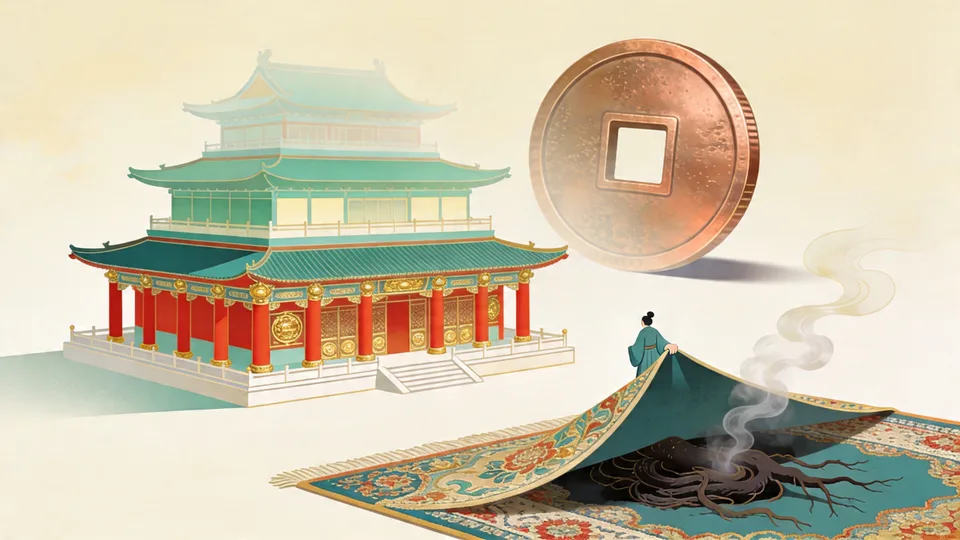
The cheap alternative is a rug over the pile. Then a larger house, so the pile is further from the dining room. Then a larger house still, so guests never get close. The parents insist the house is perfect because of what it cost. The children grow up in a mansion that smells, faintly but unmistakably, of rotting garbage — and is never permitted to be called a mansion that smells of rotting garbage.

The smell is not the trash. The smell is that nobody is allowed to say it smells. The children eventually lift the rug themselves because it is the only move the house left them that ends with them being able to breathe.

What the Silence Protects

The silence is not an oversight. It is load-bearing. To acknowledge the wound is to admit the house does not close it, and admitting this would collapse the entire structure the grandparents built their lives inside. The wealth was supposed to be the answer. Naming what it was supposed to answer would be naming that the answer did not land — that the slight still smarts, that the humiliation still lives in the body, that the empire was the shadow wearing clothes.

Most parents cannot afford that admission. So the children are handed the house, and along with the house, a gag order. The two gifts arrive in the same box and are never presented separately. The child learns, long before they learn why, that the house is perfect and the smell is their imagination.

The Children Inherit the Silence, Not the Wound

The children do not inherit the grandparents’ specific humiliation. They did not suffer the original slight; the strategy built to compensate for it is private to the person who suffered it. What transmits across generations is not the wound but the prohibition against naming it. Rigid defenses the children cannot account for. An emotional void in the living room that nobody comments on. A particular flavor of unspoken neurosis baked into every shared silence. The children inherit the strategy without the reason for the strategy — a very expensive apparatus whose original purpose has been scrubbed from the family record.

This is why so many third-generation heirs look like spoiled decadents ruining the family fortune. What they are actually doing — through addiction, vocation collapse, or long sincere therapy — is breaking the silence the house was built to maintain. They have to. There is nowhere else in the family where the material can be named. Everyone above them is still invested in the story that named is the wrong word.

This is the irrefutable invoice in generational form. The parents’ sacrifice is real. The material abundance is real. The invoice is that the children are expected to stay complicit in the delusion that the wealth was the cure — when the wealth, unaccompanied by acknowledgment, was only the treasure chest the family carried in place of doing the work.

Karma Is Metabolism, Not Judgment

Popular karma is cosmic justice: a ledger kept by a being with a beard, punishing hubris with ruin, balancing the books between lives. This is the near enemy of karma — it looks like the thing and sounds like the thing, but it points at the wrong object. If 富不过三代 is cosmic punishment, the grandparents are guilty and the grandchildren are innocent victims of someone else’s sin — and nothing in the metaphysics can explain why the grandfather dies rich and smug while the grandson, who inherited only a house and an emptiness, loses everything.

Real karma is metabolism, and silence is what prevents metabolism. Unprocessed psychic material is thermodynamic. It does not dissipate. It does not forgive. It does not know whose life it is ruining. It sits in the family system until someone names it — and in its natural state, it cannot be named, because naming is precisely what the system was organized to prevent. The grandfather is not punished by the gods. He dies with the wound intact. The wound outlives him because wounds outlive people. The grandson finds it under the rug because grandsons are the ones who eventually lift rugs.

This is the same structure Pirsig named the karma dump at the civilizational level: a system finds a designated body to route unprocessed suffering through, rather than face the source. The Identified Patient is the family’s karma dump at a single moment; the third-generation heir is the bloodline’s karma dump across time. In both cases the mechanism is metabolic, not juridical. Nobody is being punished. Material that was never named is finding someone willing, or forced, to name it.

The near-enemy reading is not merely wrong — it is useful to the system, because a family that believes in cosmic punishment still does not have to do anything. You cannot negotiate with the gods; you can only endure their verdicts. The real reading is more demanding: no verdict, only a question — who in this line is going to be the one who finally says it.

Exoteric and Esoteric

Any family with this pattern runs two texts in parallel.

The exoteric text is the one everyone agrees to read aloud: the parents are driven, successful providers who built an empire to protect their family. They ensured their children would never experience the poverty, humiliation, or insecurity they did. The wealth is the proof of their love. The house is the gift. Every family gathering, every Lunar New Year toast, every obituary reads this text. It is not false. It is partial.

The esoteric text is the one the children eventually read under the rug. The parents outsourced the psychological labor to their offspring. Their material accumulation is a monument to an internal void they refused to name. Their “love,” delivered strictly through financial provision, is a hostage situation — a deal in which the children are expected to become complicit in the delusion that money healed the wound. This is also not the whole story. It is the part the exoteric text must omit to stay coherent.

The tragedy of the third generation is that both texts are true, and the family has no ritual for reading them together. The grandchild’s integration work is holding both without collapsing one into the other. The wealth was love, and the wealth was a shield. The sacrifice was real, and the consumption was real. The grief is that these were the same act — and that saying so was never permitted until the silence finally broke on its own.

The Chinese Case

The proverb lands especially hard in the Chinese context because the family system is organized, at every level, to make acknowledgment impossible. The mianzi economy makes admitting the smell a catastrophic social event — to name the wound is to damage the family’s entire standing, not just its internal comfort. The ninth commandment of harmonyparents are never wrong — forbids the heir from even raising the question. The phantom child dynamic concentrates the entire family’s unspoken material onto a single heir in the 4-2-1 structure, removing every safety valve through which anyone else might have said something.

Under these conditions the grandchild’s options narrow to two. Keep the silence and become the phantom the family needed — outward success while the inner void metastasizes. Or break the silence publicly and be named selfish, ungrateful, a disgrace — which is the system’s way of marking that the break actually happened. 富不过三代, in this frame, is the statistically observed rate at which the third generation finally cannot continue holding the silence. The wealth returns to the pool because the living person refusing to keep pretending is worth more than the estate that required the pretense.

The Layered Reading

Dimwit: Rich kids are spoiled, weak, and sad for no reason. 富不过三代 means the universe corrects inherited privilege.

Midwit: The parents failed to self-actualize, projected their unhealed narcissistic wounds onto their children, and produced complex PTSD through emotional neglect dressed in luxury.

Better take: The wealth was never the problem. The silence around the wealth was the problem. Each generation inherits the silence more fully than the last — the grandparents remember what they are not saying, the parents half-remember, the children only inherit the prohibition. By the third generation the gag order has compounded to the point where it cannot be enforced without cost to the enforcer. 富不过三代 is not a timeline for money. It is the half-life of a family’s capacity to keep pretending.

Worse-is-better: The grandparents’ silence was not cowardice — it was the only move their situation afforded. The material base had to be secured before anyone in the line could afford to speak. What looks like the third generation squandering the fortune is the third generation finally being able, because of the fortune, to pay the price of naming what three generations of silence accumulated. Stage 1 secures the perimeter. Stage 2 breaks the quiet.

These four reads stack. The dimwit version is what the neighbors gossip; the midwit version is what the therapist writes in the intake form; the better reading is what the heir starts to see at 35; the worse-is-better reading is what they can finally hold at 50, after the grief has metabolized enough that they can feel grateful for the house whose silence poisoned them.

The Parents Are Not Villains

The temptation, once this is visible, is to indict the first generation. They built the house. They installed the rug. They enforced the silence. Indictment is emotionally satisfying and analytically lazy. The grandparents were not evil for staying silent — they were doing the only move their situation afforded. A person with a wound and no model for naming it does not have the option of naming it.

The failure is not that the grandparents built wealth. The failure is that the wealth arrived without the sentence that would have changed what it transmitted. A grandfather who builds the house and says — this wealth came from a pain I did not fully metabolize; my children should know this — transmits something entirely different from one who only builds the house. One sentence is the difference between a gift and a haunting. The wealth plus the acknowledgment is a gift. The wealth minus the acknowledgment is a curse, and the curse is not in the money. It is in the silence that pretends the money was the cure.

Main Payoff

富不过三代 is what happens when silence compounds. Not wealth dissipating — silence running out. The third generation is not unlucky and not weak; they are the generation for whom the rug has accumulated too much underneath to keep walking over. Either they lift it, name what is there, and lose the house in the process; or they refuse, let the unnamed take them, and lose the house anyway, plus themselves.

The exit is not inheriting better, parenting better, or teaching the next generation “values.” It is the act the silence forbade: somebody in the line sits down and says the sentence the family was organized not to say. Usually it is the heir, because by the time the sentence becomes unavoidable the principals are dead. Occasionally it is a grandparent late in life — and when it is, the family remembers them as a saint, because saints are mostly people who broke intergenerational silence in real time and made the next three generations lighter.

Karma, read correctly, is not the threat the proverb carries. It is the promise underneath it. The silence is always breakable — by anyone in the line willing to say aloud what the house was built not to say, and let the house be worth whatever it turns out to be worth once the sentence is in the room.