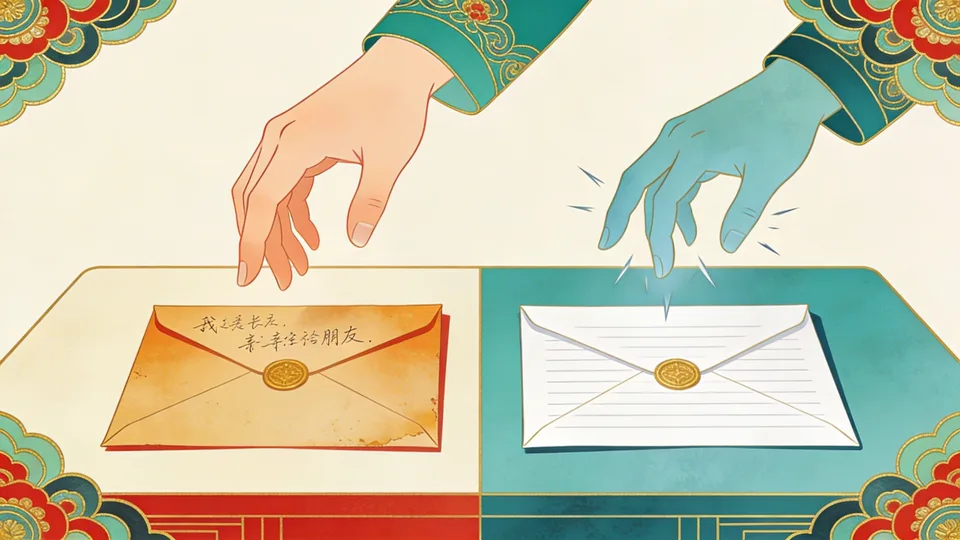
Choose your words as carefully as you like. Trust decides what they mean.
Suppose two letters arrive containing the same sentence: “we need to talk.” One is from your closest friend. The other is from someone who betrayed you last year. The words are identical, and for all you know so is the intent, yet you open the first with mild curiosity and the second with your stomach tightening. The letter did not change. What changed is what it travelled through.
We usually treat being misunderstood as a wording problem: if people take you the wrong way, choose your words more carefully. The letters suggest wording is the smaller variable. In a high-trust relationship you can say the wrong thing and people will still get your meaning. In a low-trust relationship you can be very measured and precise and they’ll still misinterpret you. Trust is the transmission medium a message passes through, and it decides much of what arrives.
The tax and the dividend
Stephen M.R. Covey describes every relationship as carrying either a trust tax or a trust dividend. In a low-trust relationship people discount what you say, maybe by half. You compensate with extra precision, extra documentation, extra caveats, and each compensation slows things down. In a high-trust relationship the same effort is amplified: ambiguity is resolved charitably, intent is assumed to be good, and a clumsy sentence is absorbed rather than prosecuted. That is why the second letter can’t be rewritten into the first. The discount is applied by the reader.
How distrust makes itself true
The tax would be bad enough if it held steady, but it compounds. The surest way to make a person untrustworthy is to distrust them and show it. Distrust produces defensive behavior, defensive behavior looks like untrustworthiness, and that confirms the original distrust. Each turn replaces a little more judgment with procedure, because procedure is what you use when you cannot trust people.
In organizations the loop has a familiar shape: Low trust breeds bureaucracy and bureaucracy breeds low trust. The OSS sabotage manual’s instructions (insist on channels, demand written orders, multiply approvals) read like a description of a company where trust has reached zero. Process kills initiative, because initiative needs the trust that process has already displaced, and the missing initiative makes more process look necessary.
The loop also runs the other way. When someone gives you genuine responsibility, you tend to rise to it, and your rising justifies giving you more. But it has to be genuine. Handing someone accountability without authority, or saying you trust them while monitoring everything, is fake trust, and people sense the mismatch between words and behavior. Pretending to care insults other people’s intelligence. It can do more damage than open distrust, because it adds betrayal to the overhead.
Isn’t this naive?
The prudent objection is that trust should be earned: let people prove themselves first. Some people will abuse whatever trust they get, so the objection isn’t foolish. But the loop shows why waiting fails. Distrust produces the defensive behavior that keeps the proof from appearing, so an organization that waits for proof before trusting waits forever. Meanwhile the rules written to stop the few abusers, the policies for the 3%, tax the 97% who never needed them. The uncomfortable conclusion is that trusting people is a risk, but not trusting them is a bigger risk. Being burned occasionally costs far less than living permanently inside a low-trust medium.
What actually limits the risk is character, which rules cannot replace. A person without principles finds a way around any system, and the system’s overhead falls on everyone else, while a person with principles needs very little system at all. Two lines quoted in Covey’s book make the point:
If you don’t have personal integrity, intelligence and high energy will kill you.
It’s not hard to make decisions when you know what your values are.
Now picture yourself as the sender of that second letter, writing to someone who no longer trusts you. No rewording will save it. When someone responds with high emotion, they are usually not being understood, and a person will not take your advice until they feel understood, so precision offered too early only stirs things up. The repair has to happen in the medium, not the message, which means someone has to extend trust before there is proof it is warranted. The open question in most strained relationships is who goes first.
References:
- Stephen M.R. Covey, The Speed of Trust