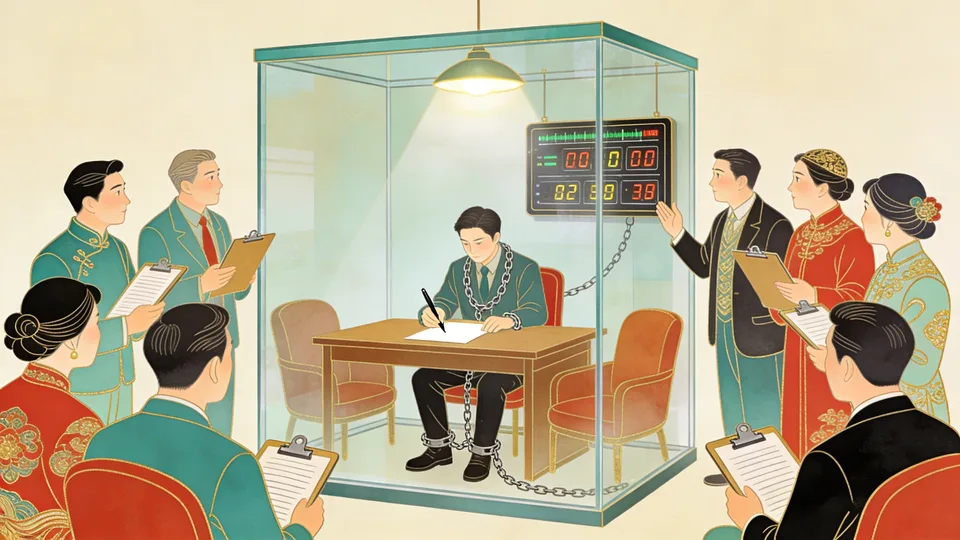
The daily standup shows management everything except the work that would actually make things better.
Picture the morning standup on a Scrum team. A first-year programmer and a fifteen-year veteran stand in the same circle and give the same report: what they did yesterday, what they will do today, what is blocking them. Both work from “user stories” written on the business side, both estimate in the same points, and both are judged by the same velocity chart. For a year the veteran has wanted to rebuild the data layer that makes every story take twice as long as it should. That job does not fit in two weeks and nobody can estimate it, so it never reaches the board.
Most engineers who resent this blame the implementation and assume a better coach or a purer Scrum would fix it. Michael O. Church’s critique of corporate Agile starts from a less comfortable possibility: that the process is working as designed, and the design was never mainly about making software better.
Transparency that runs one way
The standup makes the veteran’s working day visible to the business, task by task and estimate by estimate. Nothing comparable flows back. She does not see why one feature beat another or which decisions above her have already made half her work pointless. Church describes Agile as demanding that programmers provide humiliating visibility into their time and work, with no reciprocity, and that one-way exposure is what “violent transparency” means. Open-plan offices are its physical form: VC-backed startups that needed to manage up into investors used them to make the workspace look busy. Scrum does the same thing to the work itself.
Visibility that runs one way is a form of power. Whoever reads the board can steer and replace the people on it, and they cannot return the gaze. As with legibility in general, the arrangement serves whoever is doing the reading, and in a Scrum shop the reader always sits on the business side.
It also changes what the person being watched can do. Creative people lose their creativity when asked to explain themselves while they are working, because the attention that goes into accounting for the work is taken from the work. A veteran who must justify yesterday every morning learns to pick tasks that are easy to justify.
What gets estimated gets done
That is how the data-layer rebuild dies. Estimates push people toward work that is estimable, which means low-yield, easy and predictable, while anything worth doing has too many unknown unknowns for an estimate to mean much. Agile’s focus on short-term value pushes people away from work the company actually needs, in favor of each programmer’s real-time reputation management. The veteran is not avoiding the hard problem out of laziness. She is protecting her velocity, because velocity is what the next review will read.
Nothing in the process ever lets her stop protecting it. The two-week sprint has no exit strategy: no clause that says a team which has proven itself earns longer horizons. Church calls the result terminal juniority. The veteran and the first-year attend the same standups and write the same stories, and “I was on a Scrum team” tells a future employer only that you were treated as interchangeable. Meanwhile technical debt piles up where the people calling the shots cannot see it. The result is one mindless, near-sighted sprint after another — no progress, no improvement, just ticket after ticket after ticket.
Where the emergency posture belongs
None of this means short iterations are always wrong. Agile came out of consulting, where high-risk client projects with existential stakes really do benefit from aggressive short-term iteration, and a client paying by the week has a fair claim to see weekly progress. Aggressive project management makes sense in an emergency. The damage comes from making the emergency permanent, like a hospital running triage every day.
Once the process outlives the emergency, the honest description is that corporate Agile is not a methodology failure but a power arrangement disguised as a process. It trades the engineers’ autonomy for the business’s view of them, and the people who make that trade are not the ones who pay for it. Peopleware said as much a generation earlier: a Methodology is an attempt to centralize thinking, and it implicitly declares that the people doing the work are not smart enough to think for themselves.
So what would it take to get the data layer rebuilt? A better ticket template would not do it. Someone above the board would have to be willing to stop watching the veteran for a few weeks and trust that the silence means work. Whether a company can afford that depends on whether it believes in the people it hired, and no process can answer that question for it.
References:
- Michael O. Church, Why Agile and Especially Scrum Are Terrible