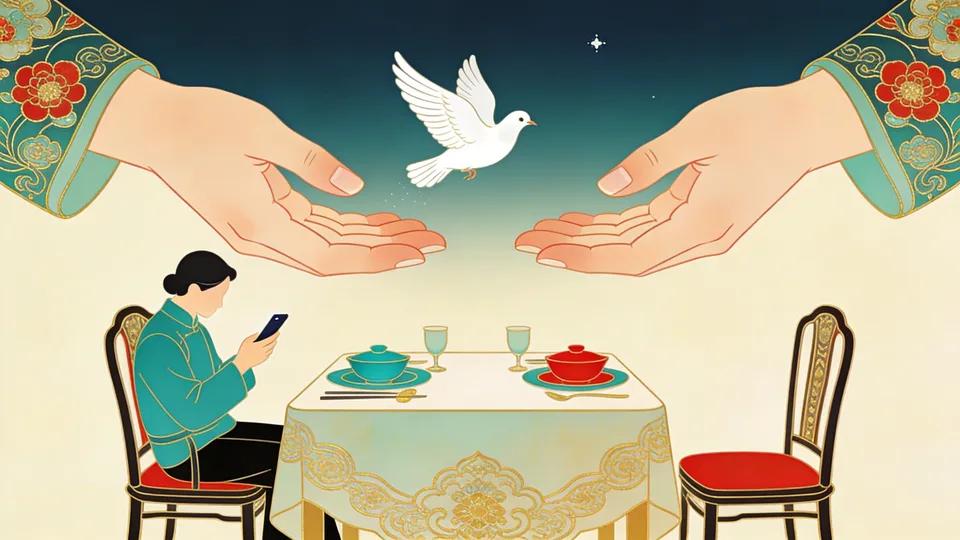
Every Saturday flake is a no somebody couldn’t say on Wednesday.
You agree to meet a friend for dinner on Saturday. Saturday morning: silence. You send a confirmation. Read, no reply. Two hours before: “so sorry!! something came up, let’s reschedule?” What came up is that they got a better offer, or didn’t feel like going, or never intended to come, but saying “no” three days ago would have been uncomfortable for twelve seconds.
In Chinese this is called 放鸽子, “releasing the pigeon.” You open your hands and the bird just leaves. The commitment was never held. It was perched.
The flattering explanation
The charitable read is game theory: face-preservation makes refusal taboo, so everyone rationally overcommits and silently culls.
That read is too generous by half, because it skips the question of who never learned to refuse, and why. The one-child policy removed negotiation from childhood. Siblings are where you first learn that your desires collide with someone else’s and nobody is coming to arbitrate. An only child never has to share a room, split a toy or lose an argument to someone their own size; conflicts go to parents, who resolve them by giving the child what they want. The gaokao system then replaced all social skills with one. Helicopter parents absorb every friction so the child can focus on the exam, and the child arrives at university technically adult and socially pre-adolescent, able to solve differential equations but unable to tell a friend “I don’t want to come” without feeling like they’ve committed an act of violence.
The result is a population fluent in avoidance and illiterate in refusal. The friend who cancelled dinner is doing what they have always done: dodging discomfort and waiting for someone else to make the awkward thing go away.
Everyone hates it, everyone does it
The irony is that they are creating the exact conditions they complain about. Everyone hates being flaked on. Everyone flakes. The person posting on WeChat about how nobody keeps their word anymore cancelled on two people last Thursday.
It persists because it is neediness at the cultural scale. The needy person cannot say no because they are terrified of the other person’s reaction, and cannot hear no because they read it as rejection rather than information. So they avoid both: they never refuse, and they never show up.
The game-theory read does get one thing right: commitment liquidity tracks surplus. In the boom years, roughly 2000 to 2020, a better offer was always one WeChat message away, and burning social capital was cheap. As opportunity contracts, reliability becomes a status signal and flaking a luxury only the insulated can afford.
But the sophisticated reading is the midwit one, and the midwit explanation is a flattering story a generation tells itself to avoid the uncomfortable truth that they simply never learned the basic adult skill of saying no. The “cultural equilibrium” is real the way an addict’s routine is real: stable, self-reinforcing, and entirely compatible with being a pathology.
The fix is boring. Learn to say no to people’s faces on Wednesday, absorb the twelve seconds of discomfort, and stop treating your calendar like an airline treats economy seating. A commitment without a specific time, a specific place, and a 24-hour confirmation is not a commitment — it is a social option priced at zero and worth exactly that. The people who manage this will find, as adults always do, that the friendships that survive honesty were the only ones that were real.