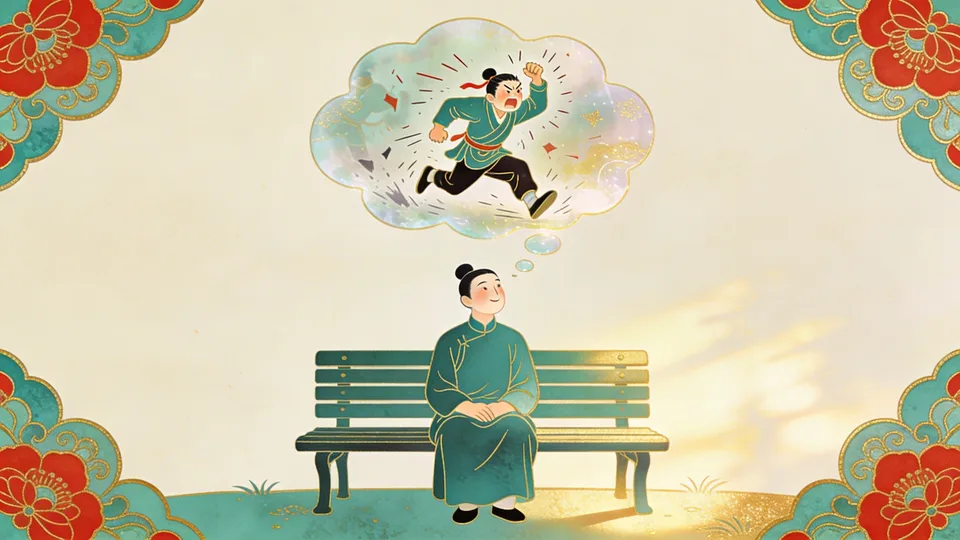
Get the promotion, and by Friday the voice in your head has a new complaint.
You want the job, the apartment, the apology. You get it, and within a week the restlessness has found a new object. The obvious conclusion is that you wanted the wrong thing and should choose better next time. Eckhart Tolle’s A New Earth draws a stranger one: the wanting was never about the thing.
All our stories are versions of “Why I Cannot Be at Peace Now.”
The ego, in Tolle’s sense, often does not know what it wants. It only knows what it does not want: the present moment. Unease, restlessness, boredom and dissatisfaction are all forms of unfulfilled wanting, and since the ego cannot have the present moment, it lives on the movement of wanting and seeking instead. So getting the job doesn’t end the story. It only clears space for the next chapter of why now is not good enough.
The voice is not you
If the ego is the voice narrating that story, the natural move is to treat it as yourself: my thoughts, my wants. Tolle refuses the identification. “I think” is just as false as “I digest” or “I pump my blood.” Thinking happens in you the way digestion does, and the ego is the habit of claiming authorship of it.
Its motive is always the same: to stand out, be special, be in control, get more. That motive hides even in self-criticism. Behind every positive self-concept is a fear of not being good enough. Behind every negative self-concept is the hidden desire to be greater than others. Both are the same structure, neediness in its performing and self-loathing modes. It can even creep into facts. You can be right that you told the truth, and “why don’t you ever believe me?” still contains ego, because the sentence is defending a self as much as reporting an event.
Seeing instead of fighting
The obvious response is to wage war on all this: suppress the ego, be less selfish. Tolle thinks that fails, because the fighter is more ego. His alternative is that the ego is not the enemy but the unconscious — and consciousness dissolves it not by fighting but by seeing. When you catch yourself performing the “why don’t you ever believe me?” move, he suggests you smile. The moment you are aware of the ego, it is no longer quite the ego, since ego implies unawareness, and every time it is recognized it is weakened. As IFS puts it from the other side, going to war against protectors only makes them stronger.
The same logic applies to identity. Trying to find yourself through possessions, status or a better self-image only produces another borrowed identity. Nobody can tell you who you are. It would just be another concept. Every belief is an obstacle, since you already are who you are.
The strongest objection is that this is vague spirituality that ignores real problems. But what Tolle offers is a different question, not passivity. The ego asks, “How can I make this situation fulfill my needs?” Presence asks, “How do I respond to the needs of this moment?”
Without placing unreasonable demands upon the world — fulfill me, make me happy, make me safe, tell me who I am — all suffering will cease.
Whether anyone can live without those demands is fair to doubt. Tolle’s most practical observation is about the demands themselves. If you think “I am needy little me,” you will always think other people are withholding from you. What you think they are withholding from you is what you are withholding from the world because you think it too small. And letting go of the job, the apartment or the apology can’t be done by trying: attachment drops away by itself when you no longer seek to find yourself in them.
References:
- Eckhart Tolle, A New Earth: Awakening to Your Life’s Purpose