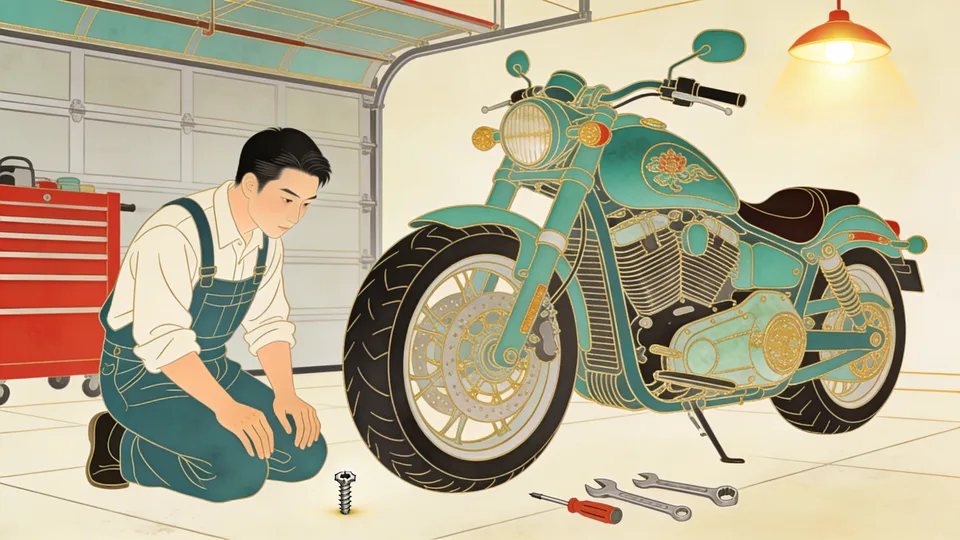
The moment the screw won’t turn is the first moment you actually look at the motorcycle.
You’re fixing a motorcycle and the slot on a small screw strips. The cover plate it holds won’t come off, and nothing else can happen until it does. Thousands of dollars of machine, defeated by a screw that cost a few cents, and the repair manual has nothing to say, because the manual assumes the screw will turn.
Robert Pirsig built Zen and the Art of Motorcycle Maintenance around moments like this, and his question is what actually gets the mechanic unstuck. The usual answer is technique: more knowledge, better tools. Pirsig thinks the deciding factor is something mechanics are trained to ignore, the state of mind of the person holding the screwdriver. When you want to hurry something, that means you no longer care about it and want to get on to other things. Caring about what you are doing is considered either unimportant or taken for granted.
Seeing the screw
While the screw turned, it was nothing: a cheap, interchangeable part, a line in a parts list. Stuck, it is suddenly the most valuable thing on the motorcycle. That value wasn’t produced by analysis. You perceived it first and could only describe it afterwards. Pirsig calls what you perceived Quality, and makes it the center of the book. Quality, for him, is neither a property of objects nor a subjective preference. It comes before both, as the direct sense of what matters before the intellect has divided the world into subjects and objects.
Squareness may be succinctly and yet thoroughly defined as an inability to see quality before it’s been intellectually defined.
The square mechanic reaches for the manual’s categories and finds nothing, because the situation is new. The mechanic who can stay with the stuck screw, look at it, and let the next idea arrive becomes better than the institute-trained man who can handle everything except a new situation.
Gumption and the mountain
What usually goes missing at that moment is what Pirsig calls gumption, the psychic gasoline that keeps the whole thing going. Anything that makes you lose sight of Quality drains it, and the book catalogs these gumption traps, from ego, which won’t admit the goof, to anxiety, which is more often why you can’t start than laziness. The one the stuck screw springs hardest is impatience: you underestimated the job, and now the screw stands between you and where you wanted to be. Pirsig’s fullest picture of impatience is a man climbing a mountain.
When you try to climb a mountain to prove how big you are, you almost never make it. And even if you do it’s a hollow victory.
The ego-climber puts his foot down an instant too soon or too late. He looks up the trail to see what’s ahead even though he looked a second ago. He rejects the here. What he’s looking for, what he wants, is all around him, but he doesn’t want that because it is all around him. The mechanic glaring at the stripped screw because it stands between him and the finished bike is climbing the same way. To live only for some future goal is shallow. It’s the sides of the mountain which sustain life, not the top. Here’s where things grow.
Pirsig doesn’t throw the goal away, though. Without the top you can’t have any sides, and it’s the top that defines the sides. The finished motorcycle is the reason you’re kneeling beside it. It just isn’t where the work happens.
The cycle called yourself
So the claim that sounds softest in the book is meant as the hardest. Peace of mind isn’t at all superficial to technical work. It’s the whole thing. The ultimate test is always your own serenity. If you don’t have this when you start and maintain it while you’re working, you’re likely to build your personal problems right into the machine itself.
Pirsig carries the same logic outward. If a factory is torn down but the rationality that produced it is left standing, that rationality will simply produce another factory. The place to improve the world is first in one’s own heart and head and hands, and then work outward from there. The machine that appears to be out there and the person who appears to be in here grow toward Quality or fall away from it together.
That is what the stripped screw was testing all along. The real cycle you’re working on is a cycle called yourself. Pirsig kept working on that cycle in lila, where he split Quality into the static patterns that preserve a culture and the dynamic force that changes it, and found that a culture’s immune system fights beneficial change as hard as it fights crime, because it cannot tell them apart.
References:
- Robert M. Pirsig, Zen and the Art of Motorcycle Maintenance: An Inquiry Into Values