The afternoon you can’t explain to anyone may be the only part of the week that’s yours.
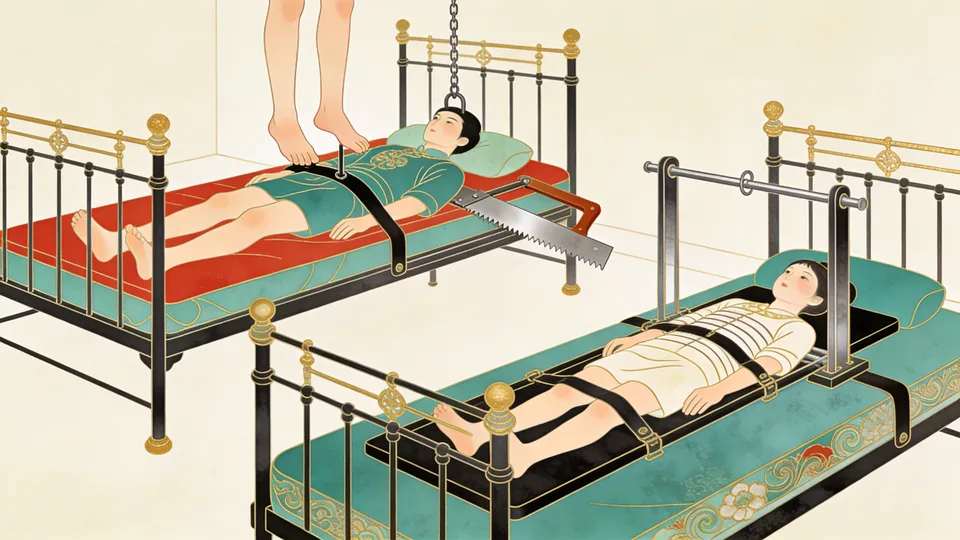
In the Greek myth, Procrustes offered travelers a bed for the night, then made them fit it: he stretched the short ones and cut the legs off the tall ones. Nassim Taleb uses him for a habit of mind. Facing the limits of our knowledge, the unseen and the unknown, we resolve the tension by squeezing life into crisp commoditized ideas, reductive categories, specific vocabularies and prepackaged narratives. We do to reality what Procrustes did to his guests.
Why answer that in aphorisms? Because an argument is itself a bed, built to a size. A one-line observation can catch a single place where the cutting happens and leave the rest of the body intact. The ones below each show a different limb being trimmed.
The hours that don’t fit
The most common bed is justification. A day is supposed to be accountable, so the hours without a stated purpose get cut first. Taleb’s reply: You exist if and only if you are free to do things without a visible objective, with no justification and, above all, outside the dictatorship of someone else’s narrative.
From inside the bed, those hours look like waste. What fools call “wasting time” is most often the best investment. Even procrastination is the soul rebelling against entrapment: in the antifragile frame, delay lets things take care of themselves. Its limit is plain, though. When you keep putting off a goal you genuinely care about, the soul may be dodging the hard part rather than rebelling.
What leaks through the performance
People also stretch themselves to fit the bed others expect, and the stretching shows. Just as dyed hair makes older men less attractive, it is what you do to hide your weaknesses that makes them repugnant. The concealment signals the weakness more loudly than the gray would. Most of what they call humility is successfully disguised arrogance. And some feelings won’t stretch at all: Hatred is much harder to fake than love. You hear of fake love; never of fake hate.
Taleb also sees why people keep performing: People often need to suspend their self-promotion, and have someone in their lives they do not need to impress. This explains dog ownership.
Institutions that hide the amputations
Institutions run the biggest beds, and they are good at hiding what they cut off. What made medicine fool people for so long was that its successes were prominently displayed and its mistakes (literally) buried. Schooling trims experience down to what can be graded, and Taleb is blunt about the result: Education makes the wise slightly wiser, but it makes the fool vastly more dangerous. The Intellectual Yet Idiot is that line given a social form: a credentialed fool whose error does more damage because the institution certifies it as judgment. And the best-run beds feel like a choice: Karl Marx, a visionary, figured out that you can control a slave much better by convincing him he is an employee.
The refusal to cut has a price. I suspect that they put Socrates to death because there is something terribly unattractive, alienating, and nonhuman in thinking with too much clarity. Procrustes was finally killed by Theseus, who gave him his own treatment. Taleb’s aphorisms leave open whether anyone gets out of the bed, or whether the best we can manage is to notice which limb is being cut.
References:
- Nassim Nicholas Taleb, The Bed of Procrustes: Philosophical and Practical Aphorisms