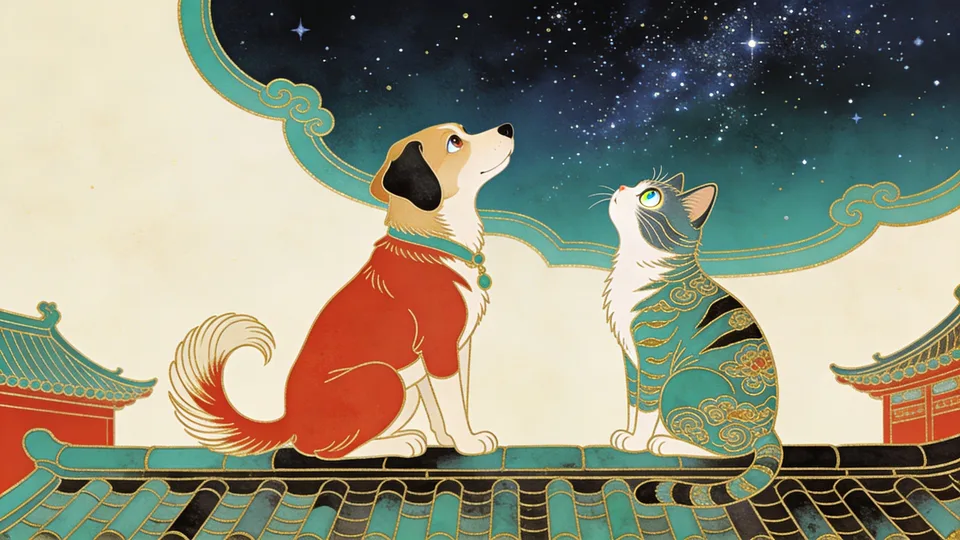
At the top of most pyramids sits a cat who never tried to climb.
Listen to how English uses dogs and you hear a vocabulary of rank: top dogs and underdogs, lapdogs and attack dogs, a dog-eat-dog world. Venkatesh Rao noticed that dog references populate our understanding of social dynamics: conflict, competition, dominance, mastery, belonging and otherness. Cat references speak to individualism, play, opportunism, risk, comfort, mystery, luck, and curiosity.
One asymmetry gives it away. You cannot really insult someone by calling them a cat. Yet there is fear associated with cats in every culture: witches, black cats, bad luck. Why should a small animal that mostly ignores us provoke that kind of unease? Rao’s answer is that the fear arises from the cat’s clear indifference to our assumptions about our own species-superiority and intra-species status. Followed far enough, that indifference describes two different ways of building a self, and explains why one of them is both dangerous and, occasionally, the origin of everything the other builds.
The cat and the king
You can wear fancy robes and a crown and be declared King by all the dogs, but a cat will still look quizzically at you, trying to assess whether the intrinsic you, as opposed to the socially situated, extrinsic you, is interesting.
The look is unsettling because the crown works only while everyone treats it as working. Our ability to impress and intimidate is mostly inherited from ascriptive social status rather than actual competence or power. The cat, unimpressed by robes and courtiers, calls the bluff and scares us, because it shows how much of our weight was borrowed.
Yet the dogs who bow are far from foolish. Validating the unreal creates dog-power, the power of coordinated action. Taxes get collected, soldiers march and courts sit on the strength of a shared belief that the man in the robes is King. Dogs create society by believing it exists.
Two ways to build an identity
The deeper difference is where identity comes from. Dog identities are largely socially constructed, built by looking at other individuals: people to be like, people to avoid being like. Because everyone is consulting the same comparison set, dog-people become more alike.
Cat identities are universe-constructed. Wherever they are on the identity mountain believed into existence by dogs, cats are looking outward, not at the mountain itself. Their mental model of other beings is space-saving and, to dogs, “wrong”: everyone is basically kinda like me. That looks like poor social perception, but the attention it saves on rank goes outward. Indiscriminate curiosity drives cats to random-sample a broader universe of perceptions, and because each cat samples a different corner, cats drift apart along path-dependent lines. Cats become more individualized and unique.
Curiosity Kills the Cat
The same curiosity that individualizes the cat exposes it. Curiosity does kill the cat. Often, it is dogs that do the killing. An animal that looks quizzically at kings and never learns the rules of rank makes enemies without noticing. For most cats, divergence leads nowhere, or somewhere bad.
A few cats, mostly successful by accident, spawn dog societies. At the very top of the identity pyramids constructed by dog-beliefs, you will find cats: cats who did not climb the mountain, but under whom the mountain grew. They are as puzzled by their position as the dogs who actually want it. Their angle on the world turned out to be one that other people could organize around, and the organizing was done by dogs.
That is why “be more like a cat and stop caring about society” makes poor advice. The cat’s value was accidental; it was not trying to be valuable, just curious. Indifference adopted as a climbing strategy is still a way of looking at the mountain. As John Gray’s feline philosophy puts it, cats never made their existence into a project requiring justification, so they have no image of themselves to preserve. A person who adopts cat-like indifference in order to be admired has acquired exactly the self-image that the cat lacks.
The cat that looked quizzically at the king was not plotting to replace him. It was genuinely not caring about the mountain, which, paradoxically, is the only way to build something the mountain will grow around.
References:
- Venkatesh Rao, On Seeing Like a Cat, Ribbonfarm