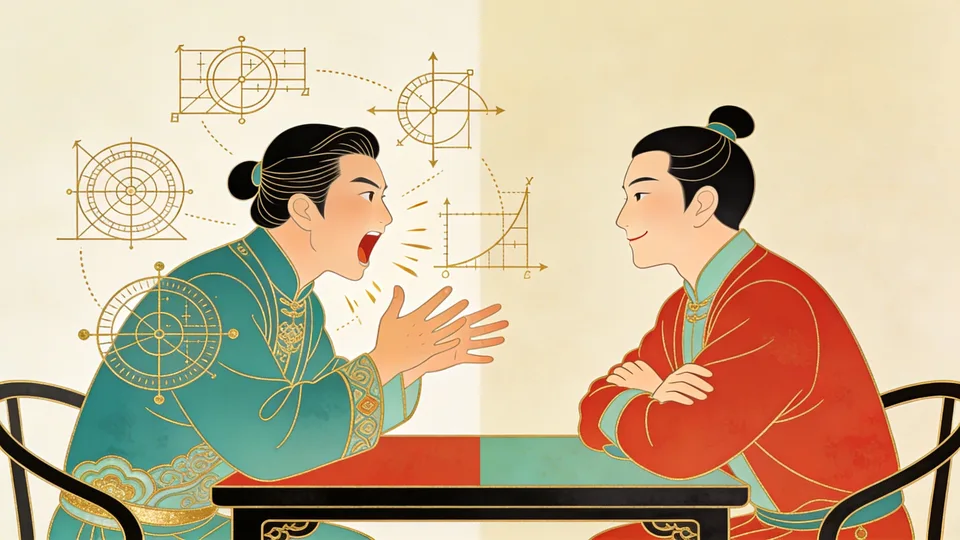
The expert is exasperated. The novice feels contemptuous and superior. The situation is stable: the expert gropes for a way to demonstrate the validity of his view at a level the novice can understand, is reduced to sputtering incoherence, and this only strengthens the novice’s illusory sense of superiority.
Play out this little piece of sketch comedy at broader scales and you get all the pathos and pageantry of human society.
Simple Picture
ELI5: imagine you can see a color that no one else can see. You try to describe it. They stare at you blankly, then conclude you are either lying or crazy. The more desperately you try to explain, the crazier you look. They walk away feeling smart. You walk away wanting to scream.
Why the Impasse Is Stable
Three forces lock the impasse in place:
-
There may be no path to persuasion. If there were always an easy way to demonstrate the novice is mistaken and then school him — suitably chastened and properly respectful — there would be no problem. But often there is no such path. The knowledge that makes the expert right is precisely the knowledge the novice lacks, and you cannot use the conclusion to prove the premises to someone who does not have the premises.
-
The novice may never suffer consequences. The expert may never get an “I told you so” moment. Worse, the novice might suffer consequences but rationalize them in ways that trap him more firmly in his delusions. This is paradigm lock-in at the individual level — the framework that makes the novice wrong is the same framework that makes the evidence of wrongness invisible to him. The trapped-prior mechanism predicts the persistence: when the prior is eating the bottom-up channel, consequences are not arriving as consequences; they are arriving already pre-rendered as confirmations of the existing view.
-
Numbers favor the novice. Most other people will side with the novice because the expert’s peers are too thin on the ground to come to his aid. The novice’s position is more accessible, more intuitive, and requires less effort to hold. Democracy of opinion favors the wrong answer when the right answer requires expertise to see.
The Expert’s Hidden Agenda
The expert’s first-order agenda is always: let me educate you to appreciate me — though he will usually deny it. Carnegie reveals this is not unique to experts — everyone’s hidden agenda is to be appreciated. The expert is merely more transparent about it. This has no happy ending for anyone. The right to criticize is granted only from superabundance — when the expert has so much that sharing costs nothing — and the exasperated expert almost never operates from superabundance, because his frustration reveals scarcity.
It arrests development in the expert, who remains trapped by his over-the-shoulder glance of longing for validation from those he has left behind. It breeds confused contempt and resentment in the novice.
The novice’s contempt is rarely pure Dunning-Kruger. The Expert Beginner is the organizational crystallization of this dynamic: an Advanced Beginner who plateaus, declares the plateau mastery, and then uses institutional authority to make the genuine expert’s perspective illegitimate. More often, the false confidence contains an element of reaction formation — a defense against a subconsciously perceived threat to self-esteem. The novice does not just fail to understand. He is motivated not to understand, because understanding would require admitting he was wrong in a way that costs him status.
This maps onto neediness at the epistemic level. The expert who needs the novice to validate his expertise is running the same pattern as the needy person who needs external approval to feel okay. The resignation the expert needs is structurally identical to self-acceptance — stopping the pursuit of validation and accepting that understanding may never arrive from the direction you are looking.
Expertise and Priesthood
At a deep level, expertise and priesthood cannot be distinguished, because the standards of truth are relative to the community that arrogates to itself the right to define them. Those who believe in falsifiability must acknowledge that their standards are still internal to the communities that accept them. Ultimately, there are no real weapons of persuasion against those whose truths are determined by the standards of religion.
This is paradigm lock-in restated as a social impossibility: two people operating from different epistemic standards have no neutral ground. Each thinks the other is ignorant. The color wheel captures the same dynamic — Blue (knowledge/truth) and Green (acceptance/tradition) will talk past each other forever because they are using different scoring functions.
The Way Out
A strange journey begins when the exasperated expert first manages to suppress his frustrated desire for validation and ask: do I actually need this person to understand?
Resignation is the necessary first step. Not resignation from the truth — resignation from the agenda of educating others to appreciate you. Once the expert gives up the need for the novice to see what he sees, several things happen:
- The expert stops performing expertise and starts doing the work that expertise enables
- The novice loses his foil and his contempt loses its target
- The expert’s development, arrested by the over-the-shoulder glance, resumes
This release is itself a small instance of cessation as understanding — the explanatory tool, picked up fully and weighed honestly, has nothing more to give in this particular conversation, and the ability to put it down quietly is the only signal that the expertise has actually landed in the expert and is no longer being performed for the audience.
This is the same move described across the garden: the non-needy person stops chasing approval. The cat stops trying to persuade humans to be reasonable. The locally optimal strategy of seeking validation dissolves when you stop needing it. The feedback pipe framework makes this operational: the pipe between expert and novice may have zero bandwidth, and every attempt to push truth through it only narrows it further. The expert’s job is to invest in the pipe or find a different one — not to keep forcing signal through a blocked channel.
Common Misread
The dimwit take is “experts are just bad at explaining things.”
The midwit take is “if you can’t explain it simply, you don’t understand it well enough.”
The better take is that some knowledge is structurally incommunicable to people who lack the prerequisites, and the inability to communicate it is not a failure of the expert but a feature of how knowledge works. The expert’s failure is not in explaining poorly. It is in needing the explanation to succeed — in being trapped by the desire for a validation that the situation cannot provide.
Main Payoff
The tragicomedy is that the expert’s greatest obstacle is not the novice’s ignorance but his own need for recognition. The novice will not be persuaded. The expert cannot force understanding. The only productive move is to stop trying — not out of contempt, but out of the recognition that understanding is the novice’s problem, not the expert’s. The expert’s job is to be right and do the work. Whether anyone else sees it is not within his control.
References:
- The Tragicomic Exasperations of Expertise — Venkatesh Rao / Ribbonfarm